The 40 Most American Movies of All Time: Your 4th of July Watchlist (Part 1)
Join us for a celebration of quintessentially American films.
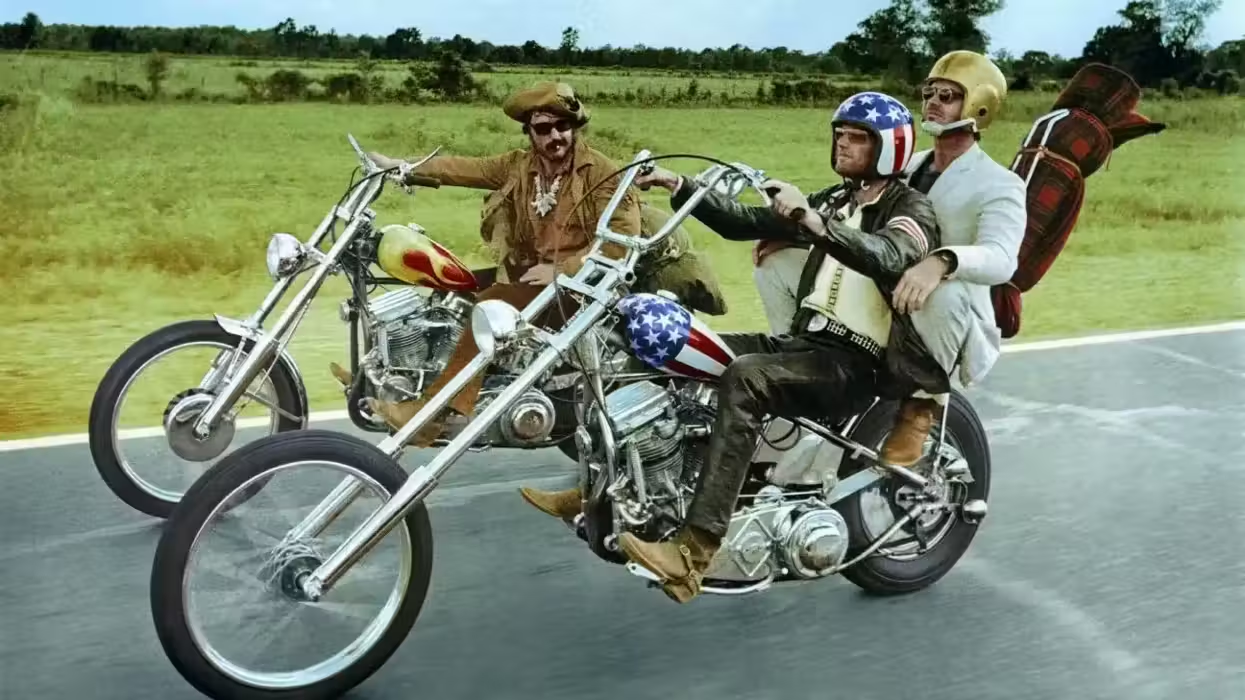
'Easy Rider'
It's the week of America's 250th birthday and almost the Fourth of July, so what better time to look back on some of cinema's most iconic films? These 40 films peer deep into what America is and who gets to belong in it. They give us the factories that grind people down, the highways that promise escape, the coal mines that own your body, the Kansas farm you can't stop thinking about, the dream of freedom that turns out to look different once you're living it.
Each of these filmmakers made a choice about how to mirror America and its people. They were trying to capture something true about the labor, the landscape, the longing, the disappointment, the hope.
Sometimes that meant refusing to use sound. Sometimes it meant staying in a place for 13 months. Sometimes it meant letting your characters curse because that's what powerlessness sounds like.
These films, in no particular order, are about America revealing itself. Let's dive in.
And when you're done, be sure to check out Part 2, Part 3, and Part 4 of the series!
Modern Times (1936)
- YouTubewww.youtube.com
Charlie Chaplin made the most defiant career move of the sound era when he chose to keep Modern Times almost entirely silent. Chaplin said, "Dialogue may or may not have a place in comedy … For myself, I know that I cannot use dialogue."
The film tracks the Tramp's collision with mechanized labor during the Depression. Chaplin's final performance as his most famous character is a kind of swan song for silent cinema, as well as a radical film in a time of technological and economic upheaval.
Easy Rider (1969)
- YouTubewww.youtube.com
Peter Fonda co-wrote, produced, and starred in Easy Rider.
"I had told the story 20 times before we ever got close to start working on it," Fonda told The Camera (via PeterFonda.com). "So I knew what I was doing all the time."
There's no wasted setup in a film that cost $375,000 and changed independent cinema. The film follows a bunch of ne'er-do-wells through the Southwest and refuses to explain itself. It's just about men discovering that freedom looks different in practice than in theory.
Harlan County, USA (1972)
- YouTubewww.youtube.com
Barbara Kopple spent 13 months embedded in Harlan County, Kentucky, filming what would become an Oscar-winning documentary about a coal miners' strike. She arrived as an outsider, with no shooting experience as a director, but driven by a conviction that labor struggles deserved documentation.
"With documentaries, you never really know what you're going to get. You think you have a certain idea, but you have to let that leave your mind and let whatever happens happen and just go with it," she told The Drunk Projectionist. "Then you'll really be telling a story that is real and has a sense of truthfulness."
Kopple's work became a document not just of a labor fight but of how filmmaking itself can be an act of solidarity.
The Last Detail (1973)
- YouTubewww.youtube.com
Clearly, for us, a lot of movies from the '70s feel quintessentially American. When Robert Towne made The Last Detail, Columbia Pictures pleaded with him to reduce the profanity that saturated his script. The first seven minutes alone contained 342 F-bombs.
He reportedly said, "This is the way people talk when they're powerless to act; they bitch."
Towne's vision survived Columbia's anxiety, and what we get is a black comedy/drama about career sailors and their reluctant charge, and all the messy emotions that come with following orders.
The Wizard of Oz (1939)
- YouTubewww.youtube.com
Judy Garland was just 16 when she stepped into the ruby slippers of one of the most iconic characters of all time.
Her daughter, Lorna Luft, told NPR, "She was 16. And when you're 16, you're—that's also a very, you know, in-between age. In fact, she sang a wonderful song called 'I'm Just An In-Between.' And you basically—you're not an adult, yet you're not a child."
Even if you're not from Kansas, this is a film that reminds us the U.S. is a home we can always return to.
Get Out (2017)
- YouTube www.youtube.com
Jordan Peele made Get Out from an unfortunately personal place. He told NPR, "This is just simply my truest passion. It comes from this fact that in order to deal with my own fears, I wanted to be able to sort of master them."
The horror works because Peele refused to make racism feel distant. He staged it as the particular terror of being Black in spaces that smile and welcome you, where hospitality becomes a weapon.
A League of Their Own (1992)
- YouTube www.youtube.com
What's more American than baseball? Penny Marshall made a film about women playing professional baseball when Sony Pictures internally called it "that girls movie," as if it were small. Marshall had already made "Big" cross $100 million.
The film feels revolutionary without being preachy, which is a feat in itself.
Paris, Texas (1984)
- YouTube www.youtube.com
If you haven't had the chance to sit in a theater and see the beautiful landscapes that open this film, find a screening immediately. Wim Wenders came to America wanting to tell "a story about America," and he brought Sam Shepard along.
Wenders believed that Texas contained the whole country. The film is all yearning and silence and heartache against some of the most gorgeous scenery you'll ever see.
Nashville (1975)
- YouTube www.youtube.com
Robert Altman sent Joan Tewkesbury to Nashville with no script, just a mission to find the movie. She wandered for a week and filled a diary. When she left the Exit/In club one night, she told Filmmaker Magazine that was the moment she knew.
"That's the movie. That's the kind of overlapping mess that Bob loves."
They made a film about 24 people in five days, supposedly about country music but really about American ambition chewing people up.
Ferris Bueller's Day Off (1986)
- YouTube www.youtube.com
Want to spend a day in America? Follow this truant high-schooler around Chicago.
John Hughes wrote Ferris in four days before a writers' strike. He said he got a sentence out of nowhere.
"And then I thought, 'I am 17 years old, and I have no idea where my life is going,' and I thought, 'That's it!'” (via Chicago Tribune).
The film became a manifesto about pausing, about not forgetting to actually live while you're becoming an adult. Hughes honored teenagers as whole people with complex inner lives, not problems to be solved.
Come back for Part 2 tomorrow!