8 Most Iconic Character Exits Of All Time
Character farewells done right!
'Terminator 2: Judgement Day'
What if I say, first impressions are slightly overrated in a movie? It is rather a character’s last impression that sticks with us. What they do in their last moments on screen determines how we remember them.
Oftentimes, we fret so much about character introductions that we overlook their exit from the narrative. But when done right, it’s the most satisfying thing of all. You know that feeling of bidding farewell to your favorite character? As writers, if you can write character exits that feel like closure to the viewers, congratulations, you’ve hacked it.
In this article, we’ve made a list of the most iconic character exits in TV and movie history, which will definitely nudge you in the right direction if character exit isn’t your strongest forte.
8 Most Iconic Character Exits in Fiction
1. Truman Exits His Show
The Truman Show (1998)
After living half of his life inside a manufactured set of a scripted reality show, Truman’s exit is one of the most endearing movie moments of all time. After surviving the channel’s desperate attempts to keep him caged in the show, when he finally finds the exit door hidden atop a flight of stairs, the moment is bittersweet. His departure marks the transition from ignorance to wisdom, symbolizing personal growth. “In case I don’t see ya, good afternoon, good evening, and good night,” says Truman as he steps into the unknown.
2. Sean Maguire’s Quiet Exit
Good Will Hunting (1997)
Sean Maguire was the ray of light that Will needed to navigate this dark and messy mind. His overall perspective towards life and his existence prevented him from appreciating either. Sean guides Will through his deeply rooted trauma, helping him free himself of his self-inflicted cycle of self-blame. He helps him realize that whatever wrong happened to him wasn’t his fault in any way. His support enabled Will to piece himself together, and before long, it was time for Sean to leave. His exit from the narrative and Will’s life is marked by a sense of pride, knowing that he has made a meaningful difference in another man’s life.
3. Michael Scott Leaves For Colorado
The Office (2005)
Who knew that watching the world’s best boss leave behind the Dunder Mifflin Paper Company to be with the love of his life would be one of the hardest things we’ll ever have to do? The goodbye was as hard for us as it was for Michael. I never wanted that episode to end. When, for a moment, it felt like Pam wasn’t going to be able to say goodbye to Michael, my heart dropped. At the airport, when Pam finally catches up to him, that last hug transcends the screens. We never hear what they talk about, and that makes his exit even more intimate, I guess. Honestly, until the plane took off, I was still hoping he’d come back…
4. George Cooper Sr.’s Death
Young Sheldon (2017)
Losing a parent is a life-altering moment for every child, and it was no different for young Sheldon. Only the poor 14-year-old prodigy sucked at expressing how he felt. That morning was no different. The house was bustling with people. Everyone was in the kitchen as Mr. Cooper picked up his travel mug and was all set to leave for work. Mary, his wife goodbye and asked Missy, his daughter, if she wanted a lift to school, but she declined. Sheldon sat right there, busy in his own world, barely acknowledging his father’s presence, like always. A final nod of goodbye to everyone, Mr. Cooper quietly left for his day. Only he never returned.
5. Sonny Corleone’s Brutal Death
The Godfather (1972)
When the aging patriarch was all set to hand over the responsibilities of his huge crime empire, while his younger son wanted nothing to do with it, his elder son, Sonny, took up the reins of the business. Hot-tempered, fiercely loyal, and impulsive, Sonny was definitely a rightful heir to the Corleone throne. Sonny’s death is one of the most dramatic and violent character exits, symbolizing the high stakes of mafia power struggles as he is killed in a calculated, merciless ambush. His death becomes a crucial turning point in the narrative, setting the stage for Michael Corleone’s transformation due to the lack of an heir to the family.
6. Wilson Falls Off The Raft
Cast Away (2000)
Wilson, the volleyball, rolled into Chuck’s life like a blessing from God. His mere presence prevented Chuck from drowning into the depths of isolation, a lack of purpose, and madness. In a strange land, with no one else around, he became Chuck’s sole companion, helping him keep his sanity while surviving the wilderness on an island all on his own. While the first meeting of Wilson and Chuck is quite striking, the moment of their separation as Wilson falls off the raft feels like a personal loss. Chuck dives into the treacherous waters to save him, but realizes he can’t. “Wilson! Wilson, I’m sorry,” —those words echo in my ears.
7. T-800 Sacrifices Himself
Terminator 2: Judgement Day
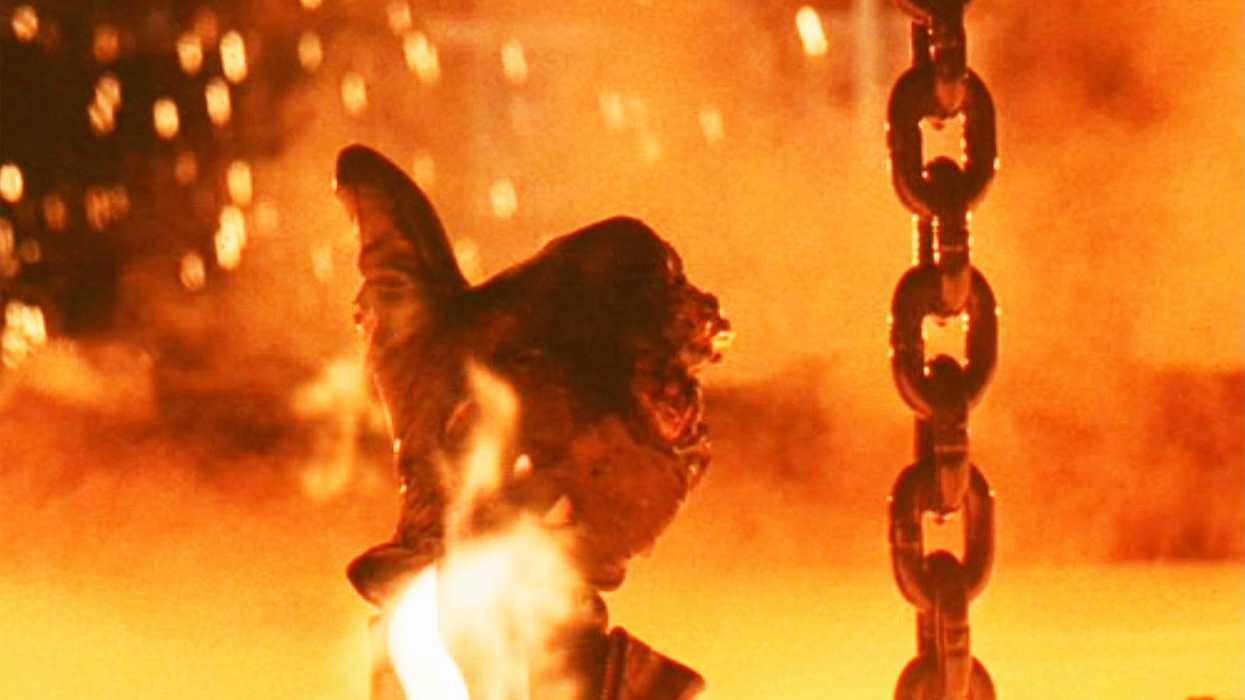
T-800’s farewell is a heavy moment in Terminator 2: Judgement Day. After helping Sarah and John Connor destroy the T-1000 and the Cyberdyne materials, T-800 realizes that his own existence is also a threat, as his programming and technology could still be used to seed Skynet. So, he asks Sarah to euthanize him by lowering him into a blazing furnace. His final gesture, the thumbs-up, as he disappears into molten steel, will melt even the most steel-hearted.
8. Ethan Edwards' Exit Is Like A Deja Vu
The Searchers (1956)
Ethan is the quintessential loner, plagued by fits of hatred, guilt, and unresolved longing that prevent him from living a domestic life. As he carries Debbie back home, in his arms, he cannot find himself stepping inside the house. He alone remains standing outside the doorway, with his silhouette briefly lingering in the frame, until he finally turns around to walk away, going back into the wilderness, accepting his fate as an outsider who is only fit for a nomadic life. John Ford recreates the first time he came to the house. Edwards leaves the same house, through the same door, in the same way he did for the first time.
The end of any character’s arc is supposed to act as a milestone in your narrative and therefore deserves as much attention as their introduction. Analyze the above character arcs to understand how even an abrupt end is strategically interwoven in each of these stories to heighten the emotional stakes in their narratives.