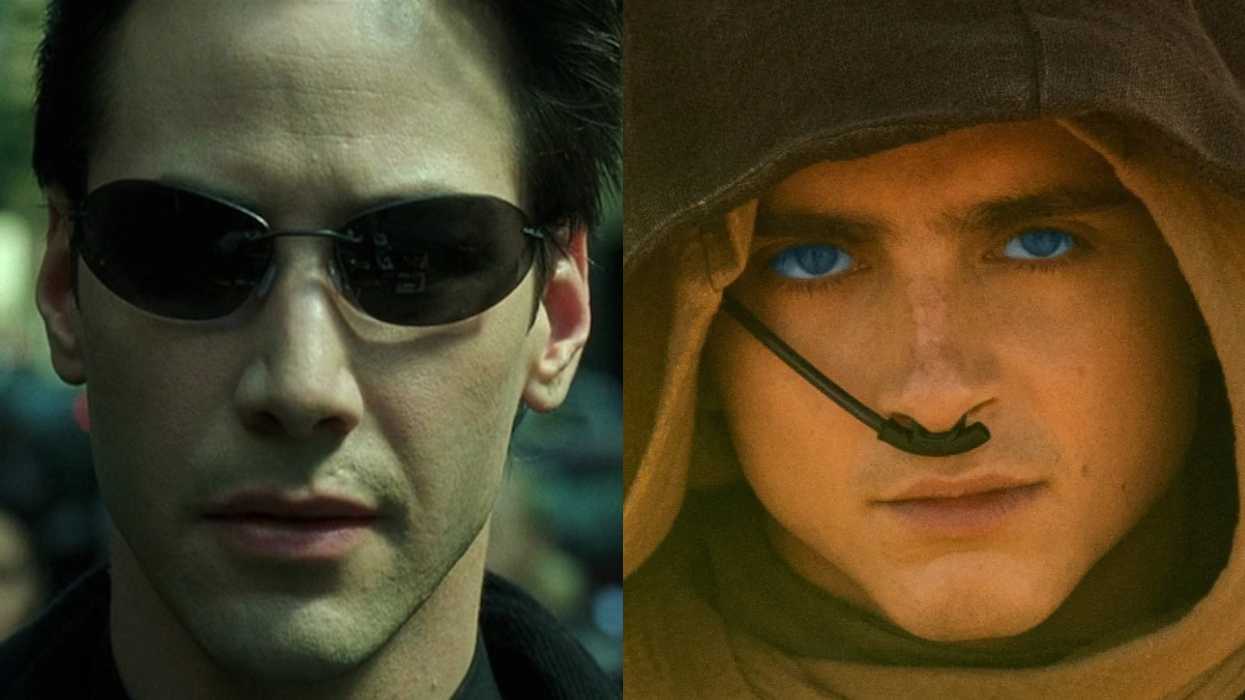
There’s a moment in certain stories when fate corners our hero and tells them to rise to the occasion, or reality falls apart. Often, it's a leap of faith without a safety net. Cinema loves those moments.
There is no promise of glory or silver linings, only the cost of becoming The One. Two of the most enduring sci-fi characters of our generation were once told the same prophecy.
Neither The Matrix’s Neo nor Dune’s Paul Atreides chose to be “The One.” It’s propaganda. It’s a prophecy. It’s their destiny.
Let’s dive in to understand this better.
Origins of Their Prophecies — The One
Neo — The Matrix
 The Matrix (1999)Warner Bros.
Neo (Keanu Reeves) is a programmed anomaly encoded by the very Machines that created the illusory reality.
Like everyone else, Neo lives and breathes in the Matrix, unaware of the secrets it holds. It’s only when Morpheus (Laurence Fishburne) arrives with a prophecy conveyed by The Oracle—the one to herald the destruction of the Matrix and save humanity from their oppression by the Machines.
But the prophecy is incomplete. It’s lore built upon a machine-designed program. The prophecy only comes true when Neo chooses to believe in the code embedded inside him.
Paul Atreides — Dune
 Dune: Part Two (2024)Warner Bros.
Lisan al-Gaib, which literally means off-world messiah, is a prophecy originating from the Fremen lore. It predicts the coming of a messiah from the outer world who will bring water to the land of Arrakis (a desert planet) and wage the holy war to overthrow the decadent old Imperium.
Paul Atreides (Timothée Chalamet) is a destined, supreme prescient born out of a deliberate Bene Gesserit breeding program, which aimed to produce a mystical force that manipulates and influences galactic events.
However, Paul arrives a generation earlier as Lady Jessica (Rebecca Ferguson), a member of the Bene Gesserit, bears the child to Duke Leto Atreides out of love, and not prophecy itself.
Neo vs. Paul Atreides: The Burden of Power
Neo
 The Matrix (1999)Warner Bros.
In Neo’s case, being The One means he can see through and alter the nature of the Matrix — he can dodge bullets, catch them, see the raw code, fly, and bend the rules of physics itself.
But the burden of that power? He understands that everyone around him is in a deep sleep, enslaved and expendable by the Machines.
Being the sixth anomaly in a repeating destruction cycle of Zion (the last remaining human state), as told in The Matrix Revolutions, Neo’s victories themselves carry an existential horror of being genuine or just another subplot in the bigger schemes of things.
Paul Atreides
 Dune: Part Two (2024)Warner Bros.
While in Paul Atreides’ case, he can see through an ocean of probable timelines — the consequences of the tiniest decisions.
But the real burden is that in Dune, he foresees a jihad in his name, where billions will die under his rise to power.
His own vision becomes a prison, as any attempt to avoid the worst outcome for his people leads to holy war. And if he doesn’t choose that narrow path, he foresees defeat for his people. He’s crushed by the fact that all roads to victory demand the blood of billions under Paul Atreides’ name.
Neo fears the failure of his actions, while Paul fears the success of his.
The Emotional Cost of Turning into “The One”
Neo
 The Matrix (1999)Warner Bros.
Throughout the Matrix franchise, Neo loses his friends, allies, and companions to the system. He carries the survivor’s guilt and can’t outrun it until he strikes a peace bargain with the Machines in The Matrix Revolutions to save humanity.
However, his arc inclines toward faith and love, which leads him to believe in himself. Neo loses his innocence but gains clarity through his pain.
Paul Atreides
 Dune: Part Two (2024)Warner Bros.
While in Dennis Villenueve’s Dune, every vision, bit by bit, strips away Paul Atreides’ childhood and his dream to lead a simple life. Every step toward power forces him to forget his past and bear a responsibility on his shoulders far greater than he had ever imagined.
From his protectors to his mother (Rebecca Ferguson) and his lover Chani (Zendaya), all become witnesses to Paul’s colder, quieter, and distant nature. Not because he wants it, but the future (the prophecy) demands it.
Neo runs toward hope, while Paul is inevitable.
The Cost of Being Loved
One of the major differences between Neo's and Paul Atreides’ journeys is how love defines their choices.
Neo
As tough as Trinity (Carrie-Anne Moss) might have come out to be at first, she always believed in Neo. Later, her declaration of love literally revives Neo from his death and plays a crucial role in Neo’s self-belief.
Moreover, when the occasion came, Neo finally broke the Architect’s cycle of the Matrix by choosing to sacrifice himself for his love for Trinity. Her love truly set Neo free and saved the world.
Paul Atreides
In the case of Paul Atreides, to love is tragic. Both Paul and Chani (Zendaya) love each other, but they can’t be together. Paul’s vision plagues their relationship and reminds him of the risk of his choices.
Every heartfelt moment they share is haunted by what’s at stake. Chani’s love doesn’t set Paul Atreides free; it shows him the cost of his destiny.
Refusal to Be The One
Neo, unknown to the power of beliefs and choices, doubts himself. So, he resists being the Messiah who will save Zion from being ruled by Machines.
But Paul is afraid of his choices instead. He knows very well, or has a hang of it, what catastrophic events will follow if he embraces the role destiny has left for him to play. He resists because he knows too much.
Final Thoughts
The difference between The Matrix and Dune is that Neo teaches us that beliefs can break the chains of our illusions, while Paul Atreides teaches us that belief can wage wars and fuel rebellion.
But one similarity is that neither Neo nor Paul Atreides chose to be the One. While one discovered the existential burdens along the way, the other already knew the cost of becoming Lisan al-Gaib — utter catastrophe.
- What Is 'Dune' About? 'Dune' Characters, Symbols, Terminology, and Meaning Explained ›
- This Is How the Oscar-Winning Sound of 'Dune' Tricks Your Brain ›
- Why 'Dune' Was Shot on Digital, Transferred to 35mm, Then Scanned to Digital ›
- Breaking Down the Philosophy of 'The Matrix' Trilogy ›
- ‘The Matrix’: Morpheus’ Most Potent Lesson ›
- 'The Matrix' Explained ›
- The Matrix’s Most Iconic Move Was Almost Impossible ›
- What ‘There Is No Spoon’ Really Means in 'The Matrix' ›
- How Did the Wachowskis Write 'The Matrix'? ›