If you’ve been following Making It, a newsletter run by our very own GG Hawkins, you know it's important for filmmakers to build their own ecosystems. To make friends and connections they can work with and not ask for permission to make a movie, but to find ways to get it all done.
Well, her newsletter and those ideas led me to speak with filmmaker Pedro Herrera Murcia, someone who is doing all that with international film.
I often get so sidetracked with Hollywood that I forget there's a whole world out there making movies. And talking with him was a great reminder.
Pedro is a Guatemalan producer, director, and cultural strategist whose career feels like a masterclass in global creative hustle. At just 21, he co-produced Cadejo Blanco, a debut feature that went on to earn both Film Independent Spirit Award and Ariel Award nominations—an almost impossible feat at that age, unless you’re Pedro, who moves through the world with equal parts intention, curiosity, and community-building instinct.
Pedro holds an MFA in Production/Directing from UCLA and a degree in Film, Visual Arts, and Entrepreneurship from Francisco Marroquín University, but what really defines his work is the way he shows up: collaboratively, globally, and with a deep belief that cinema is a tool for community.
And because he’s someone who doesn’t just talk about cultural exchange—he structures his life around it—he also founded Cine Caribe and Fundación Cine Caribe, both dedicated to empowering filmmakers from the Caribbean and Central America.
Let's dive into our conversation.
- YouTubewww.youtube.com
NFS: You often describe your work as existing “at the intersection of film, community, and international collaboration.” How do those elements come together in your practice as a producer and storyteller?
Pedro Herrera Murcia: For me, film isn’t just a creative act: it’s a communal one. I come from a country where filmmaking infrastructure is still developing, so every project becomes a community effort by nature.
Working between Guatemala and the U.S. means I’m constantly connecting different environments, different levels of resources, and different ways of working. On one side, there’s access to more established systems and support; on the other, there’s a tight-knit, resourceful filmmaking culture where people jump in because they believe in the story.
When I'm producing a co-production between two countries, my role as a producer so far has been twofold: On a practical level, my job has been to be the bridge between the two cultures as well as the point of intersection and communications between the professional filmmakers working on the project and the people in the community where we are shooting, most of who are not familiar with the rigors of production.
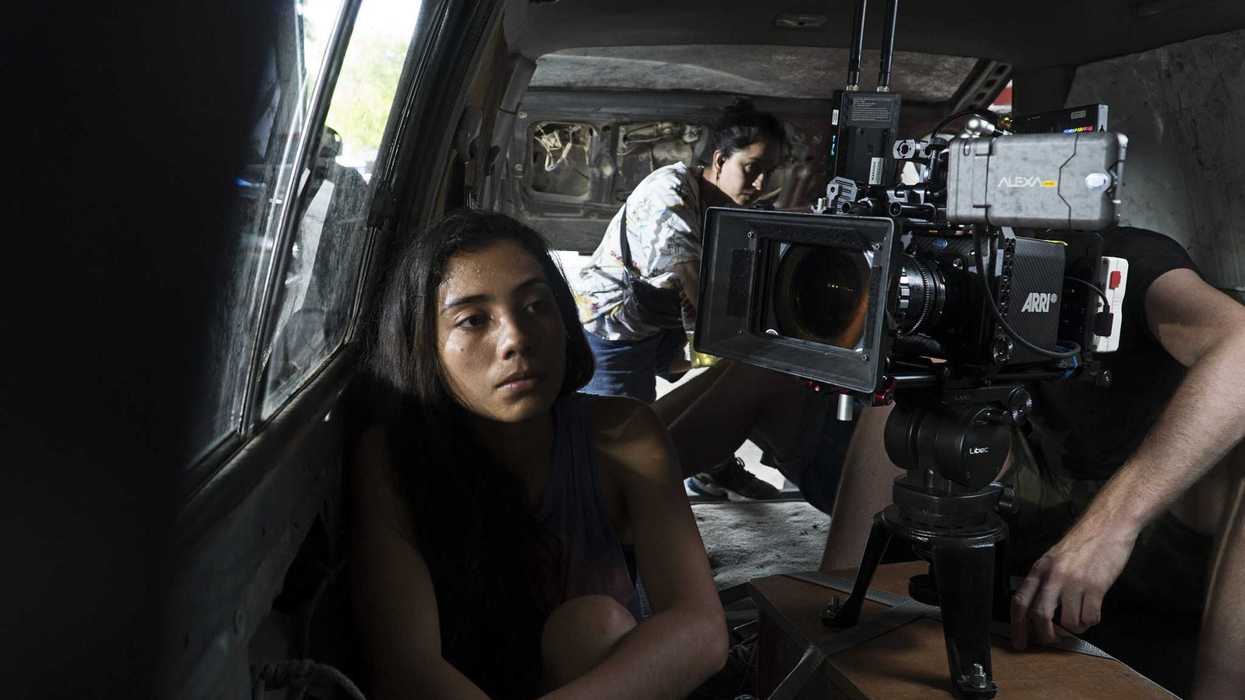
Then, on a creative level, my producer role thus far, and specifically on Cadejo Blanco, was to make sure the film was protecting the local voice and personality of where we shot (Puerto Barrios, Guatemala, my hometown). An example of this was that I was scouting locations for 2 years before shooting, making sure we could find authentic places in the city to put on film, and I was also holding open casting calls, looking for real local people to play versions of themselves in the film. This meant scouting potential "actors" at churches, parks, schools, and soccer games. It’s not a slogan or a strategy; it’s just the reality of where I come from and how I’ve learned to get films made. You have to involve the community, and the more you do, the better and more authentic the end product is.
NFS: How did you start producing at such a young age, and how did your collaboration with Justin Lerner begin?
PHM: It happened naturally. I met Justin when he came to teach a film course at UFM, a film school in Guatemala. He mentioned he was curious about possibly making a film in the country one day. I was 18 and the only student in that class who wasn’t from Guatemala City. Being from Puerto Barrios. I had the chance to offer him a look at a much different part of the country, one that had not really ever been put on film before. He took me up on my invitation, and I introduced him to people and real stories from my community. His visit was not specifically geared towards inspiring him to make a film — I was more just interested in sharing my world — but because of the people Justin met while there, that trip became the starting point for what eventually became Cadejo Blanco.
As the project started taking shape, I naturally stepped into producing — not because I was chasing that role, but because I knew how to move around in my city, how to help a crew of filmmakers earn the trust of the locals, and the right people to talk to.
From there, our collaboration evolved from student–professor into a real partnership. Justin brought experience and a clear creative vision, and I brought local knowledge and the ability to actually make things happen on the ground. We respected each other’s strengths, made decisions together, and kept the focus on serving the story and the community behind it. It never felt like a hierarchy — I was given a lot of autonomy, and it felt like building something side-by-side.
NFS: Coming from Guatemala and now working between Latin America and the U.S., what have been some of the key challenges—and advantages—of building a career across multiple film ecosystems?
PHM: The biggest challenge in Guatemala is infrastructure and access. In the U.S., you have systems, a large network of professional actors, unions, and funding pipelines. In Central America, those tools are still growing, so you learn to be resourceful, to problem-solve creatively. But that’s also the advantage: I’m comfortable operating in environments where you have to earn trust, build things from scratch, and adapt constantly. I get to blend structure with improvisation, two very different filmmaking muscles.
NFS: Cadejo Blanco is a remarkable U.S./Guatemala/Mexico co-production that centers on real stories and mostly non-professional actors. What was it like producing a project that was both so logistically ambitious and so rooted in local authenticity?
PHM: It required precision and humility at the same time. On one side, we were managing a multinational funding and production structure. The film was a co-production between the USA, Mexico, and Guatemala. On the other hand, we were filming inside real communities, in places where you don’t just show up with cameras, where you must earn the right to be there.
The logistics were demanding, but the cultural responsibility was even bigger since we weren’t just making a film; we were also entering people’s lives and homes. There would have been no other way to tell this story responsibly.
NFS: The film draws heavily from the lived experiences of young people in Puerto Barrios. What were some of the creative or ethical considerations that guided your team when working with non-professional actors and real communities affected by violence?
PHM: Our priority was dignity, safety, and honesty, and above all else, years of research and rehearsal to make sure we got everything right. We spent time doing community outreach and listening first. We never parachuted in with an agenda.
The stories told to us by our non-professional cast members shaped the script. They were encouraged to speak up if we got something wrong, and even change their dialogue or a story beat, if they didn't feel it was realistic.
Behind the scenes, we created support structures — emotional, logistical, ethical — and made sure everyone involved felt in control of their story, not exploited by it. We partnered with an NGO based nearby and were able to financially support therapy, counseling, and scholarship opportunities for several of our cast members. The line between representation and responsibility is delicate, and we took that seriously every day.
NFS: Shooting in Puerto Barrios—an area with limited infrastructure and high risk—must have been incredibly challenging. Can you share a moment from production that taught you something lasting about leadership, resourcefulness, or community trust?
PHM: What really stayed with me wasn’t one dramatic moment — it was the day-to-day process. Making a film in Puerto Barrios meant everyone had to adapt, and it forced us to operate like a big family. We didn’t have the usual infrastructure or resources, so every department — from grips to actors to neighbors — played a part in problem-solving.
I do, however, recall losing a location on the very morning we were supposed to shoot there. We had a contract signed for months with the owner of a tiendita (small corner store/market) on the road. When we arrived in the morning to shoot, there was a new person there, claiming to be the new owner. The previous one had sold it, I guess, overnight. So we had less than an hour to quickly find another shooting location. After a few hours, I was able to drive around and negotiate my way into finding a few options, using personal relationships that my family has with people in town.
One thing I learned is that leadership isn’t about hierarchy. On that set, your “title” didn’t matter — if someone from the community had an idea or a better way to get something done, we listened. Trust went both ways.
 Pedro Herrera MurciaCredit: Pedro Herrera Murcia
NFS: Cadejo Blanco earned international recognition, including nominations for the Spirit Awards and Ariel Awards. What did that success mean to you, and what does it represent for Guatemalan cinema?
PHM: Personally, it was emotional — I was so young, and suddenly the industry we admired was acknowledging a film from my hometown. But beyond pride, I felt responsibility. It showed that Central American stories aren’t “niche” — they are universal and urgent.
For Guatemalan cinema, I think it cracked open a door. It signaled that our stories deserve global platforms. I hope it inspires more film infrastructure, training, and investment in the region.
NFS: Producing your first feature as a grad student in a foreign country is no small feat. What were some of the biggest lessons you took away from navigating that cross-cultural environment—both creatively and logistically?
PHM: I learned that knowing your community is a huge advantage, but it also comes with responsibility. Being from Puerto Barrios meant I understood the culture, the dynamics, and the people, so I could move things forward and build trust naturally. But it also meant I had to be extremely careful — I wasn’t just making a film; I was working in my own backyard, with people who knew me since I was a little kid, and who I cared about.
Practically, I learned how to communicate clearly across different teams — international crew, local community, non-actors, and institutions. A lot of the job was translating—not just language, but expectations, working styles, and cultural norms.
And honestly, I learned that you don’t need to have every answer. If you listen, stay calm, and handle people with respect, you can figure things out as they come. That experience made me the kind of producer who leads through relationships, not ego.
NFS: What’s next for you?
PHM: Right now, I’m focused on two parallel tracks. On one side, I recently launched a foundation as part of my production company in Guatemala, and we’re starting free film classes in my hometown as well as workshops around the country. Building access and creating pathways for young filmmakers in places where opportunities are limited is really important to me — I believe cinema can create social change, not just on screen but through who gets to participate. At the same time, I’m also working on a few new feature projects for next year, some as a producer and one I may try to possibly direct. My MFA from UCLA is in directing and production, after all.
You can subscribe to the Making It newsletter here.
- 'A Quiet Place': How Lifelong Friends Crafted a Silent Script That Took Us All by Storm ›
- How Roger Deakins Filmed '1917' in One Shot* ›
- 'A Successful Production Always Happens in Pre-Production': How Elite Climbing Cinematography Captured ‘Free Solo’ ›
- Why ‘The Huntsman’ Proves Limitations Are an Indie Filmmaker’s Greatest Weapon ›