5 Cinematography Lessons From the DP Behind David Fincher’s 'Fight Club'
'Fight Club' DP Jeff Cronenweth on hiding eyes, ugly light, and perfect inserts.
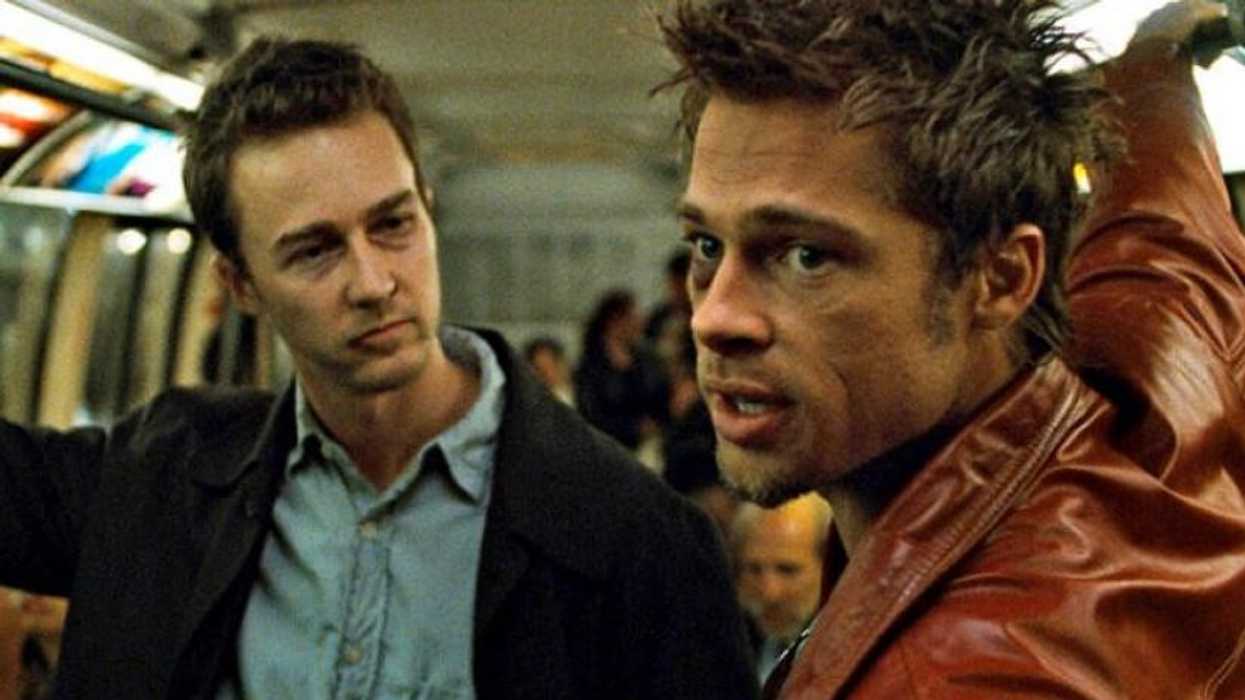
'Fight Club'
Jeff Cronenweth drove to David Fincher's house expecting to be offered another second unit job. He left with the script for Fight Club.
He had earned that trust by shooting second unit and inserts on Se7en and The Game.
Fight Club is perhaps one of the most visually distinct films in Fincher's oeuvre, dark and gritty and dirty. Cronenweth is the DP behind that film, as well as The Social Network, The Girl with the Dragon Tattoo, and Gone Girl, and is the son of Blade Runner cinematographer Jordan Cronenweth.
"He might look at Fight Club as this big break, but I look at it as the natural evolution of what we were already doing," Fincher told American Cinematographer. "On Alien3, he and his father had been like one person. Later, he had operated on some 2nd-unit work we did on Seven when Darius Khondji [ASC, AFC] wasn't able to return for reshoots. Harris Savides [ASC] was shooting, and Jeff was operating. Sometimes I'd break Jeff off [on his own] and say, 'Go across the street and find me a shot.' I say this with humility: There aren't a lot of people that I'd just [ask] to 'go get me a shot.' I'm not talking about trust so much as the knowledge that he wouldn't need any handholding. I knew he'd come back with exactly what we needed."
In a new CineTalk podcast, he breaks down how that first feature came together. We've pulled five lessons you can take to your next shoot.
- YouTube www.youtube.com
Describe the Look as a Feeling
Prep for the film included photo references, magazine pages, and comp films. They focused on what the audience should feel instead of listing fixtures and color temperatures.
"Things like, when he goes into one of the liquor stores, that it should be like going into a 7-Eleven at midnight, stoned, like that kind of brightness, kind of like Natural Born Killers, that Bob Richardson had done in that."
What you can try is pairing a sensory note with a film reference, the way he paired the 7-Eleven note with Natural Born Killers.
You don't need a big budget or a technical vocabulary to do this. On our podcast with DP Lawrence Sher, we discussed how directors can convey what they want visually without mastering technical camera terminology, and studying existing films helps you identify a personal aesthetic in composition, lighting, color, and framing. The episode also makes the case that figuring out what a movie isn't gets you closer to what it is, so save the frames you hate, too.
Light for What the Character Is Missing
In Fight Club, the film's men are hollowed out, and the lighting says so. It meant breaking a rule on purpose, for character.
"So top light, the absence of eyes, which is not usually what you want to do, proved to be really, really impactful for most of the space monkeys or the guys that were in the house and the meatloafs and all the other guys," he says. "And then the textures were on the warm side."
Eyes are the audience's way into a character, so taking them away is a statement. Ask what your character lacks, then try lighting for that.
Let the Set Tell You Where Light Comes From
We love practical lighting. Good production design gives you your sources.
"You know, we shot a lot down in Wilmington and Long Beach area because that's where we built the facade for the Paper Street House, which was the house they all lived in," he says. "And then the rest of it was on stage. And they had newspapered the windows to keep it private, and aged newspapers with tungsten light coming through, just as a beautiful light source, and letting things fall off, and the patina in the house was so, so beautiful. It was a it was a really motivating set, it was easy to see where things should come from."
Embrace ugly practical light, like sodium vapor, instead of correcting it away, and bring the DP into conversations with the art department early.
- YouTube www.youtube.com
Your Job Is to Get Inside the Director's Head
Cronenweth's shorthand with Fincher took years of working together to build, but they now have a shared language.
"That's just one of those marriages that worked out where we saw eye to eye on most stuff, and it was easy for me to understand," he says. "Because as a cinematographer, you're trying to get into somebody else's head and present their vision. Of course, you want your personality and your contributions to exist, but it is somebody else's idea that you're trying to get out of them, to elicit this look. And so it takes a bit of guessing and finding out until you find whatever language that film wants to be."
Bring your own taste, but serve the director's idea, and expect to search for each film's visual language.
Make Every Insert Count
Ugh, I have a love/hate relationship with inserts. They're important; they tell a lot of story, but they take so much time to get on the day, so usually have to get pushed to a second unit or a pick-up day. Fincher uses them a lot.
Cronenweth and Harris Savides shot the detail inserts for Se7en's title sequence side by side on one stage.
"There wasn't an enormous amount of direction, but because it was inserts, and having shot second unit a lot and matching to other people's work, I always found that super fun and exciting," he says, "and to have an opportunity to make an insert be impactful, instead of just like a narrative story point where something drops."
Treat inserts like the important shots they are, not throwaways. Because for him, one insert got him the job on Fight Club.
He was working on The Game and needed a shot of a pen dropping and landing perfectly. He did it, with a highlight across it. Fincher went to him later and said, "That is the best insert I've ever seen."