Film Quote of the Day: The 'Casablanca' Line That's the Most Misquoted in History
"Play it, Sam. Play 'As Time Goes By.'"
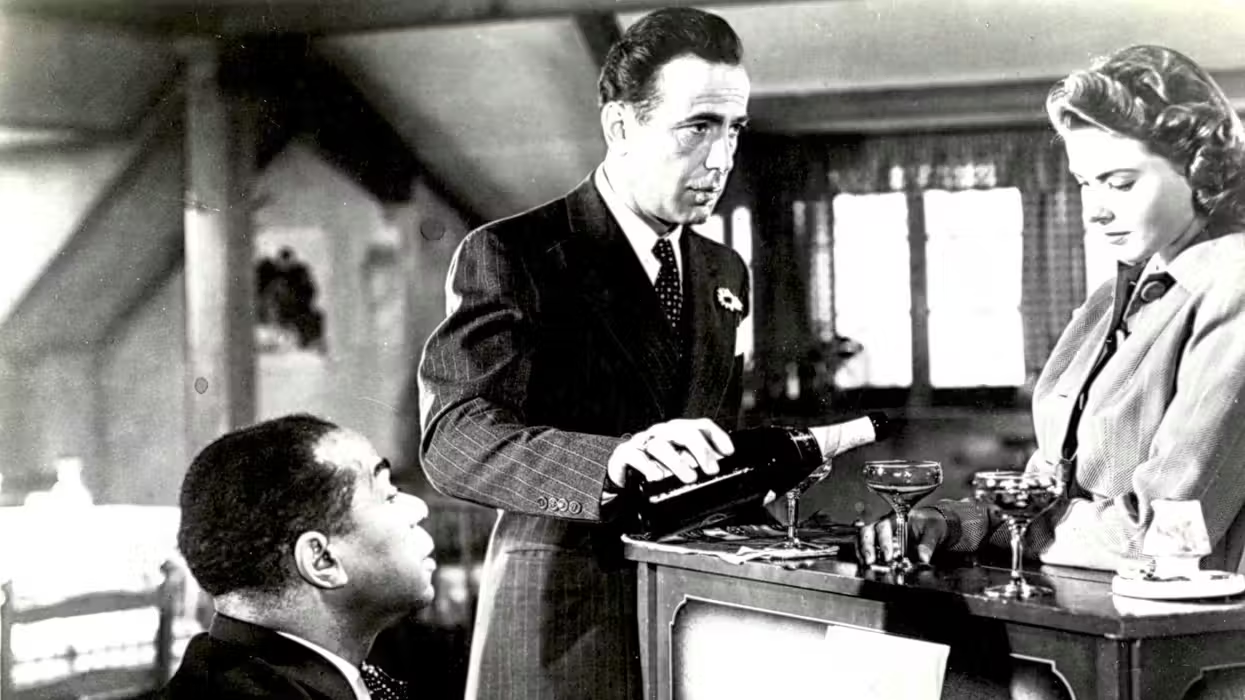
'Casablanca'
Last week, I covered a famous line from Casablanca, and in that article, I embedded a clue. Among some of the other quotes from the movie, I wrote: "Play it again, Sam."
That was me being a little cheeky, and seeing how many people would write in to correct me. After dozens of emails, I have to applaud NFS readers, but for the rest of the world, I want to let you in on a little secret.
Rick never says that line in the movie Casablanca. It's a figment of your imagination.
So today, I want to go over the most misquoted line in movie history and talk about what is actually said, and how this all came to be.
Let's dive in.
- YouTubewww.youtube.com
The Casablanca Scene In Question
Casablanca is, for my money, the best screenplay ever written and one of the greatest movies of all time. It was written by Julius J. Epstein, Philip G. Epstein, and Howard Koch, all in real time while on the set. The magic around this movie is legendary and indicative of the collaborative nature of all filmmaking.
With so many memorable lines, it's no wonder one of them is recalled so wrong, but it is always funny to me when I hear it come up in conversation.
The scene that spawned the legendary misquote happens inside Rick’s Café. Rick Blaine (Humphrey Bogart) is dealing with the breakdown of his cold exterior thanks to an old flame who has arrived in Casablanca.
Ilsa Lund (Ingrid Bergman), the woman who broke his heart in Paris, walks into his bar, and she's with a husband that she told Rick was dead.
While Rick is away from the main room of his bar, Ilsa approaches the house pianist, Sam (Dooley Wilson). They have a history, too. And Sam knows trouble when he sees her coming.
Ilsa asks Sam about Rick, and then she asks him to play "As Time Goes By". Sam resists, knowing exactly how dangerous that melody is to Rick's emotional stability and how much it would hurt him to hear their old song.
So what gets said?
Ilsa: "Play it once, Sam. For old times' sake."
Sam: "I don't know what you mean, Miss Ilsa."
Ilsa: "Play it, Sam. Play 'As Time Goes By.'"
Now, later in the film, we mirror this scene. This time, a hammered Rick approaches Sam and demands the exact same thing, but his words are angry:
Rick: "You played it for her, you can play it for me! ... If she can stand it, I can! Play it!"
The Myth vs. The Reality
Okay, now that you see the film is often misquoted, I'm sure you're wondering, "Where did 'Play it again, Sam' come from?"
Well, I think there are a couple of ways to explain it.
The first is just the fact that while the movie was popular, it's not like anyone could own it on DVD back then. So you saw it once, and then talked about it for years, maybe seeing a reissue or eventually catching it on TV decades later.
The phrase became a cultural shorthand, a way to remember just the important details of a movie that touched so many.
That phrase was then cemented in the cultural lexicon by the title of Woody Allen’s 1972 comedy, which paid homage to Bogart's persona and the movie itself.
In that moment, we remember "Play it again, Sam." And that's the word of mouth that was passed down about the film.
- YouTubewww.youtube.com
The Takeaway for Screenwriters
As I said up top, Casablanca has a perfect script, so we should try to remember the words the writers put so much hard work into brainstorming.
But the power of the real line is that it can show two distinct points of view of people. When Ilsa first requests it, it's a melancholy peace offering from the old days. And when Rick asks for it, it's a drunk, angry way to be upset about losing someone.
As writers, we often feel an overwhelming urge to make our characters say exactly what they mean, on-the-nose dialogue that just simplifies character arcs for everyone.
But there's depth in finding a scene and an example full of subtext like this one.
Casablanca teaches us that the lines people remember most are often the ones that rely entirely on unspoken emotions that connect us with the wants and desires of people in the scene without explicitly telling us them.
How can we incorporate that in our writing?
- Let your characters talk around the wound: Neither Ilsa nor Rick explicitly details their heartbreak in these exchanges, or even details Paris to us. They channel all of their longing and pain into a song that means so much to them. We see that songs mean a lot to many people; they become leitmotifs in the movie, as does the French national anthem. So try that out in your story. How can you use songs to bring forth emotion from different people?
- Brevity beats perfection: "Play it" carries significantly more dramatic weight than "Play it again, Sam" because it shows a man who is too emotionally compromised to form a polite, complete sentence. This is Rick losing his mind a bit. Let your dialogue fall apart and be messy when a character is under distress. Show us in the way they say things on the page.
- Track the changing power dynamics through repetition: Notice how the request shifts from Ilsa’s gentle, nostalgic plea to Rick’s aggressive, self-punishing demand. Using the same request twice from two different people can supercharge subtext. It all adds up to character and goals.
Summing It All Up
There is a reason Casablanca remains a foundational text for cinematic storytelling more than eighty years after its release.
And I think it will still be relevant for the next eighty as well. As long as people can watch movies and feel love and loss, they're going to keep coming back to the majesty of this movie and connecting with its characters.
I just hope they get those iconic lines right.
Let me know your favorite piece of misquoted movie history in the comments below.