Film Quote of the Day: The Sam Elliott Line From 'The Quick and the Dead' That Asked a Dark Question
"Why is it that the man who begs for mercy never gives it?"
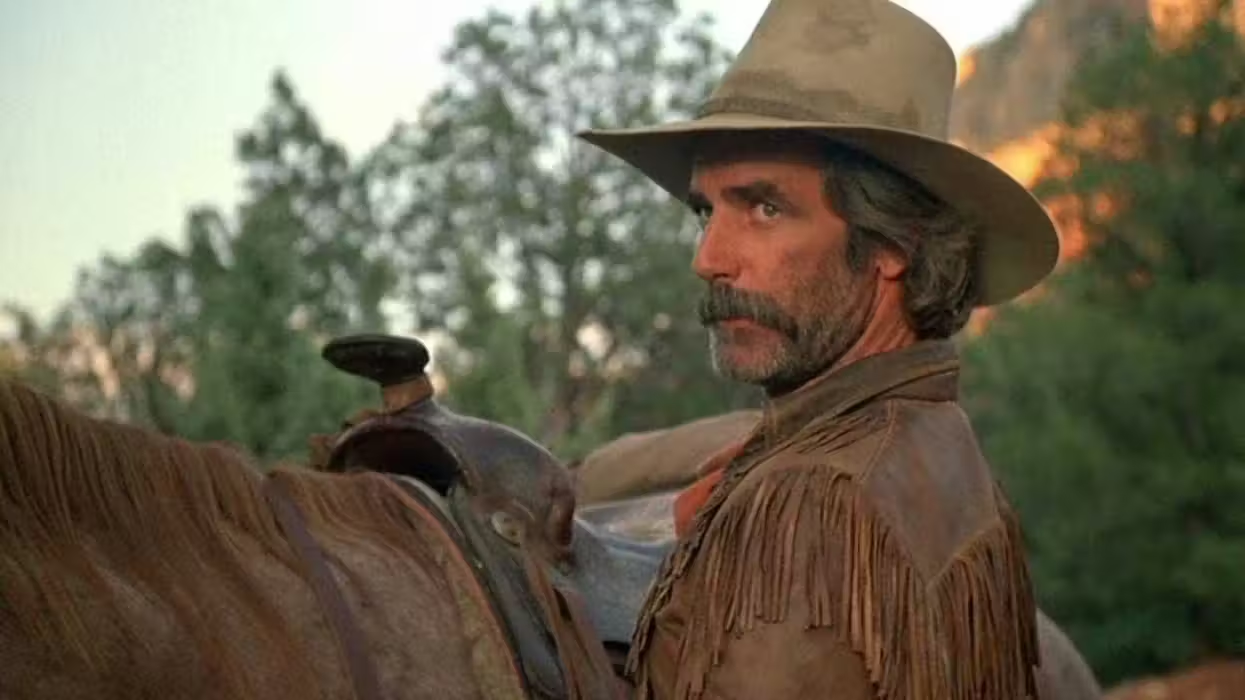
'The Quick and the Dead'
Sam Elliott’s voice carries the weight of the world on its shoulders. Yes, his voice is so muscular and baritone that it has shoulders.
When he speaks, you don't just listen to the words; you feel the dust, the leather, and see the frontier pass before your eyes.
We've gone over some of Sam Elliott's best roles in movies, but today, I want to talk about all the lines that he delivers that shook me to my core when I heard them for the first time.
It comes from the TV movie The Quick and the Dead, and sneaks past standard Western genre tropes to hit you right in the chest.
Let's dive in.
- YouTube youtu.be
The Scene In Question
In the 1987 version of The Quick and the Dead, Sam Elliott plays Con Vallian, a weathered guide who steps in to help a homesteading family.
This is an area riddled with outlaws and bandits, and Vallian teaches Duncan McKaskel (Tom Conti) and his wife Susanna (Kate Capshaw) how to navigate the dangerous territory.
The core conflict of the film is a clash of philosophies between Vallian and the family.
Duncan is an educated man who believes in the inherent goodness of humanity and the power of law. Vallian has looked into the dark spaces of the frontier long enough to know that the black hats don't play by the rules of polite society.
This is an epic throughline for the western, and it really shows how volatile the West was for settlers of the time.
Of course, after a brutal series of events, we begin to see Vallian's side of the story.
During a tense, quiet moment, the characters are forced to reckon with the sheer brutality of the bad guys in this movie. Vallian drops a line that completely reframes the film's moral core and the other characters' understanding of the situation.
"Why is it that the man who begs for mercy never gives it?"
The Paradox of Human Nature
This line is one of the best moments in the film, and it comes straight from the book. This was an adaptation of a Louis L'Amour novel, and it translates the theme to the big screen.
These words cut past the typical "good guy vs. bad guy" jargon and instead offer us a riddle that highlights human nature.
We've seen what happens when idealists who believe the best in people are confronted with pure evil.
But this is the Wild West, and the reality of the situation can hit interlopers and settlers a little too late.
Vallian is the realist. He knows that the men hunting them are not playing by any rulebook of how you should treat another person. They're savage and will never show them mercy. They'll only exploit their weaknesses, so they have to be just as mean back to survive.
When Vallian asks this question, he isn't just trying to act tough.
He's trying to wake Duncan up to a terrifying truth that he can either accept or ignore, which will lead to being killed.
It's a great moment in the movie and a transference of power between these two characters.
The Takeaway for Screenwriters
As filmmakers and screenwriters, we often get caught up trying to make our Western heroes sound like philosophy professors. We want to have these long monologues or just create depth by having them quote Kierkegaard or someone.
But the best way to do these things is just to live in these people's worlds and remain grounded in the vocabulary of someone facing these obstacles.
The best genre dialogue doesn't stop the action to explain the theme; it uses the tension of the situation to make an observation about the human condition.
See if you can emulate that in your next project.
Summing It All Up
The Quick and the Dead might has this explicit human focus on what it takes for decent people to survive an indecent world.
That, I think, is a thread that runs through a lot of his filmography.
Vallian's question leaves us to ponder our own boundaries and what we'd do to make sure we're the last one standing in a gun battle that might take everyone around us.
Let me know in the comments below.