She Shot Her First Feature in Just 11 Nights — Making 'Lockjaw'
“I’m going to make this happen no matter what.”
'Lockjaw'
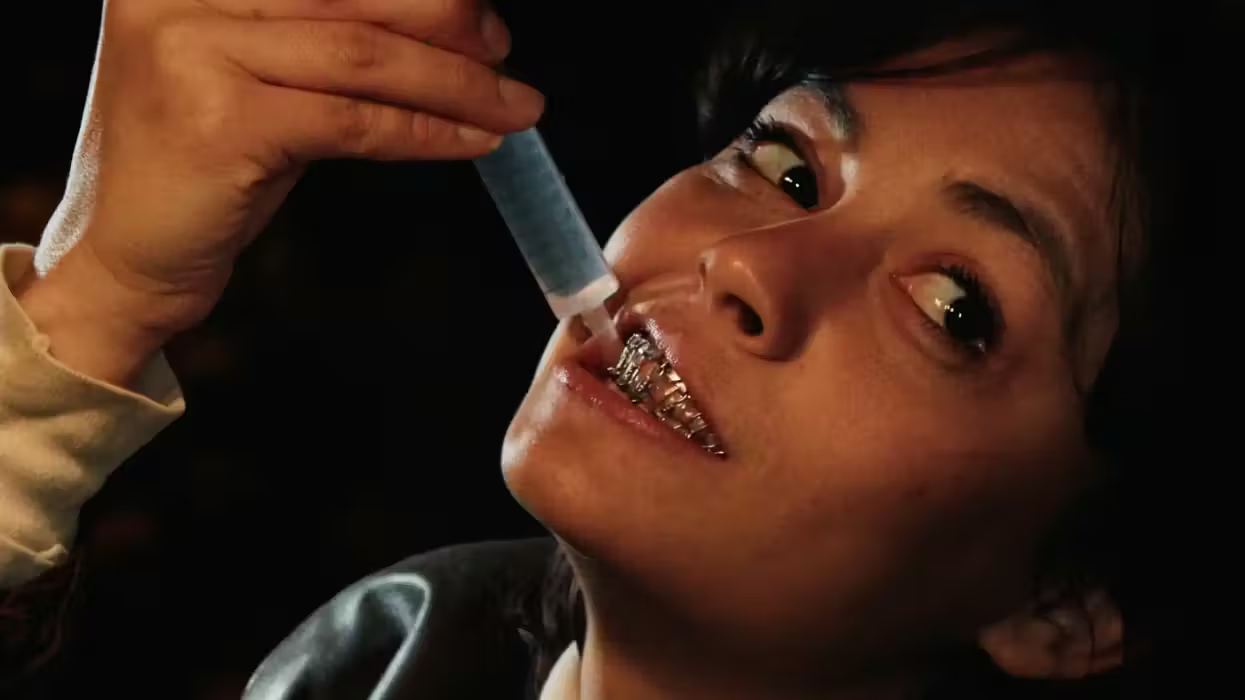
In this episode of the No Film School Podcast, Writer-director Sabrina Greco joins No Film School to discuss the making of her feature debut, Lockjaw, a dark comedy centered on a woman whose jaw is wired shut after a car accident. Greco explains how the project grew from a short into a feature, why she committed to an 11-day all-night shoot in Los Angeles, and how a tight-knit filmmaking community helped make the production possible.
She also breaks down directing Blu Hunt’s physically constrained but highly expressive lead performance, adapting scenes when they stopped working on set, using two cameras to move quickly, and drawing on her editing background to reshape the film in post-production.
In this episode, we discuss:
- How Greco went from studying film at Boston University to editing for digital media, Nickelodeon, and feature films
- Why filmmakers like John Cassavetes and the mumblecore movement changed the way she thought about feature filmmaking
- How Lockjaw evolved organically from a 25–30 page short into Greco’s first feature
- Planning the production a year in advance so winter’s early sunsets would make an entirely nighttime shoot more manageable
- Building the film around an existing Los Angeles creative community of actors and crew members
- How producer Abby Davis helped secure a house where the production could shoot for eight of its 11 days
- Deciding to move forward with the movie after Greco lost her job during the Hollywood strikes
- Developing Rayna as an active, magnetic, self-destructive protagonist rather than a passive victim
- How Blu Hunt approached Rayna without judging the character’s choices
- Using Rayna’s wired jaw as both a physical filmmaking constraint and a source of conflict, comedy, and miscommunication
- Why Greco wanted Rayna’s accident to complicate her behavior rather than simply justify it
- Shooting an 80-page feature in 11 days using two Canon XF605 cameras, small crews, autofocus, and minimal lens changes
- Rehearsing and blocking scenes before sunset so the production could begin shooting immediately once it was dark
- How Greco, Blu Hunt, and Colin Burgess reworked a breakup scene on set when its original tone stopped working
- Learning when a director needs to stop rushing, reconsider a scene, and ask collaborators for help
- How Greco’s editing background helped her know which shots were essential and which material could be sacrificed
- Cutting entire storylines that were not serving Rayna’s central story
- Bringing in co-editor Neal Wynne when Greco needed fresh ideas, then returning to the film for the fine cut
- The process of getting Lockjaw into Slamdance and finally watching audiences respond to the film
- What Greco learned about LLCs, paperwork, and production infrastructure that she applied to her next project
- Why making a feature reinforced the importance of trusting collaborators instead of believing the director has to solve everything alone
Guests:
Subscribe to the No Film School Podcast on:
Get your question answered on the podcast by emailing podcast@nofilmschool.com
Listen to more episodes of the No Film School podcast right here: