Stealing Isn't Innovation: Hollywood Heavyweights Draw a Line Against AI
Your favorite movie stars are coming out against AI exploitation and robbery.
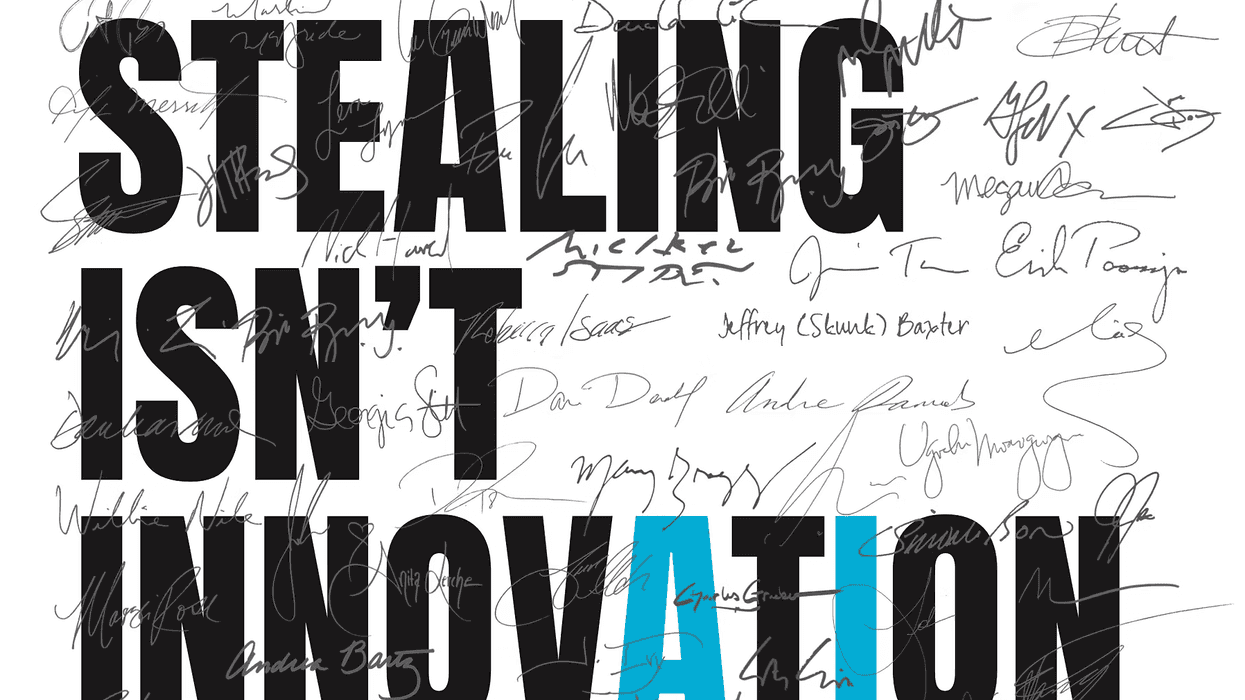
Over 700 actors, musicians, and creators have come together to call out AI for stealing their work and to take a stand against its ongoing theft.
It's a clear line in the sand that the people whose work has propped up one of the fastest-growing industries will not take it anymore.
The massive new campaign is called "Stealing Isn't Innovation" and hails from people like Scarlett Johansson and Cate Blanchett, to the band R.E.M., and Breaking Bad creator Vince Gilligan.
Major unions like SAG-AFTRA and the Writers Guild of America (WGA), the Recording Industry Association of America, The NewsGuild, and the NFL Players Association are all involved, too.
Their plan is to actually do something about AI and to gather the people whose work has been used to train these programs and to fight back as one big collective.
And it turns out, when you get 700 of the most successful people ever together, and match their power with some of their unions, it's a pretty formidable force.
Let's dive in.
What is the Campaign About?
The campaign was launched by the Human Artistry Campaign and takes direct aim at tech giants that use copyrighted movies, music, and books to "train" generative AI models without proper payment or permissions.
They want places like ChatGPT, Midjourney, and Sora to answer for their violations.
The campaign argues that using stolen human work to build commercial products without authorization, compensation, or credit undermines the very foundation of the creative economy.
It's theft, and the people who have been stolen from deserve justice.
Why Now?
We're in the middle of a battle that's been going on for years, but the war seems very winnable now. And the stakes have never been higher.
Now, there are a few landmark issues on the table:
- The Likeness Battle: Scarlett Johansson has been a leading voice since her public spat with OpenAI over a voice assistant that sounded allegedly "eerily similar" to her own. Her involvement underscores that this isn't just about scripts; it’s about the "digital soul" of an artist.
- The Fair Use Debate: Tech companies have long hidden behind the "fair use" doctrine, claiming that training AI is transformative. The "Stealing Isn't Innovation" campaign rejects this, arguing that shortcuts and legal loopholes are being used to bypass fair market competition.
- A "Better Way" Exists: The campaign isn't necessarily "anti-technology." In their open letter, they point out that some AI companies are already doing it right—engaging in licensing deals and ethical partnerships. The message is: You can have advanced AI, but you have to pay for the fuel that runs it.
- YouTube www.youtube.com
The Economic Impact
Here's the real problem: these AI companies are making a ton of money off creative hard work. And they're not paying for it. Their argument is basically that AI is a human and "learning" all this stuff and then changing it just enough to be original thoughts.
The campaign’s open letter emphasizes that the American creative community is a massive engine for jobs and exports. By allowing AI to "scrape" this value for free, the industry risks devaluing the very work that drives the economy.
It reads:
"America’s creative community is the envy of the world and creates jobs, economic growth, and exports.
But rather than respect and protect this valuable asset, some of the biggest tech companies, many backed by private equity and other funders, are using American creators’ work to build AI platforms without authorization or regard for copyright law.
Artists, writers, and creators of all kinds are banding together with a simple message: Stealing our work is not innovation. It's not progress. It's theft - plain and simple.
A better way exists - through licensing deals and partnerships, some AI companies have taken the responsible, ethical route to obtaining the content and materials they wish to use. It is possible to have it all. We can have advanced, rapidly developing AI and ensure creators' rights are respected."
What’s Next In The Fight?
We need governments to step in and actually help with these fights. And we need regulatory bodies to look into what these massive companies are doing and to take a bite to investigate.
Lucky for us, governments in the US, UK, and EU are beginning to draft more concrete AI regulations. And artists would be the ones drawing those lines, not these corporations. "Stealing Isn't Innovation" aims to be the loudest voice in the room. They are pushing for legislation that ensures:
- Transparency: Companies must disclose what data they use to train models.
- Consent: Creators must opt in to have their work used.
- Compensation: Artists must be paid fairly when their work is used to build a commercial AI.
Summing It All Up
The battle over AI in Hollywood is something that will define the 2020s. It's an argument that I expect will take a while to sort out, but one where we should all be siding with the actual artists and geniuses that AI is ripping off.
Innovation should elevate humanity, not exploit it. And as this campaign proves, Hollywood isn't going down without a fight.
Let me know what you think in the comments.
- Tim Burton on AI: "It’s Like a Robot Taking Your Humanity, Your Soul" ›
- "Brazen" IP Theft: Why WB Is Trying to Unplug Midjourney ›
- Sora Is Coming for Hollywood's IP and the Studios Have to Opt Out to Stop It ›
- Anthropic AI Settles Lawsuit About Stealing Authors' Work ›
- Which Directors Are People Using AI to Rip-Off The Most? ›
- Is This the End of Filmmaking as We Know It? ›
- I'm Not Worried About AI, I'm Annoyed By It ›