The Irishman Ending Explained: Meaning and Final Scene Breakdown
This analysis reveals how the ending crystallizes the themes of guilt, regret, and moral decay that shape Frank Sheeran’s story.
Robert De Niro in a still from The Irishman (2019)
The dramatic series of events in The Irishman (2019) concludes with quite a muted, poignant scene.
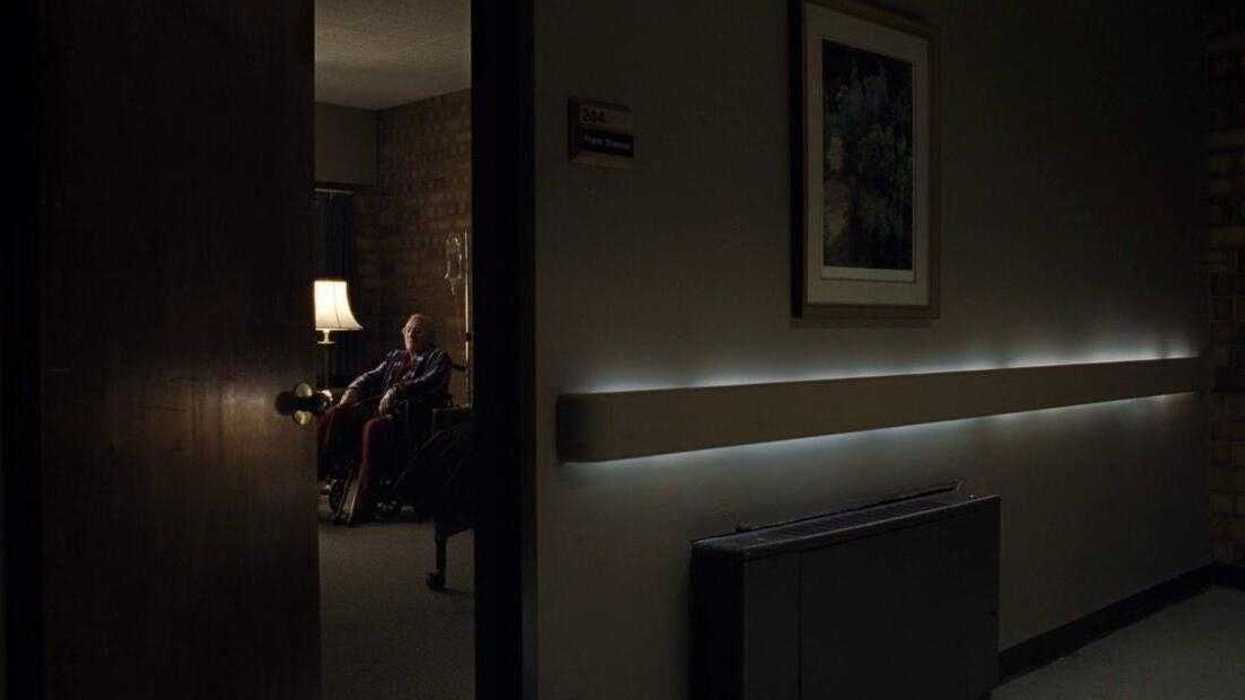
A criminal, in the last phase of his life, who has run out of opportunities for redemption, sits alone in his nursing home quarters. All his associates are long dead, the crime world he once served is miles away from him, and his family has disowned him. As he grapples with loneliness, he makes a small request to the Catholic priest assigned to him to leave the door slightly ajar.
It is seemingly an insignificant request, and yet it becomes one of the sharpest and most haunting images of emotional isolation. The scene is not sentimental; instead, it only shows a life reduced to nothing but silence and habit. As a parting gift, it gives us a look at the meager residue of a life dominated by misplaced loyalties and violence. The residue of a momentous life that ultimately amounted to nothing.
Framing the Film’s Final Moments
The Setup
Frank Sheeran’s (Robert De Niro) stirring, sensational life has now shrunk into clinical oblivion. He is riddled with old-age miseries, his world now limited to one single room in a nursing home, and everyone who once mattered (and to whom he mattered) has vanished from Earth. His daughters have severed ties with him, thanks to his criminal past as a hitman. Martin Scorsese uses this scene to position Frank’s decline as a natural conclusion of a life driven more by indiscriminate obedience rather than introspection.
The Lifeless Moment
After the assisted-living priest (Jonathan Morris) leaves, Frank is left in complete stillness, in a place that’s devoid of any warmth. The camera lingers long enough to let the deafening stillness of that moment settle. Since nothing happens, the audience is automatically directed to assess the emotional weight of Frank’s solitude.
The Open Door Image
This image is as revealing as it is heartbreaking. His request to leave the door open is a direct reference to his longing for connection. He knows it’s not going to come—he has neither the world’s goodwill nor enough time left—but this is the man hanging by a thread of hope, just for the sake of it. Still, the image is indicative of his inability to face the emptiness of his life.
Frank Sheeran’s Internal World
His Confession: As Empty as His Remorse
The scene captures a few passing moments of Frank saying confessional verses, or rather, barely repeating after the priest. His confession, if you can call it that, is perfunctory. He seems to be doing it out of a ritualistic habit rather than from the depths of his heart. He says the words out loud, but you can sense the lack of emotional truth in them. This shows how little he understands remorse, and how little is his grasp of the pain he has caused.
A Life Built on Obedience
Throughout the film, Frank is seen following orders. His obedience even leaves his loyalties in tatters. This final scene shows that he still hasn’t changed. His dormant soul-searching capability makes it impossible for him to address the choices that defined his career and life. He may appear to bear some sense of responsibility, but on close inspection, it becomes clear that it is hollow and inert.
His Understanding vs. His Denial
Frank has lived his life with full cognizance. He knows what he did, and he is aware of the consequences his actions caused, including the killing of Jimmy Hoffa (Al Pacino). And yet, he keeps himself untouched by their meaning through deliberate silences and ambiguous phrasings. The final scene highlights this contradiction. While talking to the priest, he acknowledges the events with plain factual awareness, but refuses to feel their moral weight through emotional denial.
What the Ending Suggests About His Redemption
Aside from the open door’s symbolic significance as Frank’s longing for connection, it also serves as a visual metaphor for the limbo, a space marked by avoidance that lies between awareness and atonement, where Frank remains suspended. The final shot ends with him looking out the open door (or at his redemption), but he is unable (or unwilling) to step out (or atone for his sins).
The scene also highlights that moral clarity can be possible only with honesty, which Frank cannot offer. Thus, the open door becomes a quiet symbol of longing without resolution.
Conclusion
The last moments of The Irishman are nothing but reminders that a life spent in meaningless obedience and servitude (that too at the cost of your conscience) can only result in loneliness. The deliberate emptiness of the scene mirrors Frank’s lack of reckoning.
He is just a man, existing in silence and abandonment, looking through the possibility that he will not reach.
- That One Astonishing Scene in 'The Irishman' Explained | No Film ... ›
- You Won't Believe How Scorsese Got 'The Irishman' Made | No Film ... ›
- 'The Irishman' Cinematographer on Visual Storytelling and Scorsese ... ›
- 'The Irishman' Composer Reveals How He and Scorsese Create the ... ›
- Watch How 'The Irishman' Used 'Goodfellas' to Make ILM's De-Aging ... ›
- Find Out the Filmmaking Techniques Behind Scorsese's 'The Irishman' ›
- Here's How ILM De-Aged 'The Irishman' Cast | No Film School ›
- Is the Lead Character in 'The Irishman' a Sociopath? | No Film School ›
- Deconstructing the Oner from 'The Irishman' | No Film School ›