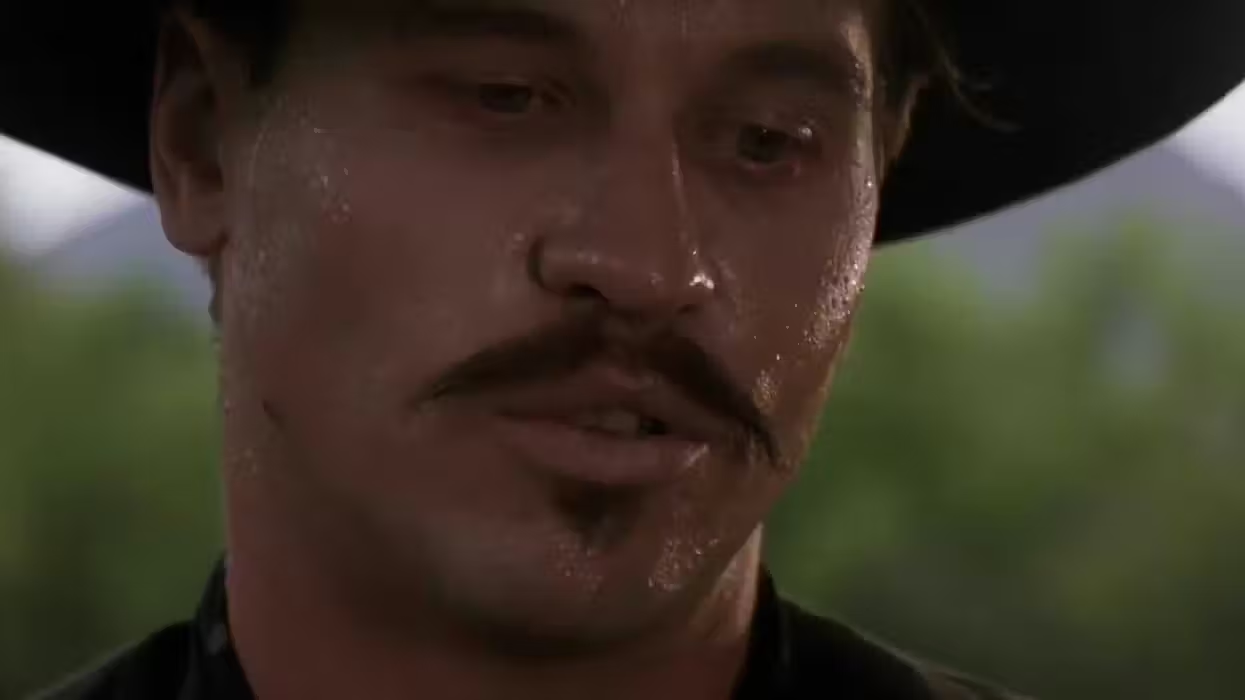
There’s a reason Doc Holliday is one of Val Kilmer’s most quoted roles. Everything he says is sad and funny at the same time, delivered in that Southern drawl. He always seems to get at something true and incisive in a voice that could only be his, which is what great dialogue or poetry or lyrics can do too.
Val Kilmer died on April 1, 2025, at the age of 65 in Los Angeles. The 1993 film Tombstone remains an iconic western, and the scene we’re looking at today is equally iconic.
- YouTube www.youtube.com
The Scene
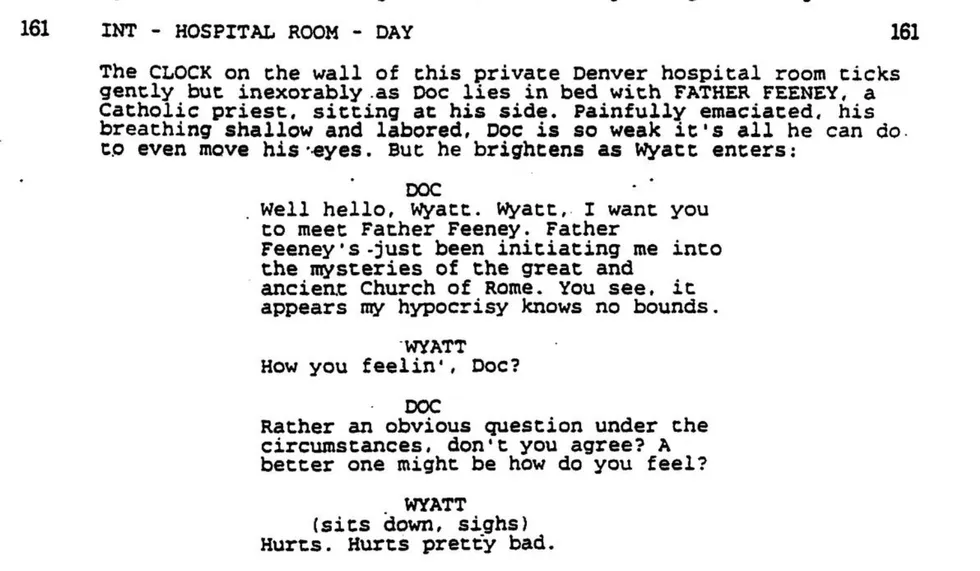
Near the end of Tombstone, Doc Holliday lies in a Denver sanatorium bed, dying of tuberculosis. Wyatt Earp (Kurt Russell) approaches and sees a priest standing over Doc. He’s visibly stunned.
The priest leaves with his Bible, and Wyatt sits next to the bed. Doc seems to be asleep, but his eyes open, and he launches right into conversation.
“Father and I were just investigating the mysteries of the church of Rome. It appears my hypocrisy knows no bounds,” Doc says.
He’s referring to the possibility of receiving last rites, although he hasn’t believed much in his whole life.
“You're no hypocrite, Doc. You just like to sound like one,” Wyatt responds.
Wyatt hands him a pamphlet, then attempts to pick up their ongoing card game, but Doc is in no mood, knowing he’s reached the end.
“I don’t want to play anymore,” he says.
In a lot of ways, his line about his own hypocrisy is one of the last jokes he tells before the conversation turns serious, and before his death.
 Credit: Buena Vista Pictures Distribution
Writing On-the-Nose
The production of this film was pretty fraught, and the script underwent pretty big rewrites. But this line exists in an early draft by Kevin Jarre, so it was always there.
It might be a line we’d consider on-the-nose, meaning it is a character saying who they are and what they believe. Typically, you avoid those, but I can think of several just from Tombstone.
There’s one moment during the big hunt sequence, for instance, where Doc declares that Wyatt Earp is his friend. He probably didn’t need to say that—we can see it in his devotion to the man and in how he keeps showing up to fight by his side. But in this movie, for this character, a line so honest has impact.
And that’s what this line does during his death scene, too. It works doubly well because Doc has been giving himself self-aware assessments the whole movie. He knows he’s a drunk, and he knows he’s a bit of a walking disaster.
“My hypocrisy goes only so far,” after killing Johnny Ringo, a few scenes before.
Even earlier: "In vino veritas," and, "Nonsense, I have not yet begun to defile myself."
His deathbed line almost reads like a punchline to a joke as a result. “I know who I am, and I’ll keep saying it, in Latin or English.”
It’s a little contradictory, too. He’s a disaster while also being one of the film’s coolest characters, confident and steady when it matters.
If you give a character a line like this, consider making it a character trait, rather than heavy-handed writing. If a character is aware enough to point out his flaws, then that’s doing something and serving the writing. If you need a character to just say what they think once, that feels a little more on-the-nose. Yellowstone does something similar with Beth Dutton, as we've written before.
Word Choice and Diction
If you really want to get nerdy about it (which I love to do), we can get into literary interpretation too. This can get as granular as word choice, the rhythm of individual sentences, and the context in which they appear.
“It appears my hypocrisy knows no bounds.”
Hypocrisy is a word he’s used before, so it’s a callback.
“It appears” is a distancing phrase. It’s not declarative. It’s observational and perspective-based. We could lose it in this sentence, and it would feel firmer, more factual.
“Knows no bounds” has a really nice repetition of “O” vowel sounds. That’s called assonance. It sounds elevated, when he could have just said something like, “never ends” or “is big.” Boo!
We should point out the difference between Saxon versus Latinate diction that a law professor recently broke down and we covered. Latinate words (longer, softer, conceptual) carry the veneer of respectability. Doc uses them to describe an unrespectable life. So there’s contrast there.
The setting, of course, is the hospital bed, so we have contrast between the dark humor and the location too.
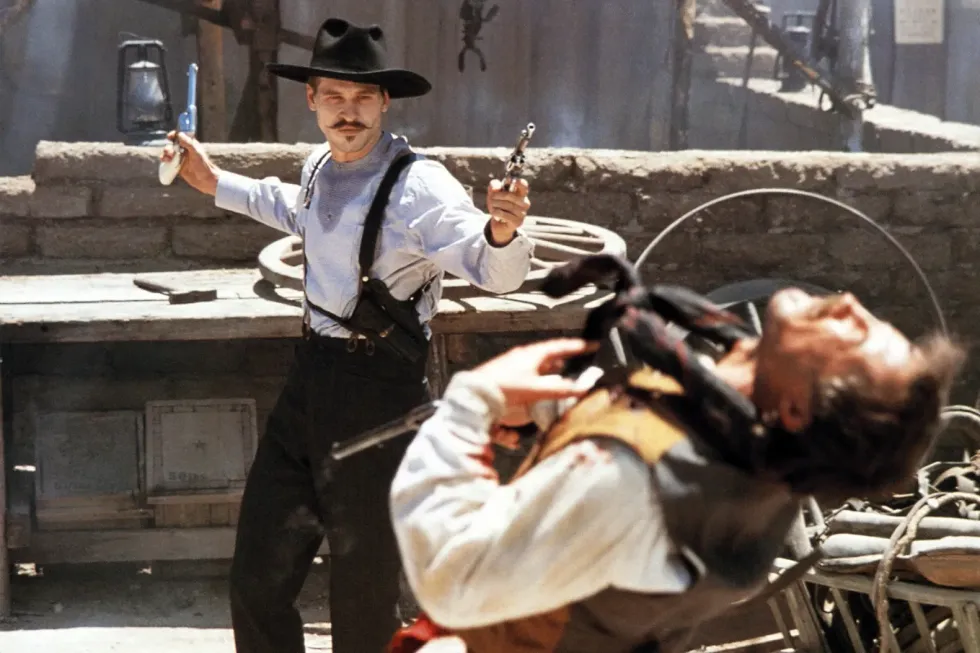 'Tombstone' Credit: Buena Vista Pictures Distribution
How Kilmer Brought Doc to Life
The contrast between light and dark in Doc’s character started on the page, but Val Kilmer was incredibly thoughtful about how he brought that character to life.
In 2017, he spoke to Deadline at length about his career. He said he first worked with dialect and speech coach Tim Monich to nail down Doc’s accent and voice.
“The main spine starts with the fact that the Southern aristocrat and his entire world had just been blown up and disappeared forever as if it had never existed,” he said. He added, “The dialect was key. It informs even the walk, the thought process … his condescension.”
He also knew that the character's darkness would have to live in every line of dialogue.
“Then, taking on the subject of death, which he’s witnessed firsthand since he was perhaps 10 years old. Ugly death. When you make that fact normal in a character profile that has to live, and not just exist as some well-written sentences in a drawer, a documentary film, if you will, that is a living guide to life that works for every situation. Death, death, death. And then add to that bleak picture a dazzlingly sharp sense of the ironic. Extra effort, I’d put into virtually every moment, to summarize, to encapsulate, to capture the elemental dark truth, even to strive for poetry, because this just might be your last shot at getting it right, to prove his way of life was not only worthwhile, but elemental director’s thriving culture.”
Hearing an actor of this caliber have such a clear and thorough understanding of a character is truly beautiful, and it’s certainly a huge factor in why Doc Holliday has become one of the more unique and enduring figures in the Western genre.
- Decoding Doc Holliday’s “Terminal” Loyalty in ‘Tombstone’ ›
- Walking Over Your Grave: Doc Holliday’s Deadliest Line in 'Tombstone' ›
- Film Quote of the Day: The Wyatt Earp Line That Remains One of Western Cinema's Coldest Comebacks ›
- Film Quote of the Day: The 'Tombstone' Line That Became Timeless Wisdom About Life's Uncertainty ›
- Film Quote of the Day: The 'Tombstone' Quote That Doc Holliday Delivered in Latin | No Film School ›
- Why 'Tombstone' Refuses to Die | No Film School ›