Decoding Doc Holliday’s “Terminal” Loyalty in ‘Tombstone’
This Tombstone (1993) scene proves that for Doc, an isolated man on his deathbed, loyalty to one friend outweighs the instinct for survival.
‘Tombstone’ (1993)
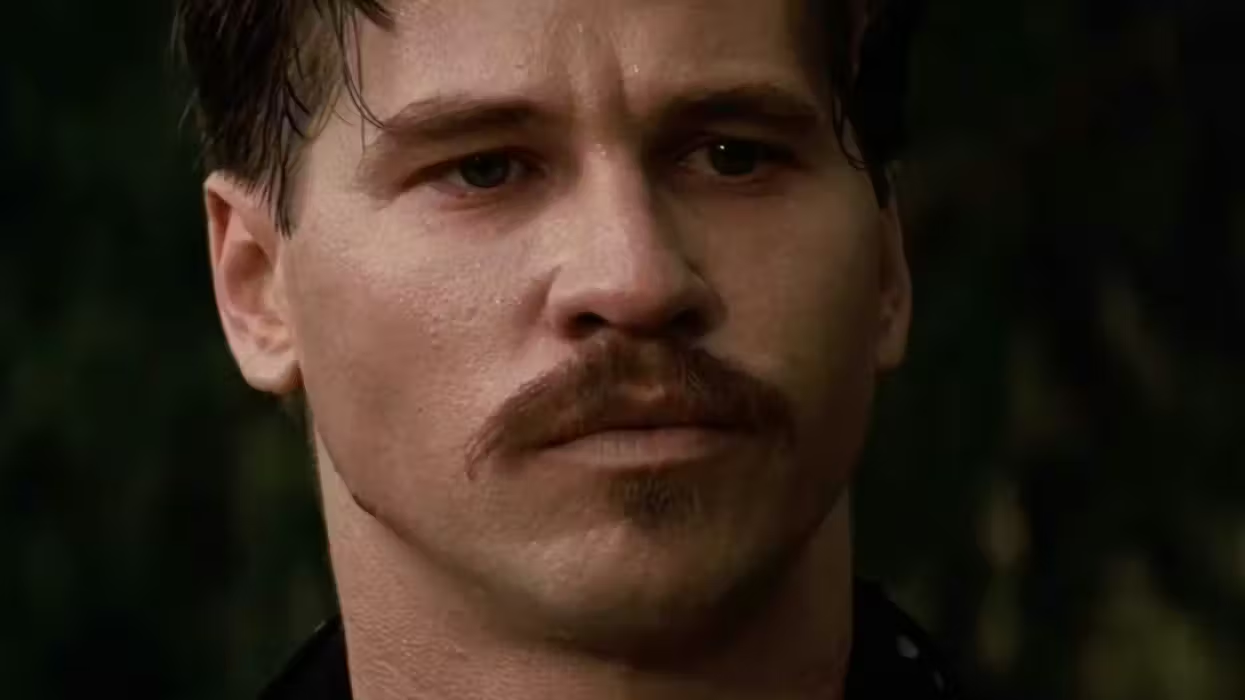
In the Old West, an efficient gunslinger is defined by strength, stamina, and a steady hand—a “true grit.” In this moment, however, Doc Holliday barely qualifies on these counts. He is consumed by a deadly disease and is in constant pain. He should be in bed (most likely his deathbed), but he is still running on fumes, purely on habit and sheer stubbornness.
Despite literally shivering, he refuses to put his gun down and rest. What’s stopping him from spending his final moments in peace? The call of federal duty? Righteous fury against the Cowboys?
Yes, it’s there. Duty and fury are the driving forces behind the Vendetta Ride. Everyone in the posse is drunk on both. But with Doc, there is more. Something personal.
You see, Doc is not just a hero looking for a “grand exit.” He is a man hanging by a single thread of friendship. And his reason for not letting that thread go tells us that, for him, it’s not (just) about the fight. It’s about the only connection he is left with in a world that is already moving on without him.
The Scene at the Campfire
The scene comes during the movie’s third act, after the legendary gunfight at the O.K. Corral and before the Vendetta Ride.
The O.K. Corral incident at Tombstone resulted in the deaths of three Cowboy gang members. Two months later, the vengeful Cowboys, led by Curly Bill (Powers Boothe), ambush Virgil Earp (Sam Elliott) and leave him with a permanently crippled left arm. Three months after that, the Cowboys ambush Morgan Earp (Bill Paxton) and kill him. Wyatt Earp (Kurt Russell) is devastated by the tragedies inflicted on his brothers and prepares to leave Tombstone with his family. However, the Cowboys are still in pursuit. Wyatt makes sure that his family leaves safely, but he himself stays behind to exact revenge. He kills one Cowboy and lets the other go with a message that he is going to put an end to the Cowboys. This is the beginning of the Earp Vendetta Ride.
Wyatt and his small group, including Doc Holliday (Val Kilmer), begin their manhunt. Now they are less of lawmen and more of avengers. The manhunt is, at the same time, exhausting and dangerous because the Cowboys aren’t exactly sitting idle either. It’s tough on everyone, but it’s downright punishing and debilitating for Doc. He is suffering from terminal tuberculosis, and it’s worsening day by day. Every step the Earp posse takes steals time from Doc that he doesn’t have.
During this time, at Wyatt’s camp, Doc is sitting by the campfire, sweating, shivering, coughing, and barely holding himself together. The sharp, sarcastic gunslinger whom we saw earlier in the film is now a diminished shadow of his old self. Seeing his condition, John “Texas Jack” Vermillion (Peter Sherayko) asks him why he is pushing his boundaries and not in bed. When Doc says that he is doing so because Wyatt Earp is his friend, Vermillion comments, “Hell, I got lots of friends.”
Doc replies, “I don’t.”
- YouTube
A Brutal Contrast in Social Geometry
The Replacements vs. The Irreplaceable
Vermillion says, “Hell, I got lots of friends.”
To be honest, this line irks me. Why would he say that when Doc is expressing his loyalty? I would be more accepting had he said, “Hell, he (Earp) has got lots of friends.” That statement would have decent logic—and wouldn’t sound tone-deaf. “Wyatt has many friends who can help him. You can rest.” That sounds right and empathetic. “Hell, I got lots of friends" sounds unnecessary and in bad taste. It’s like a rich brat bragging about his wealth to a poor person.
But that’s fine. There is no point expecting emotional maturity from a gunslinger who later became known as “Shoot-Your-Eye-Out-Virmillion,” or someone who, after his stint with the Earps, joined a con artist and gangster named Soapy Smith. Perhaps he is in character when he says that.
Now, and from an objective point of view, these words are from someone who is a socially adjusted person. When it comes to having friends, Vermillion is like most of us: We use friends as a support system that can be expanded, shrunk, or replaced as needed. Vermillion, judging from his tone, sounds like someone who wouldn’t understand (or imagine) being in the position where one single person is the beginning and end of his social circle. Nothing awfully wrong with it. It’s just a bit expendable.
The Weight of “I Don’t”
Doc’s response to Vermillion’s imbecilic boast is simple. “I don’t.” It’s simple, but not empty. In fact, these two words are packing a hell of a lot of pain and loneliness. They strip away Doc’s constitutionally witty facade. He is literally bearing himself open by admitting that, without Wyatt, he is absolutely lonely.
You should note: Doc’s implication is that Wyatt is not only his preferred companion; he is his only companion. Doc knows he will soon be dead, and until then (and even after that) Wyatt is his only link to the living world. This isolation makes his loyalty absolute.
These are the dying man’s words. There is no backup plan, like Vermillion.
Conclusion
If I have to condense Doc Holliday’s journey in Tombstone, I will say that he, like others, isn’t looking for revenge, redemption, or glory. He has found one good thing in his (quite small) life, one friend, one companion, one single reason to go on, and he is not willing to let it slip out of his hand just so he can die peacefully in bed.
Doc is the kind of man who would trade the comfort of a quiet death for the cold, excruciating, and perhaps violent death if he gets to live a few more moments for the only one who matters.
- What Does 'I'm Your Huckleberry' Mean From 'Tombstone'? | No Film School ›
- The Psychological Brilliance Behind Doc Holliday’s Iconic “I Have Two Guns” Response ›
- Walking Over Your Grave: Doc Holliday’s Deadliest Line in 'Tombstone' ›
- Tombstone vs. Wyatt Earp: Two Westerns, One Legendary Showdown ›
- Sam Elliot the Quick and the Dead ›
- The 'Tombstone' Line That Became Timeless Wisdom ›
- Film Quote of the Day: The 'Tombstone' Quote That Perfectly Captures Doc Holliday's Wicked Sense of Humor | No Film School ›
- Why 'Tombstone' Refuses to Die | No Film School ›