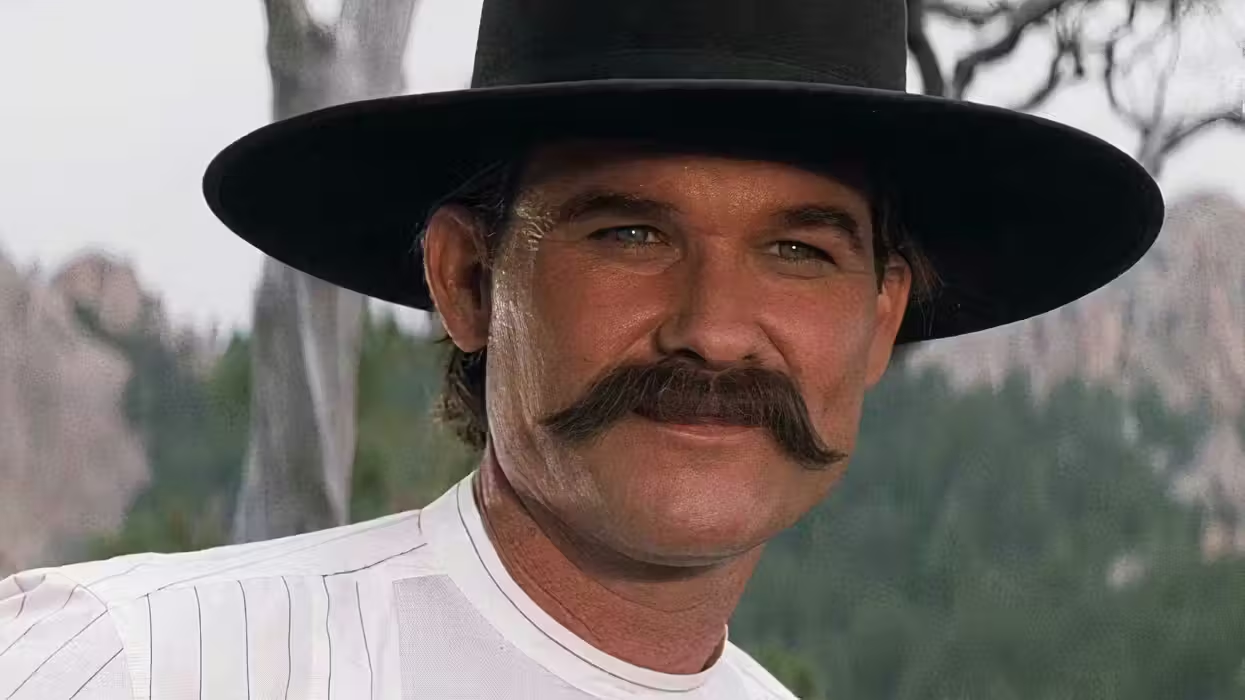
There is a specific class of cold-blooded hero action lines. They feel effortless and scary without being a joke, usually because they're delivered with intense conviction or at the culmination of a tense confrontation. You can probably think of a few right now.
If you're remembering Tombstone alone, you could probably rattle off half a dozen hero lines. They're plentiful, especially if you're a Doc Holliday fan.
But let's look at one you might have forgotten from fairly early in the film. It can teach us a lot about writing unique confrontations.
"You gonna do somethin' or just stand there and bleed?"
It's a line delivered so casually that half the audience doesn't even realize it's the power move of the entire scene. Wyatt Earp says it to Johnny Tyler, and by that point, Tyler is literally bleeding and pale and hasn't fought back at all.
It's a risky scene, and one you could easily botch. You might lean toward making it a shouting match or a gunfight or some explosive confrontation. But Tombstone does something far colder by showing what happens when one character removes every option the other person has, without ever raising their voice.
- YouTubewww.youtube.com
The Scene
Wyatt Earp enters the Oriental Saloon and walks toward a Faro table where Johnny Tyler is dealing. Tyler has been bullying the players, loud, aggressive, drunk on his own power. He immediately sees Wyatt and starts snarling.
"Somethin' on your mind?" Tyler asks.
"Just wanted to let you know you're sitting in my chair," Wyatt says calmly.
Tyler looks Wyatt over and sneers. Wyatt is unarmed. That's Tyler's advantage—or so he thinks.
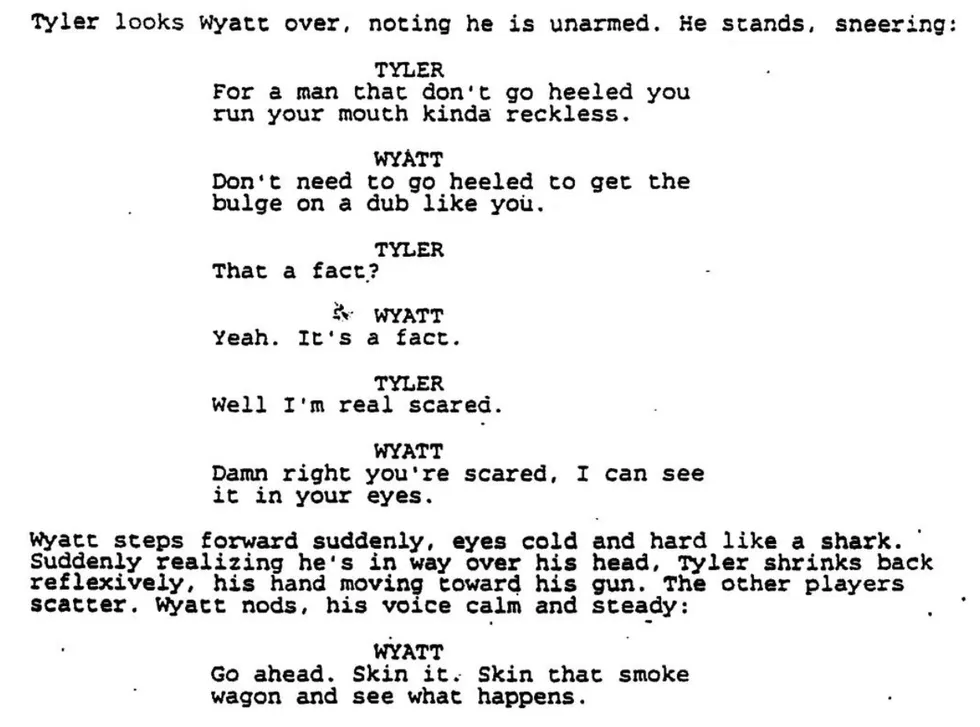
"For a man that don't go heeled, you run your mouth kinda reckless, don'tcha?" he says.
They exchange a few lines. Wyatt doesn't raise his voice. He just makes statements. When Tyler says, "Well, I'm real scared," Wyatt steps forward.
Tyler reflexively reaches for his gun. Wyatt nods and tells him to draw.
"Go ahead. Skin it. Skin that smoke wagon and see what happens."
Tyler tries to escape by talking. "Listen, mister, I'm gettin' awful tired of your—"
Wyatt slaps him. "I'm gettin' tired of your gas. Now jerk that pistol and go to work."
Tyler freezes. Wyatt slaps him two more times. Blood trickles from Tyler's mouth.
By the third slap, Tyler is broken and unresponsive.
Wyatt says, "You gonna do somethin' or just stand there and bleed?"
The answer is no. Wyatt takes Tyler's gun and hands it to the barkeep. The confrontation is over. Tyler never even had a chance to fight back. It's one of the most effective power moves in Western cinema.
How Most Writers Would Screw This Up
Many beginning writers would turn this into a shouting match or an automatic shootout, with both characters yelling, insulting, and trying to out-tough each other through dialogue. The violence would be explosive.
Maybe even the whole saloon would get involved, which is what you typically see happen in less nuanced or old-fashioned Westerns. (I'm thinking of the Western segment with Billy the Kid in Bill and Ted's Excellent Adventure, a movie I love. But that scene explodes into an inexplicable melee in about two lines.)
Or they'd make it about gun speed and skill, some cinematic showdown where Tyler reaches for his gun and learns the hard way he's no match. The classic quick-draw, which we see elsewhere in this film.
On-the-nose dialogue might have Wyatt overexplain the power dynamic. It would make him perform his dominance or announce his authority through clever insults or threats. Think cringey '80s action lines.
Instead, this scene shows Wyatt systematically removing options. Much like Tarantino uses dialogue as a weapon to stretch nerves until a single move will ignite the room, Wyatt does something similar here. As a result, we get several iconic Western lines in the scene, including a few you can find as popular T-shirt options.
 Credit: Buena Vista Pictures
The Screenwriting Lesson
If you want to show a powerful character, chances are you don't want them walking around talking about how great and tough they are. It'll read as disingenuous because real power doesn't need to prove itself through words. Usually, a character in power says less, not more.
The most intense scenes build through characters' actions, not only what they say. In this scene, Wyatt immediately reads Tyler. He sees the true fear underneath the aggression. When he steps forward and Tyler flinches, Wyatt knows he's already won. Tyler doesn't want to fight. He just wants the posturing to be enough. But Wyatt won't let that work.
Building tension can be about narrowing options. Wyatt removes Tyler's escape routes. The verbal escape (or talking his way out) is blocked by the slaps. Physical escape is blocked by Wyatt's forward momentum and certainty. Psychological escape (the tough-guy act) is blocked when Wyatt names what he sees.
"Damn right, you're scared. I can see it in your eyes."
When your character tries to escape through dialogue, you have to cut off that escape route. So the moment Tyler waffles, Wyatt slaps him. By the third slap, Tyler has figured it out. I have no way to win here. I can draw, or I can go. Regardless, I'm done. Or, we guess, he could have just stood there bleeding.
Once you understand your character's actual goal (in this case, systematically break the other person's will), the actions and dialogue flow naturally.
The most compelling confrontations rely on subtext and what's beneath the surface, not on what's said. Wyatt doesn't need to explain that he's in control. Both Tyler and the audience feel it.
Let silence and action do more work than dialogue. "You gonna do somethin' or just stand there and bleed?" only works because Tyler is already broken. The real work happened in the slaps, the stepping forward, the calm voice telling him to draw, and the absolute certainty underneath it all.
Go into a confrontation like this knowing, as a writer, what each person is trying to accomplish. Then show what happens when one person's will is broken down.
The coldest action lines sound like they're not trying at all. They're not threats or pronouncements. They're just statements from someone who already knows the right answer.
- Walking Over Your Grave: Doc Holliday’s Deadliest Line in 'Tombstone' ›
- What Does 'I'm Your Huckleberry' Mean From 'Tombstone'? ›
- The Psychological Brilliance Behind Doc Holliday’s Iconic “I Have Two Guns” Response ›
- Film Quote of the Day: The 'Tombstone' Line That Became Timeless Wisdom About Life's Uncertainty ›
- Film Quote of the Day: The 'Tombstone' Quote That Perfectly Captures Doc Holliday's Wicked Sense of Humor | No Film School ›