You probably weren't expecting a law professor's lecture on 19th-century rhetoric to improve your screenplay today. Neither was I, to be honest, but I'm super glad to have found a resource that allowed me to learn.
But in a conversation with writer David Perell, Ward Farnsworth (a law professor and author of books on classical rhetoric) breaks down how speakers and writers can formulate memorable language.
For screenwriters, these insights can help write dialogue and action with a voice that stands out. Plus, it's just a really interesting way to look at writing and its foundations, so you can approach your screenplay with academic rigor if that's your jam.
Check out his video with David Perell below.
- YouTube youtu.be
Saxon vs. Latinate
English gives you two ways to say almost everything. There's the simple word and the fancy one. "Make" versus "assemble," "get" versus "acquire," "write" versus "compose."
Farnsworth explains that the former are Saxon words (short, hard, direct), while the latter are Latinate words (longer, softer, conceptual). According to Farnsworth, the Saxon words come from Germanic roots, while the Latinate words arrived with French-speaking Norman conquerors and became associated with aristocracy and education.
For example, Abraham Lincoln had a habit of saying things twice—once in Latinate language, once in Saxon. In his 1858 House Divided speech, he said, "I do not expect the union to be dissolved. I do not expect the house to fall."
He's basically saying the same thing twice, just using a different tone for a different impact.
You can do this for your characters who code-switch or repeat things for effect. You can also use this tactic for different characters.
You probably already know your characters shouldn't all sound the same. A character under emotional stress might speak in Saxon style. Short words with blunt sounds. "I didn't kill him."
A character hiding behind formality or trying to sound impressive goes for Latinate language. "I did not perpetrate the alleged homicide."
Your working-class mechanic shouldn't sound like an Ivy League doctor. The mechanic's dialogue skews Saxon. The doctor might hide behind Latinate constructions.
A character's word choice tells you about their background, their education, and their emotional state.
Sentence Endings Hit Hardest
The most important part of any sentence is usually the end. That's what rings in the ear. That's what an audience remembers.
To do this in your own writing, you might set up a sentence with fancier, more conceptual language, then bring it home with simple, direct words that land with a punch.
Oliver Wendell Holmes Jr. wrote in a Supreme Court opinion, "If there's any principle of the Constitution that more imperatively calls for attachment than any other, it is the principle of free thought—not free thought for those who agree with us, but freedom for the thought that we hate."
Note the beginning. Principle, constitution, imperatively, attachment. But the sentence ends in straightforward words. "Freedom for the thought that we hate." Farnsworth calls that "a run of hard Saxon words."
This works in dialogue when a character needs to land an emotional moment. They can start intellectual, conceptual, and evasive. Then finish direct and simple.
You can think about this on a more macro level, too. You might have a long, complicated dialogue scene that ends with a punchy line. You could call that the scene's button, like an exclamation point.
How to Use Repetition
Repetition gets a bad rap in screenwriting, which makes sense. You don't want the same beats happening over and over or lines that give identical information.
But other types of literary repetition can work in screenwriting.
For example, Winston Churchill's 1940 House of Commons speech used anaphora, or the repetition of a word or phrase at the beginning of successive clauses, sentences, or verses.
"We shall fight on the beaches, we shall fight on the landing grounds, we shall fight in the fields and in the streets."
Lincoln used what's called epistrophe, the opposite—ending phrases with the same words. The most famous example is the Gettysburg Address. "Government of the people, by the people, for the people."
You see this all the time in memorable movie speeches. Anaphora shows up when a character is building momentum, stacking arguments or declarations. Epistrophe works when they're hammering home a central idea.
However, we should use it sparingly. If every line uses repetition, none of them stand out.
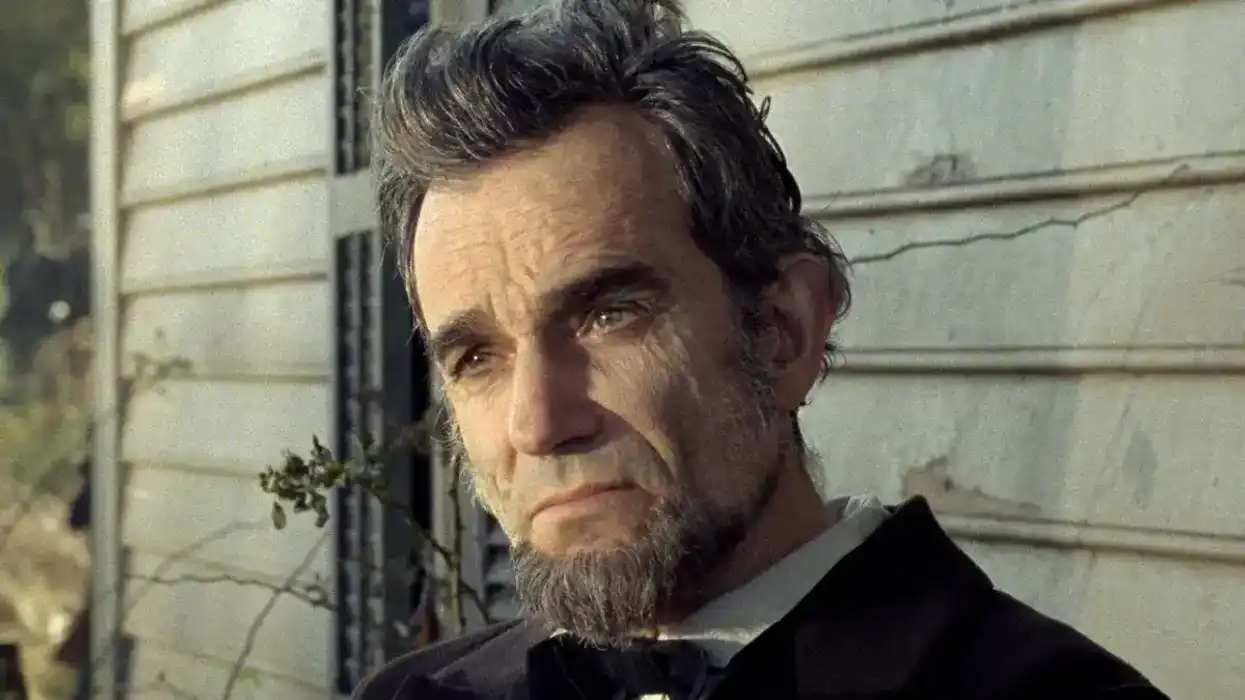
 Lincoln Credit: 20th Century Studios
Flip It and Reverse It
Ever heard of chiasmus? It's a reversal structure. You set up elements in one order, then flip them.
Farnsworth points to Kennedy's 1961 inaugural address ("Ask not what your country can do for you—ask what you can do for your country") as the classic example.
The reversal makes it feel complete, like a closed loop. It sounds wise and elegant because it's so tidy.
The most widely known film example is from The Dark Knight. "You either die a hero, or you live long enough to see yourself become the villain." You start with death and heroism, then flip to life and villainy.
For screenwriters, this can be a tool for creating the big trailer moments when the character says something profound and beautiful.
But as Farnsworth points out, only certain kinds of statements naturally lend themselves to this structure. If you're constantly trying to chiasmus every line, you'll sound like you're trying too hard.
When to Use Rhetoric
These techniques do call attention to themselves. They're rhetorical flourishes. They aren't typically used in everyday speech, and won't work for every character or every piece of writing.
That means you need to deploy them strategically, like for a character's big speech. Or a moment of clarity or decision or declaration.
To get better at using these devices, you should read great dialogue. Study speeches and scripts. Consider keeping a record of your favorite lines and determining their structure. Don't copy those lines, but if you understand them, it will help you come up with your own.
But as you learn, keep writing in your own voice. Dialogue doesn't always have to be natural, but it should sound pleasing, and it should work for the world you've created. Maybe you fill a story with the smartest people on earth who only use rhetoric. Or you don't. The choice is yours.
- What Is Hypophora (Definition and Examples) | No Film School ›
- What Is Anastrophe (Definition and Examples) | No Film School ›
- What Is the Chiasmus Definition? (with Examples) | No Film School ›
- What Are Rhetorical Devices? Examples That Make Ideas Stick | No ... ›
- 7 Best Lines From ‘No Country For Old Men’ – Ranked ›
- 13 Writing Formulas Every Screenwriter Should Know ›