Will a Federal Tax Credit Fix Runaway Production? Breaking Down Trump’s Hollywood Incentive Endorsement
This bipartisan action would help bring more jobs home.
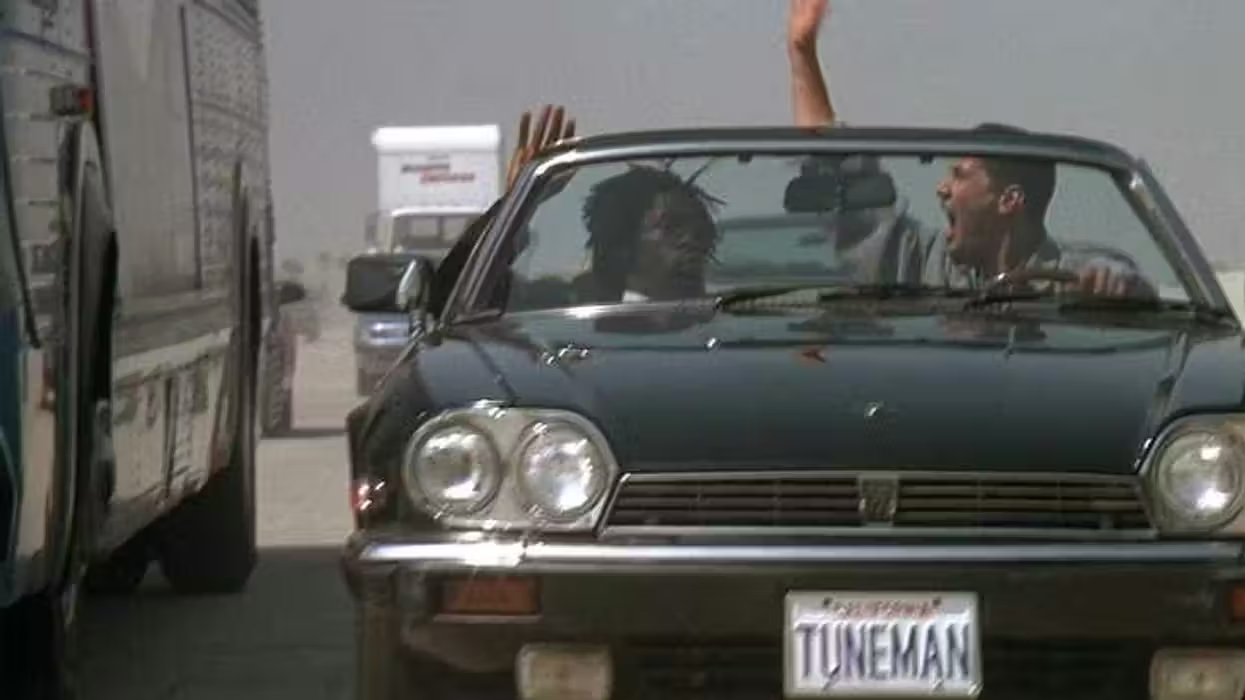
'Speed'
Over the last few years, I've watched as my friends, colleagues, and I have boarded a plane and flown internationally to work on a Hollywood project. The reason is that production in the United States lacked a real financial incentive.
You had places across Europe and Canada where you could basically double your budget thanks to tax incentives alone.
That situation hurt crews and unions across the USA, as those jobs never came back home. The only way to combat this was to offer something similar at home, to make sure business didn't go abroad.
Now, that's happening.
In a major pivot for film policy, President Donald Trump has publicly backed a bipartisan federal film tax credit to curb the ongoing tide of runaway production.
Trump took to Truth Social to call Hollywood a "Complete and Total Disaster" over its loss of domestic projects, but asked Congress to immediately pass a "Federal Production Incentive to create Entertainment Jobs in America".
As reported by Variety, the announcement marks a strategic shift away from his previous threat of a blanket 100% tariff on foreign-produced films, which we covered.
This is a new proposal that follows months of lobbying by veteran actor Jon Voight, the Motion Picture Association (MPA), and the Entertainment Union Coalition.
The big question remains: Could a federal film tax credit actually bring production back home, and how would it change indie filmmaking?
Let's dive in.
The Backstory
As I said up top, American film and TV production has been drifting abroad to take advantage of massive local tax rebates and labor subsidies. States have fought back, but the financial measures they provide just couldn't match what whole countries had to offer.
When Trump initially floated 100% import tariffs on foreign-shot films a year ago, industry analysts warned it would cripple foreign distribution models and maybe start a trade war over movie distribution.
Luckily, that was just an idea tossed around.
Now, we have a better one, which is having a federal production tax credit that mirrors how competing nations keep their domestic industries thriving.
And it has bipartisan support, with California Governor Gavin Newsom tweeting this morning about getting it done.
Bipartisan Support Doesn't Mean It Happens
Like anything in Hollywood, just because people love it doesn't mean it will definitely happen. But early signs show a ton of praise from people like the Motion Picture Association Chairman and CEO Charles Rivkin, the Directors Guild of America (DGA), and individuals on Twitter, who were happy to keep jobs stateside.
So why would this not happen?
It's hard to imagine representatives who have states where Hollywood doesn't shoot or have jobs backing something that gives money away. Now, one wise move would be to blstr production in your home state to capitalize on this incentive, but you can see where it might be a hard sell to get the votes if it doesn't help you at all.
There are also these two major issues:
- Tax Code Complexity: Designing a credit that is either refundable or easily transferable for productions without corporate tax liability requires deliberate crafting and may take a long time to actually get done. That could mean waning interest.
- Budgetary Costs: Fiscal conservatives in Congress may scrutinize the short-term cost to the federal treasury. This will be expensive, with major Hollywood productions seen as reaping the benefits, even if those productions employ thousands of people. So just an optics hurdle.
What a Federal Incentive Means for Filmmakers
While major studio blockbusters stand to save tens of millions under federal subsidies, the impact on independent and lower-budget filmmakers depends heavily on how the legislation is written and who can take advantage.
It is undisputed that if this passes, it will help studios bring jobs home; we've seen evidence of that.
But your micro-budget may not garner any additional support here.
Still, we can speculate on how this may work to your advantage.
1. Stacking State and Federal Credits
If you're making a movie right now, you have to location scout almost entirely based on local tax structures. Those change state to state, as well. If a federal production credit is passed, it will likely stack on top of existing state-level incentives.
That means you can double-dip to save money.
- State-Supported Areas: A project shooting in Georgia or New York could combine state tax credits with a baseline federal credit. You can pitch that as an ROI incentive to anyone investing in your indie.
- New Baselines: States without existing film programs would suddenly become viable shooting locations because a federal baseline is set.
2. Qualified Local Spend vs. Minimum Spend Thresholds
The key issue for independent filmmakers will be the minimum spend threshold in order to get these incentives. I would assume it will be set at least in the hundreds of thousands, if not in the millions.
Again, these are speculative because we have no details.
- High Thresholds (e.g., $1M+): This would only benefit some indies, most studio features, and high-budget television. It would leave micro-budget and mid-tier indie filmmakers out of the equation.
- Low Thresholds or Tiered Models: If they allow projects under $500k to claim rebates for qualified local expenditures, equipment rentals, and U.S. crew payroll, they may see more jobs created and more cash flow, as more people can use these incentives.
3. Crew Retention and Below-the-Line Relief
The USA needs some relief for our crews. We're struggling to keep people employed and to make working in production a viable way to raise a family.
Even now, U.S. crew members have frequently had to relocate abroad or change careers due to dry local production schedules.
A federal incentive designed to keep below-the-line jobs in the U.S. could stabilize the domestic crew pool. You could have more teams working together for years, making more experienced local DP, grip, sound, and art department talent more accessible for indie shoots.
Summing It All Up
If Congress acts on this incentive, it could represent the biggest structural shift in American film financing in decades.
We're hoping this passes and that we can see production not only move home, but also more jobs created and more indies able to use this stuff to get made.
Let me know what you think in the comments.