Why 'The Terror' Is the Perfect Horror Series to Watch After Netflix's 'Below'
Finished Netflix's Below? Eight years on, AMC's The Terror still shows how to hide a monster and let character carry the slow-burn horror.
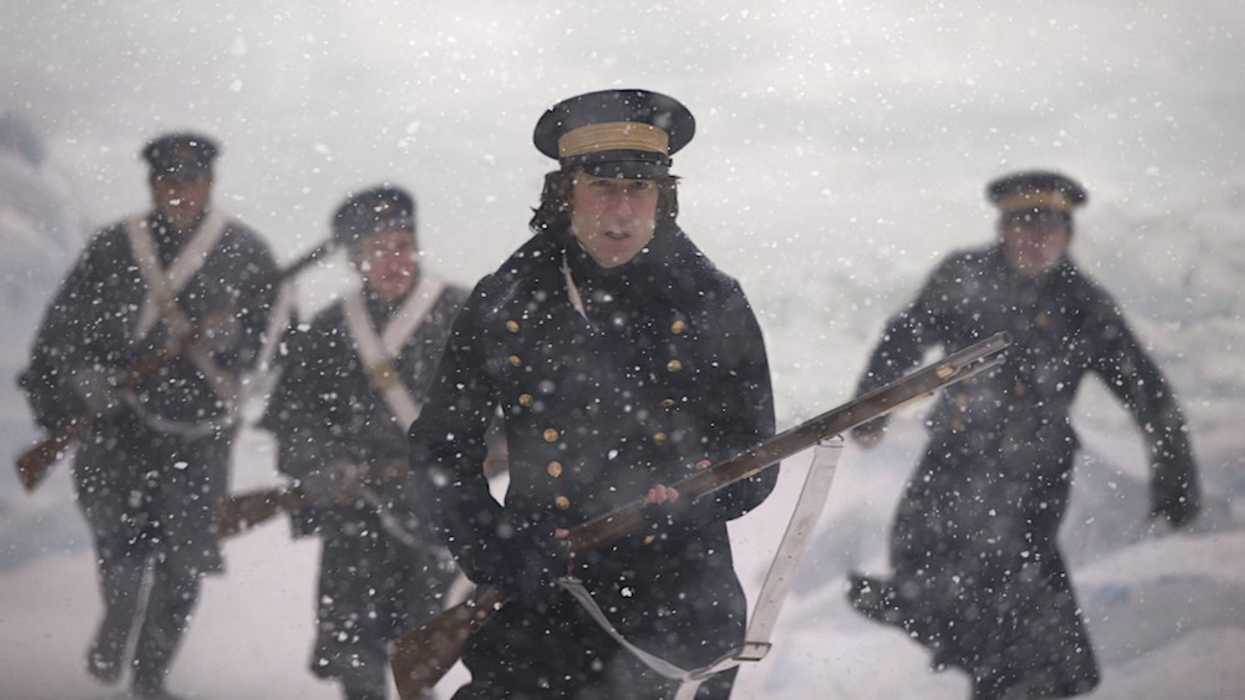
'The Terror'
If you know me in real life, you've probably had to sit through me bringing up one of my constant hyperfixations—the Franklin Expedition of 1845, a real-life British expedition that ended in disaster for its two ships, Terror and Erebus.
The true story was dramatized beautifully in the AMC series The Terror and featured a stellar cast, including Jared Harris. The series was based on a historical horror novel by Dan Simmons, blending supernatural foes with good old human hubris.
I bring this up because a lot of fans are looking for something to watch after the Netflix series Below. All six episodes of the Josh Hartnett/Mackenzie Davis/Charlie Heaton limited series hit Netflix on Oct. 8, 2026, from creator/showrunner Jesse McKeown.
Hartnett plays Calvin Penney, a Newfoundland fisherman still haunted by his father's death decades ago, whose town is terrorized by an unidentified sea creature.
All this to say, if you finished it craving more cold water and slow dread, go back to The Terror. In this essay, I will—um, I mean, let's look at the similarities between the shows and why they're a perfect double feature.
- YouTube www.youtube.com
Two Stories of an Unforgiving Environment
There's something viewers seem to love about putting characters in places where the very surroundings seem intent on killing them.
Simmons' 2007 novel draws on the Franklin Expedition, when Erebus and Terror went looking for the Northwest Passage and vanished, with all 129 men meeting their demise. Their remains are still being found and identified to this day in real life.
Simmons and the show added the Tuunbaq, which is presented as an ancient being taking the shape of a giant polar bear with a man's face. The clueless British shipmen have no idea what they're dealing with, even when Silna (Nive Nielsen), an Inuk angakkuq or shaman, tries to warn them off.
Below is set in Newfoundland, where a sea creature is the terror.
"I've been coming to Newfoundland for many years, and it's become a part of my life," McKeown told Tudum about finding the show's setting. "I just always felt like I wanted to set something here, that this would be a great place for something big and something kind of epic. It's such a unique landscape and such a rugged, dangerous, isolated, scary place in a lot of ways. But then there's also this other side to it, which is that the community is so warm and the people are so funny and unique and there are so many eccentricities about the place."
While Below's premise does not include the supernatural, both shows treat a hostile landscape as a character and isolate a community that can't fight on equal terms with nature.
Hiding the Monster, then Diversifying the Horror
You probably know the old horror adage of hiding your monster for as long as you can, because the imagination provides something far scarier than any effects house. Both of these shows take that to heart. Below doles out glimpses of its sea creature over several episodes.
Mashable praises that element specifically, saying the series "artfully conceals its creature for some time, showing a glint of a giant eye here, a flash of a tentacle there."
But there's an existential threat, too—of climate change, of paranoia and in-fighting in a small community, of tech companies infringing on rural land.
The Terror does the same. You might think a show about a British expedition in the Arctic would need to call on its monster pretty regularly to keep things interesting. It does not.
Showrunner Dave Kajganich built a "palette of dread" instead of a palette of fear, and viewers don't get a clear look at the creature until episode five. The restraint "proved that we didn't need the monster," he said in 2019.
Soo Hugh, co-showrunner, said, "The number one rule of horror is: don't show. You want to hold it back, not just to play games with the audience, but only just to build that tension, and the audience will see that every character will have their own monsters to deal with" (via AMC).
Once the Tuunbaq is visible, the show moves its dread onto the men themselves. The show's beauty is that many of the men meet their ends because of situations they create through poor planning, starvation, alcoholism, and eventual mutiny. The monster doesn't fully appear until the middle of the series, then at the finale as the final slap to the men's arrogance.
- YouTube www.youtube.com
Finding the Moment Each Character Enters the Horror Story
For characters in a horror story, there's likely a "before" period of backstory you can use to develop characters and show how their worlds change. Kajganich said characters in The Terror see themselves as adventurers at first.
He told Rotten Tomatoes, "We were interested to know, in the writers' room, at what moment each character stepped from a high adventure story into a horror story, and that's obviously different for every character. And we knew there were going to be a handful of characters who refused, Blanky (Ian Hart) at the top of that list. He never enters the horror story; he wouldn't dignify a horror story with his participation, ever, so he stays in the adventure story 'til the very end."
Hickey (Adam Nagaitis) starts the show already living in a survival story.
"But we also knew we wanted a character to—Hickey being chief among them—who just already start the show in a horror show, and he's in a survival story when we meet him and has been for years."
In Below, Calvin is much the same. Calvin watches his father die as a child. By that logic, he enters the series already in his horror story, like Hickey.
This approach can be super helpful for developing characters in a horror world. When do things cross into genre territory for each of them?
You can stream Below on Netflix.
The Terror anthology is still alive. The third installment, Devil in Silver, premiered May 7 on AMC+ and Shudder, based on Victor LaValle's 2012 novel, with LaValle co-showrunning alongside Chris Cantwell.