Film Quote of the Day: The 'Star Trek' Line That Offered a Timeless Lesson on Making Difficult Choices
"What is necessary is never unwise." - Sarek.
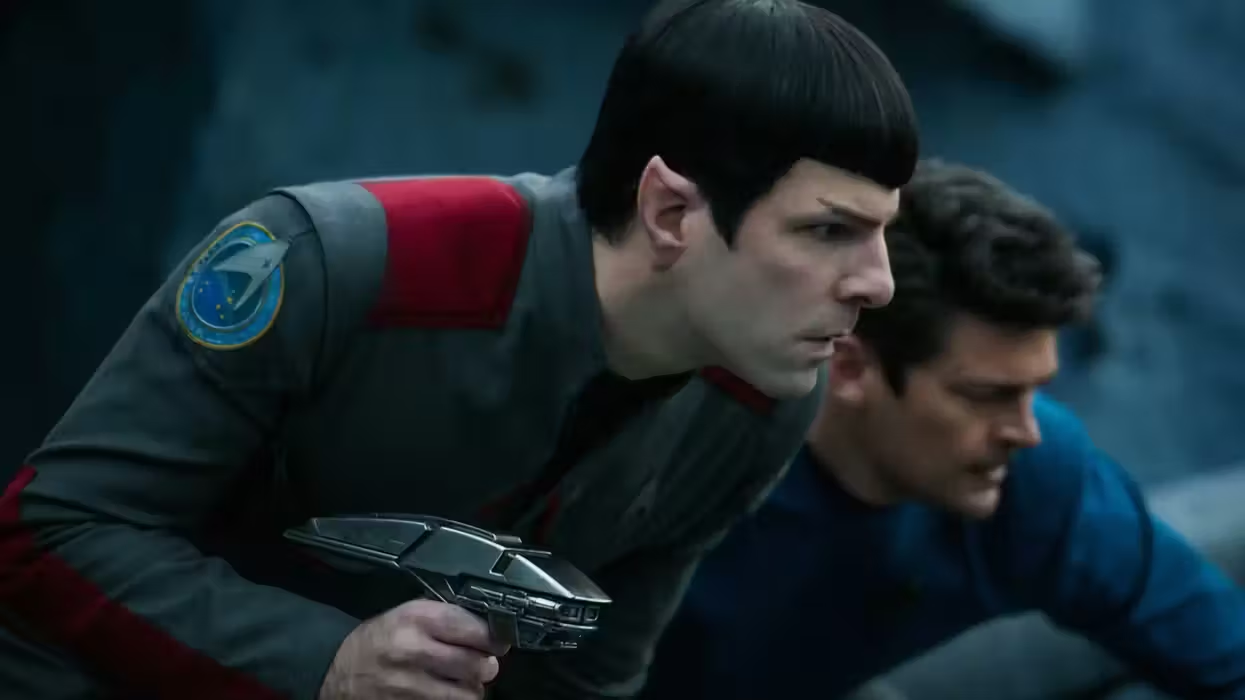
'Star Trek'
Making a movie is like a relentless onslaught of problems you have to solve, sometimes in real time. You are constantly making choices on the page, on the stage, and even with the budget and crew. It's this beautiful cacophony of balancing what you want to do and what you need to do.
In those moments of chaos, I always try to find peace and just center myself on a Vulcan line from the 2009 Star Trek movie that has always kept me coming back for more.
It actually perfectly captures the painful reality of the creative process, even though that's not really what it means in the movie.
Let's dive in.
- YouTube www.youtube.com
The Scene in Question
As I said at the top, filmmaking and creativity in general are chaotic. It's swirling ideas in your head, and you are just trying to reach out and grab the right one.
So how do you know what's the right path to follow?
Take this wisdom from the 2009 Star Trek reboot, written by Roberto Orci and Alex Kurtzman, and directed by J.J. Abrams.
Throughout the film, Spock (Zachary Quinto) navigates intense internal friction, constantly struggling to balance his human emotions with his Vulcan logic.
His mother was a human, and his Dad is on the Vulcan council. He wants to shelve his emotions and just fit in with the Vulcans where he was raised, but his time spent with humans on the Enterprise and in the Starfleet Academy has shown him the complete opposite side.
That struggle reaches a breaking point when his home planet, Vulcan, is completely destroyed by the antagonist Nero, who kills Spock's mother.
Spock attempts to maintain his command of the USS Enterprise by repressing his grief, but after being provoked into an emotional outburst by Kirk, he steps down and finally admits he is emotionally compromised.
So what is a Vulcan to do? He seeks out advice from his father, who is stoic throughout the movie and is sort of the paradigm of the Spock he wants to be.
But in that moment, we're going to get a better look at what makes a complete person (or Vulcan).
Spock finds himself alone with his father, Ambassador Sarek (Ben Cross), who counsels him about his outburst. Spock has been taught to suppress his human side, and losing his emotional control feels like an outright failure of his Vulcan training.
But their conversation unlocks one thing I believe about the creative process, and also about what it means to be human.
The convo goes like...
Sarek: Speak your mind, Spock.
Spock: That would be unwise.
Sarek: "What is necessary is never unwise."
The Takeaway for Filmmakers
On the surface, Sarek is speaking about confronting grief and allowing yourself to be vulnerable. That's all the stuff you can work out in therapy.
This is a filmmaking website, so I'll make it all about us instead.
To me, this is a masterclass in creative decision-making.
No matter if you're writing, directing, or producing, you will constantly face moments where "the necessary choice" feels terrifying.
Should you cut a scene, change the blocking, or just eliminate all the dialogue? Can you change the location for budget reasons or nix more characters?
Every single day on set or in front of an edit bay or screenplay is full of killing your darlings and also making many more hard choices.
It might mean acknowledging a massive flaw in your script, having an incredibly awkward but essential conversation with a collaborator, or stepping aside to let someone else's idea take priority because it's what is best for the project.
In those moments, I find it best to try to balance my human emotions with being a Vulcan. You want ot remain calm and calculated, but you also want ot feel.
The reason film art connects with so many is that it gets made because it hits on an emotional level. But if you're only emotions and no logic, the practical things won't get done that can bring those powerful feeligns ot the screen.
Sarek’s wisdom reminds us to reframe that anxiety into understanding that the necessary steps may be hard, but they are still worth doing and caring about because they make us, and our projects, that much better.
Summing It All Up
Filmmaking is not easy, and the marathon we run to be a success can be a real slog. But despite all that, the emotionality and struggle are beautiful and feel triumphant when you choose what has to be done and do it.
Protect the core of your film, but be willing to accept the structural compromises or difficult conversations required to get it across the finish.
What is necessary is never unwise...even if it might suck to do. You and your work will be better for it.
How do you handle brutal cuts or logistical compromises on your own projects?
Let us know in the comments below!