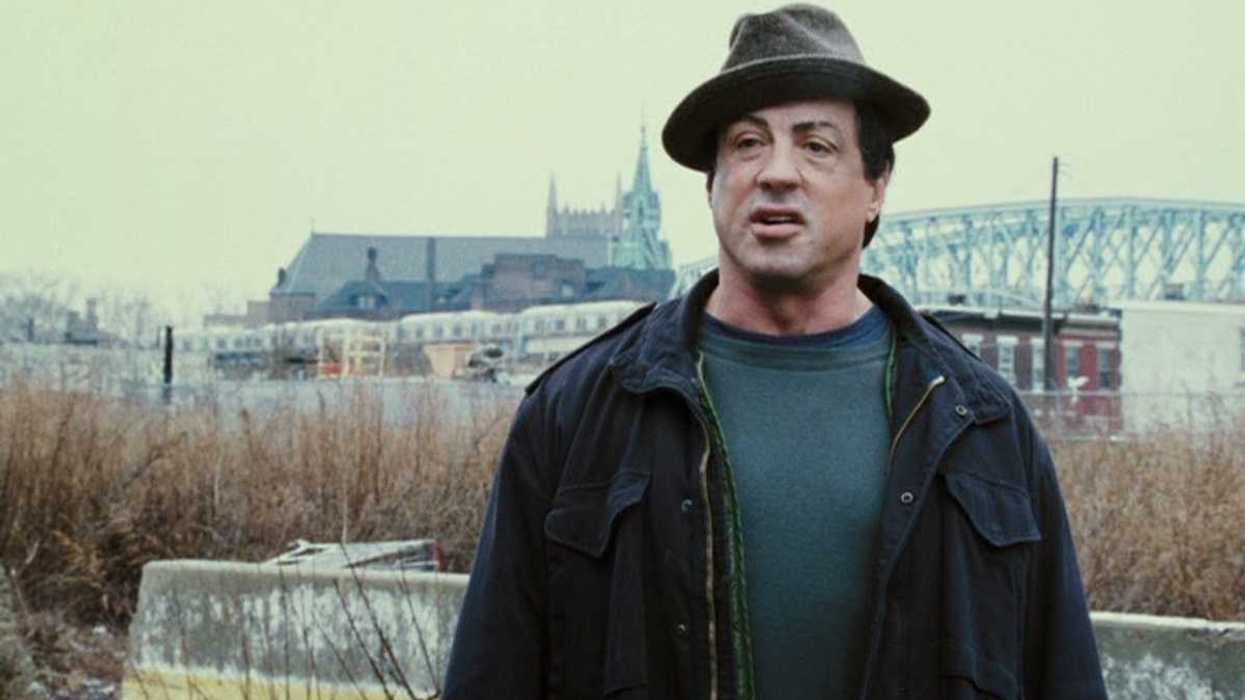
There have been many iconic and inspirational lines in sports movies, but the ones in Rocky Balboa just hit so hard.
He is the ultimate underdog who has defied the odds time after time. So when he stops, clicks his tongue, and gives a speech in the middle of the road, you'd better buckle up and listen.
We are talking about an intimate moment between a father and his son from Rocky Balboa that sums up Rocky’s own journey: ”It ain’t about how hard you hit, it’s about how hard you can get hit and keep moving forward.”
Let’s break down this speech that pumped a whole generation with hope and resilience.
A Little About the Story
 'Rocky Balboa' (2006)Credit: Metro-Goldwyn-Mayer
The 2006 Rocky sequel, Rocky Balboa, marks the return of the beloved underdog. Balboa, retired from boxing for years now, runs a small Italian cafe that he opened with his wife, Adrian (Talia Shire), who’s no more.
An older man now, who dearly misses his wife, Balboa spends his days telling stories of his days of glory to his customers while quietly trying to mend his strained relationship with his only son, Robert Jr. (Milo Ventimiglia), in vain.
That’s until a sports channel airs a computer-generated simulation between Rocky (in his prime) and the current undefeated heavyweight champion, Mason (Antonio Tarver), which suddenly brings Balboa back under a lot of media attention.
As the world gets divided between the two fighters, Balboa tries to remain unbothered but eventually realizes that for him, this fight against Dixon is less about showing an opponent down, but more about dealing with something buried deep inside, or as he calls it, “Stuff in the basement.” So, he applies for his boxer’s license. While the board is skeptical about allowing him back into the ring, now that he is older and out of touch, they eventually give in.
An exhibition match in L.A. is scheduled between Dixon and Balboa.
The Context of the Scene
While Rocky’s fans are ecstatic about his return, the one person who Rocky actually cares about is very upset with his decision. Robert Balboa, his son, strongly believes that his father is being extremely whimsical, egotistical, and childish in challenging an undefeated heavyweight champion to a boxing bout at an age when he is completely out of touch with the sport.
The continuous media coverage and public conversations about his father are affecting him negatively. Robert Jr. feels that his father’s stubbornness is bringing shame and embarrassment to the whole family.
The Scene
 'Rocky Balboa' (2006)Credit: Metro-Goldwyn-Mayer
It’s a beautiful evening. Balboa is entertaining guests at their Italian cafe when Robert walks in, looking to speak to him privately. He is here to convince his father to give up the fight.
The two walk out of the cafe, and Robert immediately brings up the fight. Rocky tells him that he will start his training for the bout the next day.
I’m scared to death,” Rocky confesses before his son.
“You don’t look scared,” says Robert.
“You ain’t supposed to,” Balboa replies, casually.
“You don’t have to do it,” says Robert.
“Yeah, well, I think I do.”
Rocky’s response triggers Robert, and he immediately lashes out at his father, complaining how he never got a chance to have an identity of his own, because his father’s image always overpowered him. He admits to being embarrassed by his father and almost threatens him to give up on the fight, to spare him the embarrassment of Balboa’s obvious defeat in the ring.
He tries to remind Balboa that people will talk about this foolish act of arrogance and that he must think of his son’s reputation in society, if not about his own self-respect.
Rocky is stumped by his son’s reaction. The grief on his face is clear. He takes a deep breath and responds to his son.
The Monologue
 'Rocky Balboa' (2006)Credit: Metro-Goldwyn-Mayer
It’s a one-minute-long monologue, where Balboa talks about the hopes and dreams that he had for his child. He tells Robert about how he and his mother believed that Robert would have the strength in him to be his own man when he grows up.
But as he grew older, Robert changed. He started allowing others to tell him, “you’re no good,” and when things got hard, instead of facing life, he “started looking for something to blame, like a big shadow.”
The next few lines are not for Robert alone and feel like a smack in the head—
”You, me, or nobody is gonna hit as hard as life. But it ain’t about how hard you hit, it’s about how hard you get hit and keep movin’ forward. How much you can take, and keep movin’ forward. That’s how winning is done!
Now, if you know what you’re worth, go out and get what you’re worth – but you gotta be willing to take the hits. And not pointin’ fingers sayin’ you ain’t where you want to be because of him or her or anybody. Cowards do that, and that ain’t you! You’re better than that.”
The last line in Balboa’s monologue literally gives me goosebumps, every single time, “But until you start believing in yourself, you ain’t gonna have a life.”
Rocky says his piece and walks back to the cafe. The father and son look at each other one last time.
Analyzing the Legend’s Wise Words and the Impact of the Scene in the Narrative
 'Rocky Balboa' (2006)Credit: Metro-Goldwyn-Mayer
The Impact of the Scene on the Narrative
I’d like to begin with the beauty of this scene’s mise-en-scène. The father-son duo walks out of a noisy place and is having a one-to-one conversation, when the son begins lashing out at his father.
As Robert finally stops accusing Balboa, waiting for his father to respond, we see that they have arrived at a crossroads—Balboa standing right in the middle of it. They are all alone.
After Rocky speaks his heart out, he walks away, walking past Robert, back to the cafe. He stops to give him one last look before walking inside, symbolizing that his professional choice isn’t in conflict with his personal.
The moment marks a pivotal change in Robert’s arc, as he truly understands his father and a long-lost champion, who’s desperate to make a worthy comeback. His father’s words cut through his conscience like a dagger, and he realizes that he was looking at life in the wrong way.
The next morning, he meets his father at his mother’s grave, and the duo mend their differences and reconcile.
Robert quits his job to support his father’s comeback, accompanying him every step of the way.
The Wise Words
In this monologue, Balboa is not only talking to his son; he is also reminding the viewers what it means to be alive.
Life is not a bed of roses, and more often than not, life will prove itself to be a bigger opponent than any self-proclaimed opponent or rival that you will ever have in your life.
The trick is not in chasing strength only, but chasing perseverance because ”It ain’t about how hard you hit. It’s about how hard you get hit and keep movin’ forward. How much you can take and keep movin’ forward. That’s how real winning is done.”
Balboa urges his son (and us) to give up on the tendency to look for someone else to blame for setbacks. When you stop the blame game and take accountability for your state in life, that’s when you start living.
Summing Up
Rocky Balboa explores themes of courage, determination, and perseverance through one of the greatest underdog characters in movie history, who taught us to dream big and go after them.
Which is your favorite movie in the Rocky franchise? Let us know in the comments.
- Analyzing The Story Map: The Original Rocky Script ›
- Rocky Balboa vs. Adonis Creed — Immigrant Dream vs. Inherited Legacy In Film ›
- How 'Rocky Horror' Invented Interactive Cinema ›
- Ranking the 'Rocky' Movies In Order of Greatness ›
- Rocky Isn’t a Movie About Boxing: Why It’s Actually Hollywood’s Greatest Character Study ›
- How Sylvester Stallone Fought to Keep the 'Rocky' Script From Being Sold Without Him ›
- Rocky's Iconic Training Montage That Changed Movies Forever ›
- 8 Iconic Sports Movie Speeches Still Give Us Goosebumps Decades Later ›
- “If He Dies, He Dies”—The Most Cold-Blooded Line in the ‘Rocky’ Franchise ›
- What is necessary is never unwise. ›