7 Writing Tips From Anne Lamott
Advice from the celebrated writer whose sense of humor and relatability are her biggest assets.
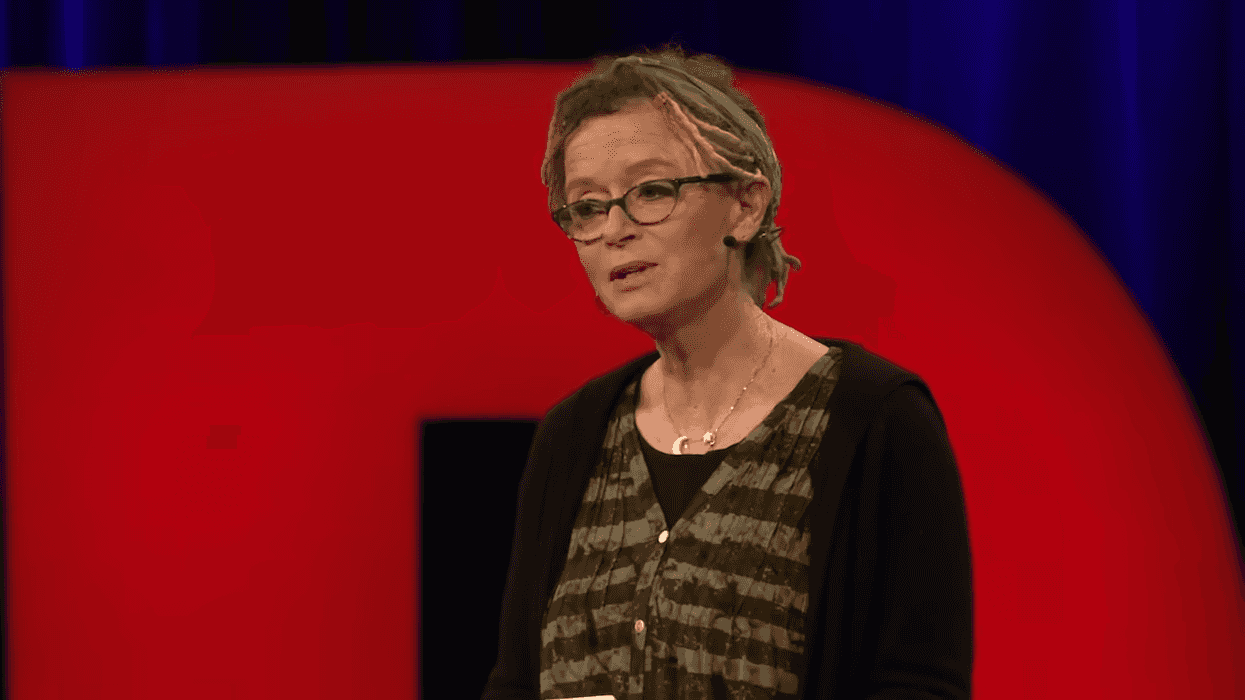
Anne Lamott during her TED Talk
I became a fan of Anne Lamott after reading Hard Laughter.
The book follows the catastrophic journey of a 23-year-old writer (and part-time house cleaner), Jeniffer, who has just discovered that her beloved father, Wallace, is battling a brain tumor.
Hard Laughter is unexpectedly sweet and divinely humorous. I related to it, especially because I’m the kind of person who makes jokes at the most inappropriate moments. But when I saw some of her interviews, I was charmed!
Humorous and sensitive, Anne Lamott is widely known for her warm, conversational, and deeply honest writing style. Her self-deprecating humor, which seamlessly blends with her personal struggles, feels like a warm blanket on a winter afternoon. Her stories are so relatable that you feel safe with her book, almost as if you are confiding in her.
Lamott’s writing tips are uniquely quirky. In this article, we’ve compiled some of her best writing tips, exploring her perspective on how to become a great writer.
7 Writing Tips From Anne Lamott
1. Set Yourself a Writing Time
In her Facebook Live interview with TED, Annie shared how she is the kind of writer who thrives on structure. She said that discipline feels like freedom to her.
At the Point Loma Writers' Symposium By the Sea in 2014, Annie further shared how she forces herself to write and doesn’t wait to be inspired. She made herself write even during one of the most chaotic and busy phases of her life, when she was taking care of her children, grandchildren, and two pets, one of which was ill. All she had was three hours in the morning (9 to 12 p.m.), but she did it every day.
Funnily calling herself “a dog with a chew toy,” Lamott said that she is one of those writers who is easily distracted and quite chaotic in her process. When she is at that desk, her butt glued to the chair.
“I’m strict with myself. I’ll be strict with you. I would say, you know, just do it, you’re gonna feel so great all afternoon if you get your work done today,” Lamott said at the symposium.
Don’t wait for a time to feel good about writing.
“No writer ever sits down and has a good feeling about themselves,” Lamott added in her Facebook Live.
2. Where To Start?
Not knowing where to start is a natural feeling. To those who often struggle to find a start, Anne recommends looking into their own life experiences so far.
She said in her 2024 TED Talk, “Remember that every single thing that happened to you is yours, and you get to tell it.”
She added, “You're going to feel like hell if you wake up someday and you never wrote the stuff that is tugging on the sleeves of your heart.”
At the same talk, she commented in her typical dry humor about where to start with writing characters. Look at the people around you.
“If people wanted you to write warmly about them, they should have behaved better.”
This always lingers in my mind as I develop characters. I find that it broadens my understanding of the nuances of my characters’ shades of gray.
3. Lamott’s “Lily Pond”
Imagine you are standing on one side of a lily pond, and to cross it, you need to step onto different lily pads, one by one. You can see multiple lily pads floating on the water's surface.
In her 2017 Facebook Live interview with TED, Lamott likened a piece of nonfiction to a lily pond, with the floating lily pads representing the beats of the story.
She says that when she starts a piece of fiction, she buys poster-sized graph sheets, where she draws huge circles between points A and B. Even if she is not sure where it ends, she decides on the closest ending and returns to the beginning to fill in as much as she already knows about her story.
If there are certain points she wishes to touch base on, she scribbles her ideas around the lily pads to keep them together visually. Once done, she trusts the process to guide her.
Not every idea is supposed to work.
“You try something, it doesn’t work, it doesn’t mean you’re a morally inferior person,” she says. “It means that now you know what the thing isn’t, and you can take it out. Try again.”
4. Take Inspiration From Real Life and Then Try to Give It a Third-Person Lens.
At the Writer’s Symposium by the Sea, Lamott talked about how she got her inspiration for one of her stories that was about a man who hurt his dog.
Although that was quite an unpleasant experience for her during a family vacation, it was a story she wanted to tell.
“Usually I’m just having a life experience, and, and, later, it’s like a new pair of glasses. You get a tiny bit of distance from it.”
Then she decides whether it is a strong enough story to tell. If it is, then it is bound to have a meaning.
“If you’re not finding it, it’s because the story is not over.”
5. Sit With Your Verb
Lamott recommends brewing on the verbs of the story. At A Writing Room’s first writing retreat, she said, “So you find your verb. You work with it. You wait, you sit there quietly [with it].”
According to Lamott, your verb speaks a lot. She explained this at the same seminar with a hypothetical example—“My mother walked towards me.”
She suggested not just writing “walked.” Try to identify the exact kind of verb that describes the action. Did she stomp? Did she rush? Did she glide? That reveals a great deal about what’s happening and what is about to come next.
6. Pick Up on the Seemingly Invisible or Insignificant
Lamott believes that as writers, our job is to try to see beyond the visible, keenly picking up on things that non-writers usually miss.
To her, the process is this: “To see the bleak, unspeakable stuff and the wild, lovely stuff that no one else noticed and to turn it all into words” (via A Writing Room).
Lamott also believes that this can only be done in its truest essence when a writer finds their authentic voice.
She says her favorite writing prompt is, “There is a tree.” From there, she suggests closing your eyes, imagining all the possibilities around it, trying to figure out, beat by beat, what happens next.
7. Almost Everything Will Work Again if You Unplug It for a Few Minutes, Including You
This advice comes from her TED Talk. Honestly, I’ve tried this a couple of times and it has worked wonders.
Lamott said, “Every writer you know writes really terrible first drafts, but they keep their butt in the chair. That’s the secret of life. That’s probably the main difference between you and them.”
So maybe if you’ve hit writer’s block, or are continuously getting inadequate ideas to fill in your “lily pads,” try unplugging for a bit to reset.
Which of these tips do you think will work for you?