I've been on a war movie kick recently, not for any particular reason, but it's been interesting to see how different global conflicts have been featured on film.
Now, it would not surprise you to know that both World Wars have many movies about them, and many of those films share the same tropes and ideas. But also, they share the same visuals as well.
It's actually pretty interesting to see how directors handling World War I versus World War II manipulate visual space in fundamentally opposite ways in order to show the conflicts on screen.
Let's dive in.
World War I: The Micro-Scale of Claustrophobia
If you know nothing about World War I, I suggest you go watch the amazing Peter Jackson documentary, They Shall Not Grow Old. It's so amazing, and it taught me so much about trench warfare and the conflict.
One thing that defined all of World War I was the horrific conditions. This was a war fought in muddy trenches and dangerous open fields called "No Man's Land."
At the time, they called it The Great War, but it was mostly defined by people holding ground and inching forward.
In order to show this reality, we've seen the conflict almost exclusively handled with micro-scale and tight spatial framing.
Hear me out...
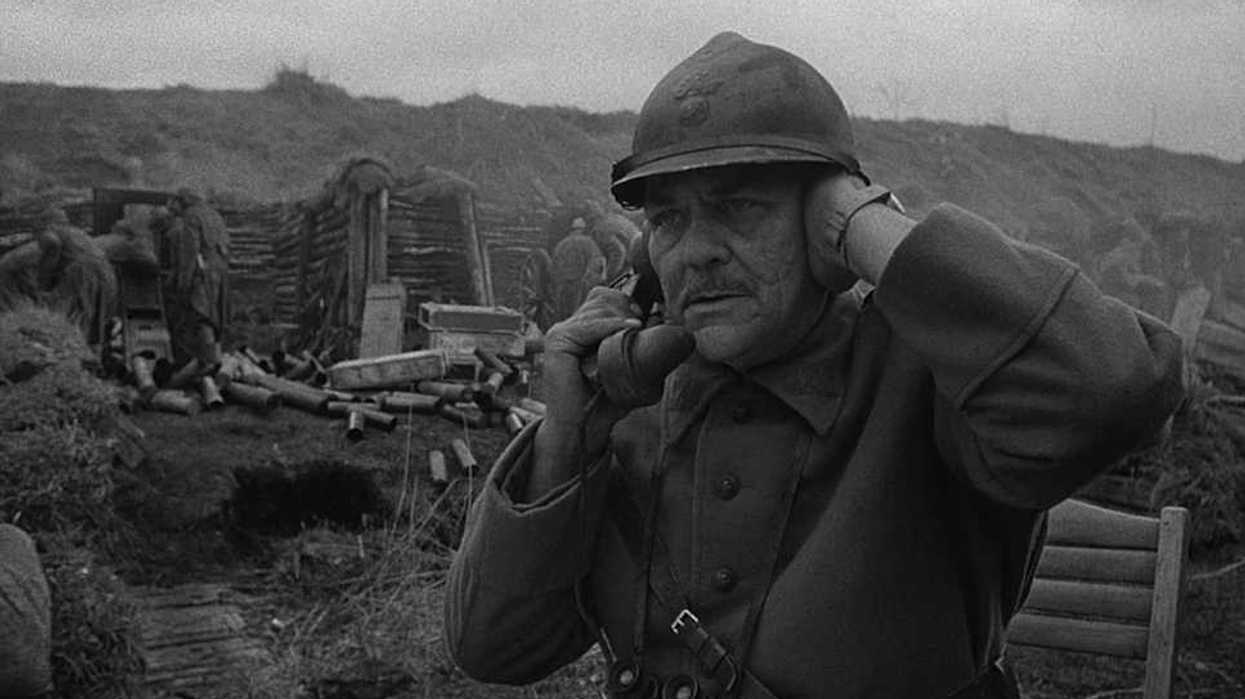
- Lens Choice & Compression: In Stanley Kubrick’s Paths of Glory, we see those famous tight tracking shots that follow Kirk Douglas through narrow trenches. There, the men are compressed, and so is the action; even when bullets are flying, we're never really seeing much aside from the aftermath. We're suffocating by dirt walls. Even modern entries like Edward Berger’s All Quiet on the Western Front (2022) use wide-angle lenses close to actors’ faces. This forces the viewer into the claustrophobic mud alongside them.
- The Void of No Man's Land: If you want an exception to the tight spaces, you can see it in some of the scenes in Sam Mendes’ 1917. But since we have this continuous-shot trick, we're only ever seeing wide-open spaces as they reveal themselves to our characters or get uncovered by them. In addition to that, Deakins frames No Man’s Land as an endless void. You also get these shots in Peter Weir’s Gallipoli; the open terrain of the Nek becomes a terrifying bottleneck where space offers zero cover. You cross, you die.
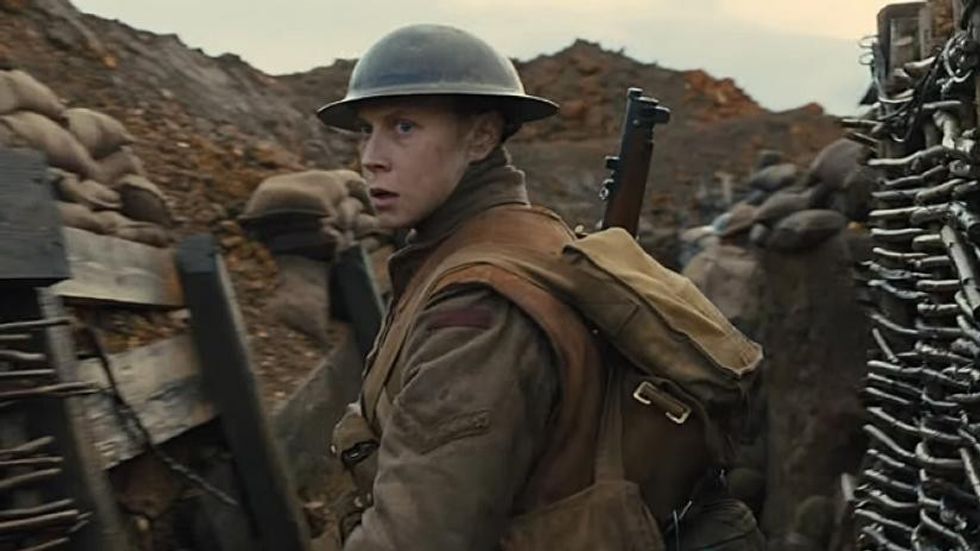 '1917' Credit: Universal
World War II: The Macro-Scale of Global Scope
Now, I am much more familiar with World War II movies. And I think that's because there are just so many of them. This is definitely the most popular war to put on film, and I think for many of our older directors, this was the war they grew up hearing about. So there's a certain mystique to it.
At its core, World War II was a war of global movement. Not of inches, but of miles. We saw mechanized armor crossing vast plains, paratrooper drops, massive armadas crossing oceans, and multi-theater campaigns on each side of the globe.
We also got an atomic bomb dropped as well.
The stakes, scope, and scale feel massive, and the stories and visuals have to live up to our grandiose ideas of this war, which has clear good and evil at its center.
Scale in WWII cinema is inherently expansive.
- Panoramic Canvas: Directors rely on deep focus, extreme wide shots, and large-format capture to show sweeping operational scope. Christopher Nolan used 65mm IMAX cameras in Dunkirk to capture open beaches and dogfights in clear skies. Terrence Malick’s The Thin Red Line uses ultra-wide landscape shots of Guadalcanal to dwarf human conflict against the scale of nature. We're always given these expansive views, like in Atonement's beach scene, where we see the breadth of what has been happening and have to reconcile it.
- Multi-Axial Depth: WWI blocking is largely linear. We see soldiers moving straight down a trench or over the top and onto No Man's Land. But that's not how WWII was fought. In those WWII combat scenes, we focus on people coming into towns or across beaches or riding in tanks over fields and streams. Take Steven Spielberg’s Saving Private Ryan Omaha Beach landing. It operates on multiple visual planes simultaneously. We see foreground infantry dodging obstacles, midground landing craft taking hits, and background naval bombardment hitting the bluffs, all in succession. He cuts between them to tell a much bigger story and to paint a wide picture of what the landing looked like. Then he anchors these visuals in the advancement of one boat and its members, as they walk through all of it, eventually coming back over to the wide shot to settle on one dead soldier, which sets the narrative.
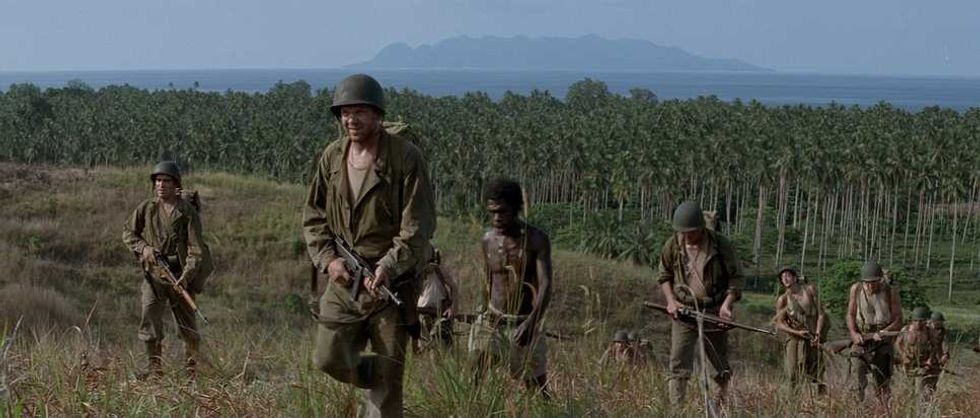 'The Thin Red Line' Credit: 20th Century Fox
Summing It All Up
Let me know what you think in the comments.