Film Quote of the Day: Val Kilmer's Iconic Dialogue That Turned Rivalry Into Respect
"You can be my wingman anytime." - Iceman
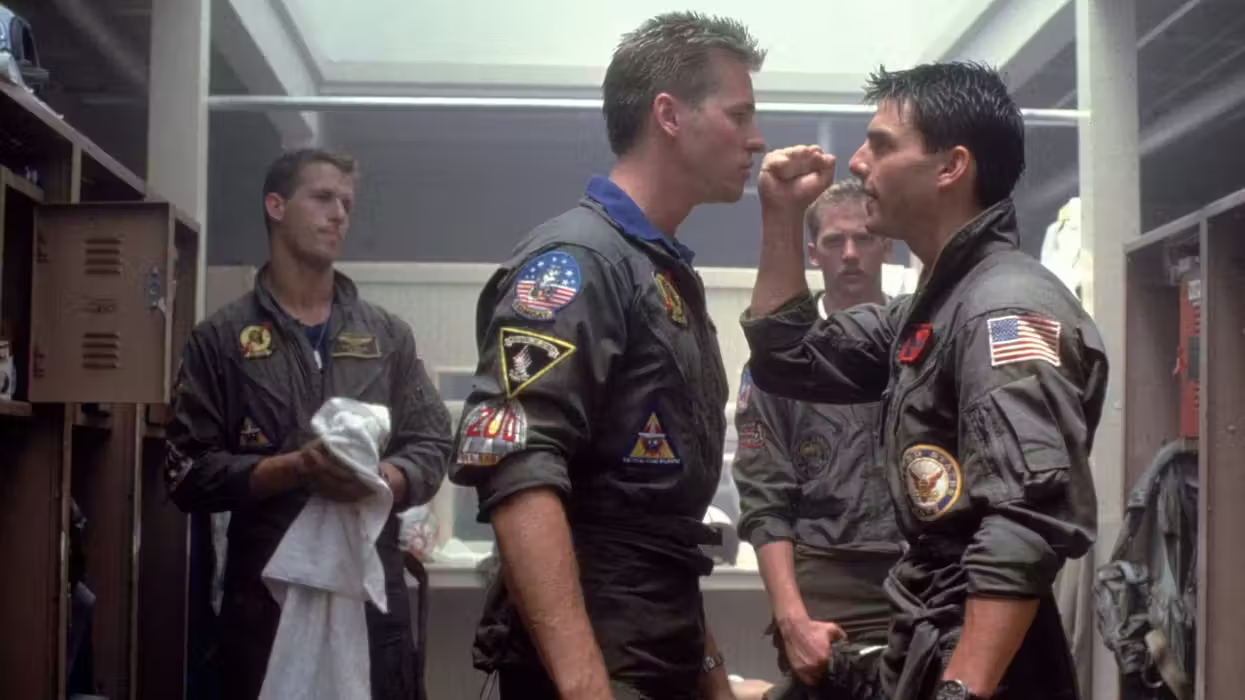
'Top Gun'
Sometimes, you just need the warmth of a classic summer blockbuster to keep you entertained, and that's why I threw on Top Gun the other day.
I am always in awe of Tony Scott's 1986 jaunt through the skies. You can get lost in the roaring adrenaline of the jet engines and the sun-drenched, high-contrast cinematography.
But this is a movie with deep feelings as well.
Now, I think we all remember the volleyball scene and the technical marvel of the aerial dogfights. But today, I want to talk about the movie's emotional climax.
That's right, I want to dig into an unlikely friendship that becomes the core of the film and shows a mutual respect that can elevate above a rivalry.
Let's dive in.
- YouTubewww.youtube.com
The Scene in Question
Top Gun is a movie about male bravado as a metaphor for America. Can we put all that swagger behind us when the world calls for us to work together to defeat an enemy that needs us to crack and break in order to exploit our weaknesses?
At the core of this move are Iceman and Maverick, two guys kinda cut from the same cloth emotionally, who are trying to figure out whether they hate each other or not.
These are guys who are all fighting for the same side, but whose machismo gets in the way of them getting along. It's all about competition, and every man for himself.
But the main lesson here is that in the air, you need someone watching your back.
On one side, you have Pete "Maverick" Mitchell (Tom Cruise). What can we say about him? He's reckless and driven entirely by emotion and dangerous instinct.
On the other hand, you have Tom "Iceman" Kazansky (Val Kilmer). That guy is tall, handsome, and likes to do things by the book.
Both of them want to be the top airman of their class.
Stakrs get real when they go to war, and they see fellow classmates dying for something bigger than both their egos. These are real-world warzones with real-world consequences.
Their dynamic is defined by sharp confrontations and classic character-archetype friction. But it all culminates on the flight deck after the film's final, lethal dogfight.
Facing down actual enemy bogeys, the two are forced to rely on one another and not to let their egos take over.
Maverick saves Iceman's life, and once they're back on solid ground, Iceman cuts through the noise of the celebrating crowd to deliver his final verdict:
Iceman: "You can be my wingman anytime."
Maverick: "Bullshit. You can be mine."
- YouTubewww.youtube.com
The Meaning of a Wingman
The whole movie is about trust and accountability. When you are flying a multi-million dollar jet at Mach 2, your belongings belong to the person flying next to you.
Getting that onto the page is what makes this screenplay pop, and what gives both Cruise and Kilmer something to grab onto while they fight in earlier scenes. They know there's a natural culmination coming.
When you look at how to write a scene that resolves a major narrative arc, you have to look closely at the subtext.
Throughout the script, the word "wingman" is established as the ultimate metric of professional and personal respect.
This movie is going to be about the power of two, not of just one. So how do you arrange for both guys to meet at one place? Well, you start with them apart and then design scenes and stakes, then keep pushing them together.
When Iceman calls Maverick his wingman, it's an admission that his worldview has fundamentally shifted. And even when Maverick retorts, it's with a smile, signaling the same shift in his persona.
The underlying mutual respect gives us an ending we can believe in.
The Takeaway for Screenwriters
This is a great movie to watch for writers who want to study how to write tight, efficient dialogue during major character turning points.
We got a plant and payoff with the wingan idea, and then clear arcs that actually subvert archetypes and lean into a catharsis for these guys.
Here are a few things I wanted to highlight for my writer pals:
- Find Your Metric of Trust: Establish a specific motif early in your script that represents the ultimate bond between characters. By the time you reach the climax, a simple acknowledgment of that term can carry the entire emotional weight of the journey.
- Keep the Friction Alive: A resolution doesn't mean your characters have to become completely different people. They just need ot have come to terms with an internal struggle that makes them more complete. The banter between Maverick and Iceman works because the competitive spark is still there.
- Cut to the Essentials: If an emotional climax feels bogged down, try stripping away the exposition. See if you can let a single, earned line do the heavy lifting.
Summing It All Up
Top Gun became part of the cultural lexicon and also made a huge imprint on Hollywood. It's no wonder years later its sequel saved theatrical exhibition and reminded us of the power of cinema.
Well, none of that could have been possible without this original movie finding its heart and giving us a line that completes two great arcs.
Let me know your thoughts on this iconic exchange in the comments below!