The Greatest Cut in Cinema: Why the '2001: A Space Odyssey' Bone Cut is Perfection
Stanley Kubrick brought philosophy to the process of film editing.
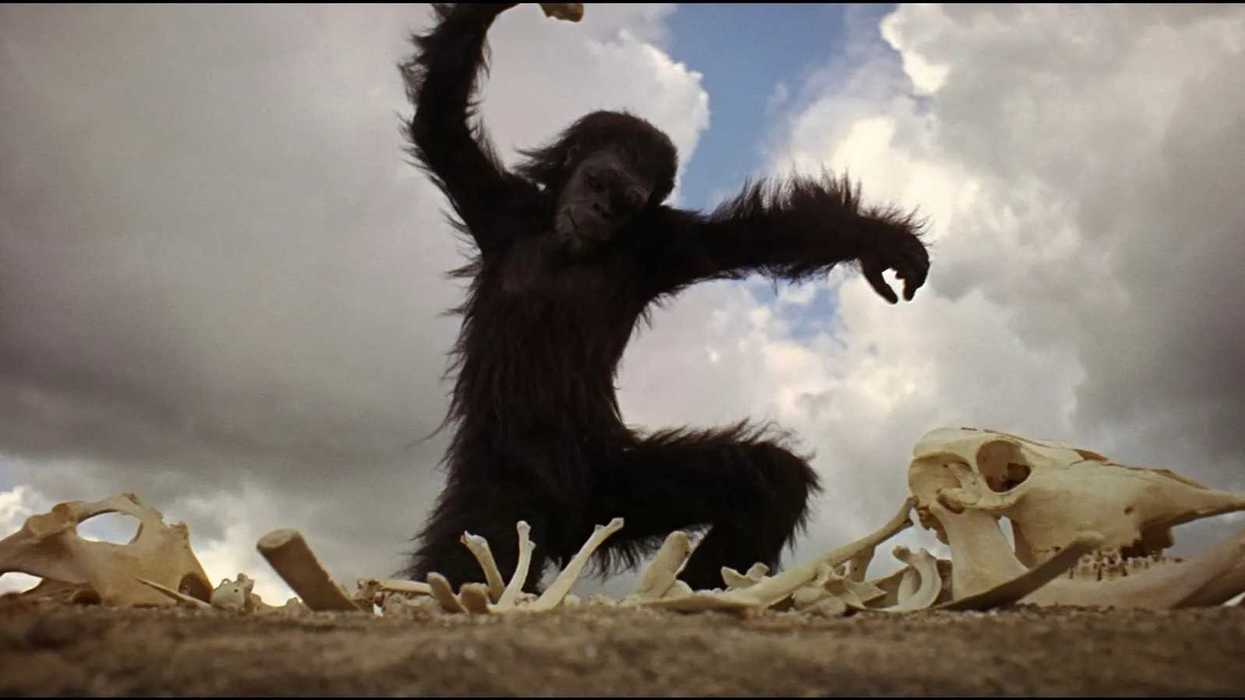
'2001: A Space Odyssey' (1968)
In 2001: A Space Odyssey (1968), Stanley Kubrick compressed human evolution into a single, audacious, and mind-blowing edit. This single cut, squeezed over millions of years, with a wordless transition that most wouldn’t even dare to imagine.
Stanley Kubrick bridged prehistoric realities with the sophisticated complexities of our future, and without any dialogue, depicted the arc of human ambition. By turning a primitive weapon into a spacecraft, he bridged two bafflingly unrelated and distant eras: from the first tool that enabled survival to the pinnacle of space exploration.
While this obviously captured the essence of human ambition, it also spoke volumes about the filmmaker’s own ambition: limitless, fearless, and unrelenting.
What makes this edit the greatest edit in film history? What can it teach us about the audaciousness of artistic expression?
Let’s jump right in.
Why This Is The Greatest Edit In Film History
This edit occurs very early in the film and serves as an iconic transition between the “Dawn of Man” sequence and the modern, spaceship era, where the film spends the majority of its runtime. An ambiguous monolith inspires the leader of the ape tribe to discover a bone as a tool. He uses it to smash bones for meat and to kill a rival ape, capturing the bare violence of the prehuman era with ruthless cinematic expertise.
During what feels like a triumphant moment, the ape hurls the bone high into the air, where it spins and cuts precisely with the visual of a long, slender spaceship, millions of years into the future. The audaciousness of the cut lies in its very imagination.
While it is revered today, the very idea leading to the attempt, let alone pulling off an edit such as this, stood the risk of being misunderstood or even ridiculed. But Kubrick never let that deter him from shooting and editing it with precision.
Editing is undeniably crucial to the process, but few edits in the history of filmmaking feel as philosophically charged as this one. The ambition and audacity aren’t just related to the physicality of the cut but the very thought behind it. While mentioning the timeline in the lower-thirds of the screen is considered a norm, Kubrick took a completely different route. He let his edit encapsulate a seismic generational shift, without relying on simplistic, commonly followed procedures.
In terms of the edit itself, the shapes of the bone and spacecraft align graphically in terms of their form and their direction. The shift is endlessly imaginative and carries a deep sense of urgency in how it teleports the viewer from one era to another, skipping so much of what happened in between through a single edit.
Artistic Bravery & Doing The Unthinkable
Before an artist does the unthinkable, they have to imagine it. This act of imagination or conception itself requires tremendous bravery, especially on a scale as massive as that of 2001: A Space Odyssey. Stanley Kubrick is one of the most ambitiously fearless filmmakers in the history of cinema, so as pathbreaking as this edit is, it isn’t surprising that it came from his film.
Kubrick did the unthinkable by making the film’s timeline leap across millions of years in a single, silent edit. In 1968, when most filmmakers relied on dissolves, montages, or even voice-over bridges between timelines, Kubrick trusted the audience to perceive a colossal leap in time through a single masterful editing decision.
As viewers, we are accustomed to being directly informed about a timeline jump either through text or an obvious visual change. Kubrick skipped the text and embraced the visual change with the help of a match cut, which served as a bridge between two timelines that are rarely even mentioned in the same sentence.
This brave edit and the intentional “jump” it makes us feel, in a few seconds, speaks volumes about the concept of evolution without using a single word. Instead of telling us “what happened”, the cut makes us feel it. The brilliance of this forced perspective sort of thought process lies in how subjective each viewer’s perception would be. We all perceive time changes differently, whether it's about a single day or about the change of eras. This edit invites viewers to bring their own imagination and ideas of what evolution would mean through a bold, never-before-seen film edit that is rightfully considered the greatest in movie history.
Lessons For Filmmakers
The list of what filmmakers could learn from Stanley Kubrick is a very long one, but the list of what we can learn from this cut alone isn’t short either. Here are three such takeaways.
A Cut is More Than a Cut
While traditionally, an edit is used to move from one visual to the next, with this match cut, Kubrick taught us that it can do a lot more. If this weren’t a match cut, it would still be powerful because of how boldly it crosses generations. The fact that it is a match cut elevates its powers and makes the viewers more attentive towards the transition.
Complex Ideas Distilled into a Visual Change
The match cut prioritizes graphic continuity, making us perceive a complex, philosophical idea through an edit. The complexity of the thought behind this edit does not diminish its effect because the manner in which it is conveyed to us is not complex. Kubrick uses cinematic language to explore the vast differences between two contrasting eras without forcing these ideas through dialogue or text.
Can an Edit Capture What’s in Between?
I consider this to be the most intriguing aspect of this match cut. An edit in filmmaking, as we’ve discussed, takes us from one moment to another. But what about what’s in between? Think about it. With this match cut, Kubrick doesn’t just achieve a masterful transition; he lets our minds wander about the infinite possibilities that lie between both ends of the cut.
Final Thoughts
The match cut in 2001: A Space Odyssey is perhaps the greatest edit in the history of filmmaking because it does much more than what an edit was expected or understood to do. It captures an imaginably large generational shift, but also makes us wonder about the “in between”, thereby capturing the history of humankind with one single edit.
Which is your favorite Stanley Kubrick film? Tell us about it.
- What Are Stanley Kubrick's Best Shots? ›
- Remember When - Stanley Kubrick Rewrote the Future with 2001: A Space Odyssey ›
- The Opening Scene of '2001: A Space Odyssey' Just Isn't the Same with a Different Score ›
- Stanley Kubrick Explains the Ending of ‘2001: A Space Odyssey’ ›
- What Does the Ending of '2001: A Space Odyssey' Mean? ›
- Editing the Sundance Coming-of-Age Film 'Chasing Summer' | No Film School ›
- 3 Pillars of Editing: Cuts, Effects, and Motivation | No Film School ›
- Know These Terms: The Film and TV Editor Glossary | No Film School ›