Should You Turn the 180 Rule into a 360?
When disorientation is the point, the 180 rule can be ignored.
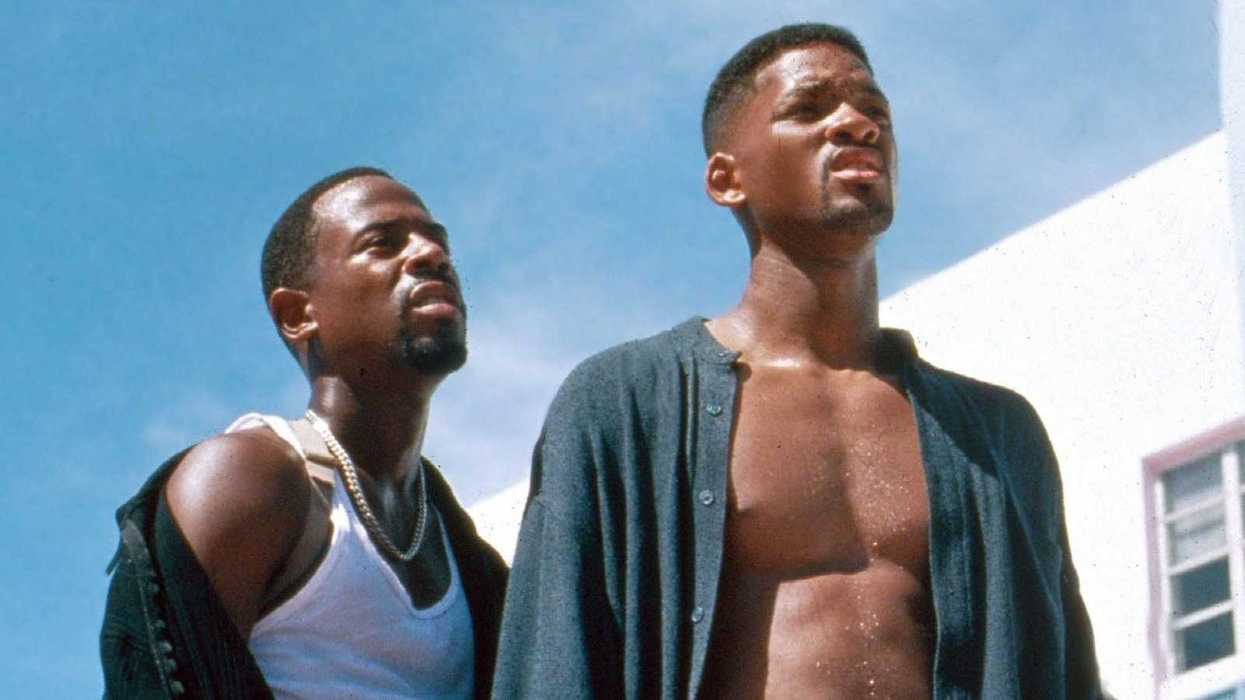
'Bad Boys'
If you get on a set and start to discuss shot ideas and camera set-ups with your DP, you might, in the moment, hear them say, "We can't do that. It crosses the line."
Not some metaphysical or moral line, hopefully. They mean the line that you establish to follow the 180-degree rule.
The 180-degree rule is one of the first things they drill into you when you're learning cinematography. Draw an imaginary line between your two characters, pick a side, and stay on it, so the audience always knows who's standing where and who's looking at whom.
If you break it carelessly, viewers feel off, maybe without even knowing why. It's disorienting. But it's also a rule you can unlearn once you understand what it protects.
In a recent Filmmakers Academy video, cinematographer Shane Hurlbut, ASC, breaks down a sequence from Waist Deep, directed by Vondie Curtis-Hall, in which a father named O2 (Tyrese Gibson) sprints through the streets hunting for his kidnapped son.
As the DP on this project, Hurlbut deliberately breaks the 180 rule, using the sequence to show how a DP can weaponize coverage to manufacture panic. See how it's done below.
- YouTube www.youtube.com
Start with a Feeling, Not the Shot
Camera, lenses, film vs. digital don't matter as much as what the scene hopes to accomplish. Hurlbut and Curtis-Hall decided what the audience should feel, then reverse-engineered the camera to get them there. What should the camera be doing to impart an emotion?
"Exhaustion is the first thing that comes to mind," he says, with loneliness and confusion close behind.
So the camera earns those feelings in stages.
It opens locked off and motionless while the sound design pushes O2's heartbeat to the front. Then a Steadicam eases in and accelerates, cutting between a tight lens and a medium one so the push never stops building.
"His world is swirling. The wheels are coming off," Hurlbut says, and that swirl carries the exhaustion inward until O2's point of view blurs out of focus, before a familiar voice snaps him back to Coco (Meagan Good).
This is all camera movement as emotion. It's motivated by the character's turmoil, not just moving the camera for the sake of moving.
The Camera's Emotion Should Have Peaks and Valleys
Hurlbut treats the whole sequence like a roller coaster. Obviously, a lot of this gets built in the edit, but you still need to capture the speed-ups and slow-downs on the day.
"Peaks and valleys are huge in creating great drama and great action," he says, because an audience that never gets to exhale eventually stops feeling the spikes at all. A movie or sequence can't be all go, go, go. The audience needs to breathe.
The brief calm as O2 finds Coco resets us for the next surge when she flees, and O2 pursues. This is just a second of stillness, and it's all we need.
You'll also want to consider that a lot of handheld on the big screen (if you're doing theatrical) can lead to motion sickness. I remember the complaints online when Cloverfield came out. So don't be shaking the camera willy-nilly.
Here, every push and every swirl is motivated by where O2's head is in that exact second, and the stillness is given just as much weight as the movement.
Go Handheld
When the chase reignites, the equipment serves the adrenaline. Hurlbut shot much of it on the compact ARRI 235, a small, light film camera that they chose so they'd be able to shoot handheld.
"Very small, lightweight camera, so we could run like hell," he says.
He also rejected the smooth float of a shoulder rig.
"I wanted the camera to feel not like perfectly handheld on a shoulder, but much more erratic," he says, so the operator worked all three axes to put a roll and a lurch into every step.
They also cut to a handheld overhead on a tighter lens, so the viewer still feels like they're an observer, even when you're not running with the character. Handheld comes across as aggression and immediacy, and here it doubles as desperation.
Confuse Viewers on Purpose
Hurlbut wanted viewers as lost as O2 as a character, so he asked himself how a cinematographer manufactures confusion, and pointed out two specific tools DPs can use.
First, his lenses. Shooting tight means you can't follow O2 cleanly from point A to point B, which constricts the frame and strips away the map of the space.
Second, and bigger, is "jumping the line." And he does it in this sequence again and again.
"But this is by design. We want you confused," he says.
Where a tighter lens crops you down to a claustrophobic sliver of the scene (meaning you can't see O2 running from point A to point B), breaking the line rule rips the whole floor plan out from under the viewer. One tool tightens the walls. The other makes the viewer wonder where the walls even are.
Turning the 180 into a 360
Normally you honor the axis so eyelines stay consistent and two people in a room feel like they're facing each other in a way that makes sense to the viewer. Hurlbut and Curtis-Hall ignored that.
They covered the O2/Coco confrontation from every direction. We see over O2's left shoulder, then his right, 50/50s from both sides. The screen direction keeps flipping, and your brain can't lock onto a stable geography.
Hurlbut describes it as turning the 180 into a 360, hopping the camera over one shoulder, then the other, until you're as unmoored as O2.
He brought the idea to Curtis-Hall in prep, pitched the double coverage and the constant line-jumping, and the director embraced it because the goal was understood and clear.
Look, technically you can jump the line whenever you want. But there's a good chance you'll get confusion that you don't want if you do it messily or in a way that's unmotivated. This is the kind of rule you break with a reason, or not at all.
"You feel confused, constricted, exhausted, and then alone," Hurlbut says. And that's why they did it.