What makes Francis Ford Coppola’s Apocalypse Now an extremely influential anti-war movie? Coppola’s masterful use of contrast and absurdism.
In between blaring gunshots and explosions, Captain Willard’s PTSD and Colonel Kilgore’s love for the smell of napalm, Kurtz's idealism, and the cabaret dance for soldiers right on the battlefield, Coppola brings us very near to the truth of violence, painting pictures of war deeply rooted in reality.
In this article, let’s examine how Coppola uses contrast and absurdism to bring out the innate surrealism of war in Apocalypse Now against the backdrop of the Vietnam War.
A Little About the Vietnam War
To catch the real meaning of Apocalypse Now, it is important to know the basics about the Vietnam War, so here’s a quick history lesson.
The Vietnam War lasted for over two decades, from 1955 to 1975. It took place shortly after World War II. The world was essentially split into two types of economic systems—capitalist and communist.
During the Cold War, many countries in the East of the globe began to adopt communism, which capitalist countries in the West interpreted as a threat, especially after China adopted communism in 1949.
After French rule in Vietnam ended around 1954, Vietnam was divided at the 17th parallel by the Geneva Accords into North and South Vietnam. North Vietnam, led by Ho Chi Minh, a communist leader, sought to unify Vietnam under a communist government; however, South Vietnam, led by Ngo Dinh Diem, opposed communism.
Invoking the domino theory, the U.S. extended diplomatic support to the latter to hinder the spread of communism across Asia.
The Vietnam War broke out in 1955 and soon escalated into a major war, with China and Russia supporting North Vietnam. The U.S. sided with the South and finally authorized military action in 1964, after the Gulf of Tonkin incident, when the U.S. misunderstood that they were attacked by North Vietnam at the Gulf of Tonkin. They entered the war without a formal declaration.
The Vietnam War is a bitter part of U.S. history, as the country was unable to keep up with the conflict’s guerrilla warfare, even with its high-end ammunition and war resources. This was the first time that the U.S. had ever lost a war in a different country.
The war had disastrous effects on the U.S. It was one of the longest wars ever fought in history and drained the U.S. both financially and socially. It was also among the first wars to be broadcast on television, bringing civilians face-to-face with the true nature of war. Protests spread as casualties mounted and the conflict dragged on with no clear objective. Young draftees, many barely out of high school, were sent to fight. The U.S. ultimately withdrew, making this the first major American military defeat.
Examining the Absurdism and Contrast in Apocalypse Now
Let’s study six important scenes, sequences, and elements from the movie to understand how Coppola uses absurdism and contrast to bring out the chaos of war in Apocalypse Now:
1. Captain Willard’s Introduction
Many war movies explore PTSD, but Coppola does it slightly differently. Throughout the narrative, we hear Captain Willard’s voiceover as he recounts his perspective on events that unfold as he is sent back to the battlefields in Vietnam. However, the absurdity lies in the perspectives of the people he interacts with.
After returning from his last military mission, Willard, waiting in his hotel room, shaken by the battlefield chaos, is selected for another mission.
Two officials arrive to deliver a letter and inform him that he is scheduled for a meeting.
The officials find Willard in ruins, but it’s not Willard’s beat-up condition that shakes us. It is the two officers' nonchalance toward his condition.
They try to reason with him for a moment or two and then pull him out of bed, drag him to the bathroom, and place him under the running shower.
2. Captain Willard’s Crew
Willard is assigned a top-secret mission to assassinate a former high-ranking military official, Kurtz, who has seemingly gone insane and subsequently gone rogue, running a cult that's interfering with the U.S. military strategies.
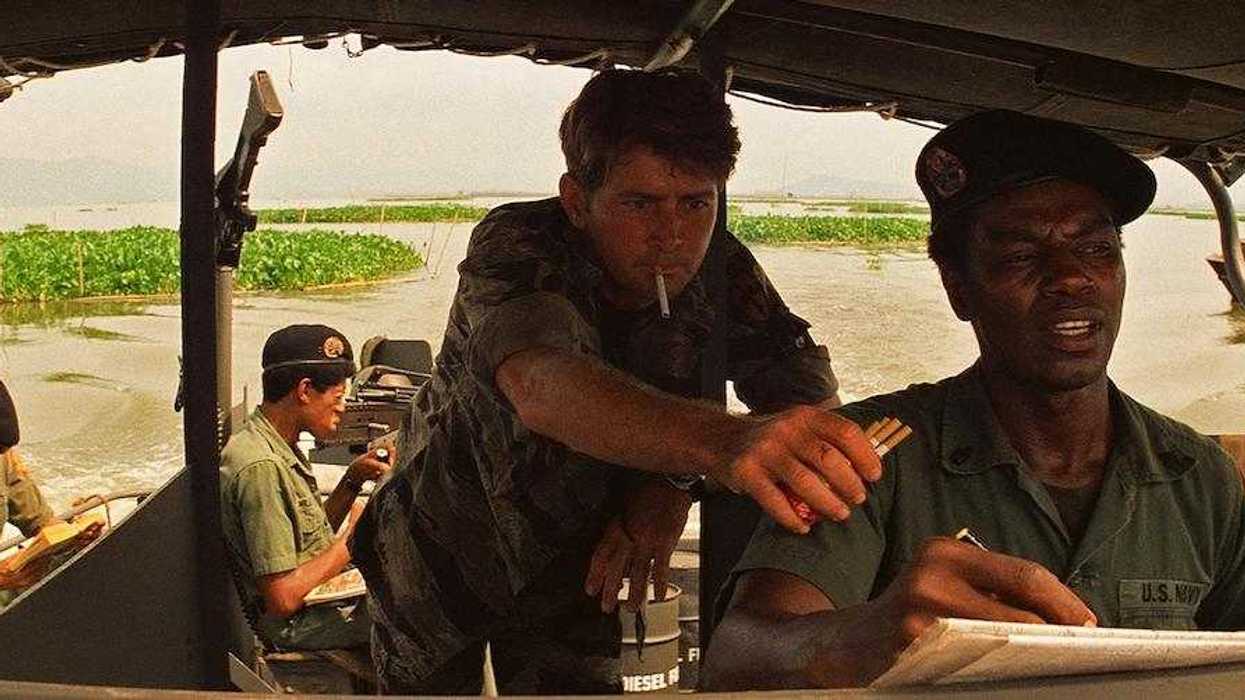
The captain sets out on his mission on a small naval patrol boat to avoid attracting too much attention with a team of four others. Out of them, three are in their late teens and early 20s, people who’ve probably never even seen a real gun in their lives before. They, set against the backdrop of the Vietnam War and Colonel Kilgore’s love for blood, are both absurdism and contrast at their peak.
Chef’s constant breakdowns and near-panic attacks each time he dodges a bullet by inches or hears a blood-chilling explosion is the truth of war. But Chef eventually learns to fire a firearm (by the time they reach Kurtz), which shows how war changes an individual, even in mere hours.
He was still scared to death, but his reflexes had adapted to survival mode, enabling him to pick up the gun and fire away, as if it were not his first time.
3. Captain Kilgore’s Love for Blood
Kilgore is a controversial character, and one reason Apocalypse Now will forever be misunderstood as glorifying war. Kilgore is reverse psychology in its brilliance.
The man has been on a battlefield for as long as he can remember. Coppola doesn’t reveal if he has any family or not, but his basic demeanour suggests that he doesn’t. The man is also the leader of a unit as a colonel and is always high on power. In Coppola’s narrative, the U.S. military is seemingly winning at that particular front (all thanks to Kilgore’s reckless military attacks).
In contrast to Willard, Kilgore has turned his PTSD into his strength and adapted to the ways of violence; now he loves the smell of napalm and burnt bodies after an explosion. He has lost faith in life so much so that he attacks a particular beachside just to clear off any enemy, so that he can watch Lance, the surfer, surf. (Who knows, Lance might die in the next hour, or even worse, he himself might not make it another day.)
He shoots down innocent Vietnamese villagers running for their lives from a helicopter above as if he’s in a video game. His utter disregard for life prompts us to question our regard for life and peace. After all, even Rambo with his machine gun wouldn’t be cool if he started firing at innocent, unarmed people.
4. Behind the War Scenes
The battleground is a place of heroism, but what happens during the breaks?
Obviously, the action cannot go on 24/7. In the film, we see a version of the soldiers that’s rarely revealed in our leaders' speeches about the country’s military force.
I’ve heard from some of my trusted sources that Coppola’s depiction of the war’s behind-the-scenes moments is not very different from what happens in an actual war.
In the movie, we see how the soldiers are being served with women, booze, and entertainment to keep their morale high. It’s an absurd sight to see men behave like animals, in the name of “I could die next minute.”
5. Clean and Chief’s Deaths
Both deaths are extremely symbolic. Clean’s death is a pivotal moment in Apocalypse Now. This young man from the South Bronx dies in a random attack, unable to dodge a round of intense gunfire.
He is midway through a message from his mother when their boat runs into an attack. The rest of the crew is shaken by his death.
The scene becomes especially disheartening as Coppola backs his dying moments with his mother’s voice over his dead body, asking him to ensure that he comes back home in one piece.
When Chief dies, his actions make me reflect on the complexity of the human mind. He dies from a spear thrown by the enemy. Willard rushes to him and catches him as he drops to the ground.
But in his dying moments, he tries to kill Willard. He pulls Willard toward himself with all his strength, trying to stab him with the same spear that’s plunged into his chest, but Willard manages to overpower him.
Chief's attempt to kill Willard reflects how we often seek closure in others’ misery.
6. The Media
Willard and his men are directed by a crew of journalists. They’re told they must not look into the camera and pretend to fight the war as they cross the frame. It’s both absurdity and cynicism at its peak.
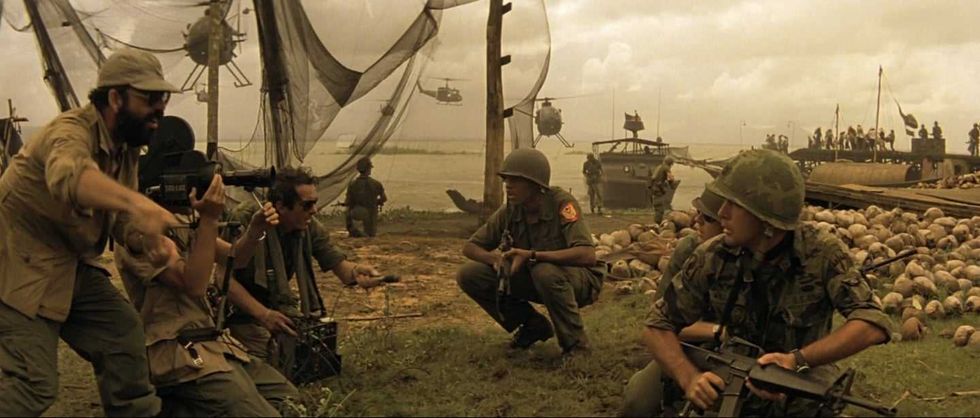 Apocalypse Now (1979)Source: Paramount Pictures, Starz Entertainment, Miramax, Studio Canal, United Artists
Throughout the narrative, Coppola sprinkles in some dark comic relief, showcasing how war and TV ratings are more closely related than you think.
Coppola forces us to think about who is actually benefiting from the war.
Then there is the tattered U.S. flag that is placed on Clean’s body before he is lowered to the ground, the endless dead bodies, the mindless sex and drugs, and so much more, portrayed through the filter of absurdism that screams of the futility of war.
In short, Apocalypse Now sends a strong message in layers of wit, cynicism, absurdism, and contrast.
There is a scene in which Willard’s crew gets desperate to keep a puppy they find after they misunderstand a simple Vietnamese woman and shoot her dead—that’s how contrast makes you uneasy!
Considering how production was a nightmare for the movie, Coppola did a miraculous job with Apocalypse Now. Let us know your thoughts.
- The Hidden Irony in “I Love the Smell of Napalm in the Morning” ›
- Putting Sanity At Stake: Coppola Interviews John Milius About Writing 'Apocalypse Now' ›
- Watch: Why 'Silence' and 'Apocalypse Now' Are Two Sides of the Same Coin ›
- Why 'Apocalypse Now' Might Be Dangerously Overrated ›
- “Charlie Don’t Surf!”: The Absurdity of War in ‘Apocalypse Now’ ›
- 'Apocalypse Now' Cut Breakdown: 1979 Theatrical vs. Redux vs. Final Cut | No Film School ›