Sarah T. Schwab has directed three features, so why does she say she doesn't know anything? When asked this in a recent video from Film Courage, she laughs and points out that she never went to film school.
And who needs it? It's kind of our ethos around here.
Schwab is a writer/director/producer and a member of the playwrights and directors unit at the Actors Studio. She talked with Film Courage about making three features in three years. Life After You is about the fentanyl crisis. A Stage of Twilight is about end-of-life decisions. It premiered at the Woods Hole Film Festival, starred Karen Allen and William Sadler, and won Schwab Best Emerging Director. Crybaby Bridge is a psychological thriller built on American folklore.
Dive into the full conversation below. Then check out what writers and directors can take from her about learning on the job, structure, and working with actors.
- YouTube www.youtube.com
Stay a Beginner
If you ever meet someone who says they've got everything about filmmaking figured out, they're lying. This job is too hard and too changeable for anyone to know everything. Every shoot brings a new cast, new locations, and new needs, like stunts on one film and an intimacy coordinator on the next, as Schwab says.
I've never interviewed anyone who says they aren't always learning. That's part of the fun of the whole thing. A single scene can be a challenge, and it's fun to figure out, and it can take days to do so.
"So I guess it's not that I don't know anything," she says. "It's that I'm never going to be like a master at this because it's always a new challenge every time we shoot something."
That attitude helped her on her first film, when a problem on set forced a story change in the moment.
"I just went blank. And I was so lucky that I had all these other people there to encourage me and to talk me through it. And we came up with a solution. We solved it, and we made a beautiful film."
When you freeze, your crew can carry you. So it's a good idea not to have an ego.
- YouTube www.youtube.com
Write Bad Pages, Then Build the Blueprint
Schwab loves first drafts. She's an advocate for the vomit draft, where you just get everything you can on the page.
"And it doesn't matter if it's not good at the end of the day. It's just, you have so much material, and you're just emptying your brain. And that's really important to get all of that out. It's the second draft that begins to kind of stink a little bit because you have to really start killing your babies and looking at the parts that are strong and less strong for the story."
Structure comes next, and she's specific about the tool she likes to use.
"So, I'm a huge proponent of the book Save the Cat by Blake Snyder," she says. "It's my personal writing bible. I know some people think that it's too formulaic, but it really helps me keep track of my thoughts and ideas and creates a blueprint before I go and start actually writing the script."
You see the pushback against this kind of structure sometimes because some writers feel they can simply hit the beats outlined in a formula like Save the Cat, but you won't win that way. There are so many intangible elements that have to come with structure, like voice and character development and dialogue and visuals... it's hard, is what we'll say. So having that structure is like putting down a foundation. It's up to you to build beautiful things on top of it.
Schwab creates the hero first by asking where their life starts, where it ends, and how their arc forms, and then builds the structure around the character. She keeps index cards so that research doesn't turn into stalling.
"I really like to have that blueprint there so that it keeps me on track and it doesn't send me down that spiral of always researching and learning more because then it's just an excuse to not actually try to finish the project."
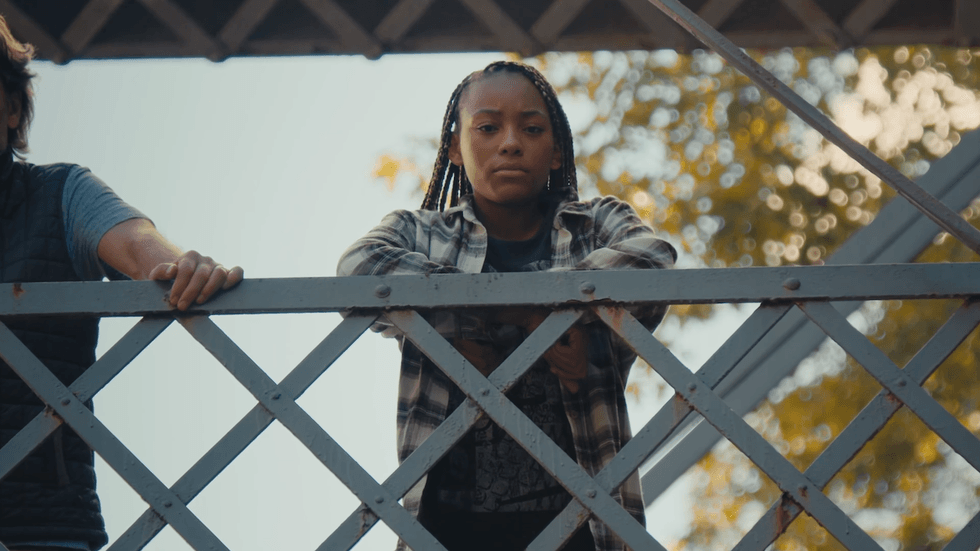 'Crybaby Bridge'Credit: X4 Pictures
Make Every Scene Turn
Speaking of structure, this is a great reminder for forward momentum. Her rule for scenes is simple.
"My approach to writing a great scene is that the scene always has to turn no matter what," she says. "And what I mean by that is that if you start off on a positive note, it should end on a not-positive note, and then the next scene after that should [start] on a not-positive note and end on a positive note. That's going back to Save the Cat style, but it keeps the waves of the story flowing for me."
In this case, she's talking essentially about the vibe of a scene, but what you're looking for in a "turn" is some change. A character could try something with hope and fail. That would be a positive-to-negative turn. Every scene should influence the next. Otherwise, you just have a series of disconnected moments.
In novel writing, some authors rely on a scene and sequel turn. A character will have something happen to them, then they'll spend some time thinking about it, then they'll make a decision to move forward. You can't do this exactly in a screenplay, but it might help you think about internal and external conflict from scene to scene.
Direct by Listening
Directing is hard. You're managing about ten billion decisions at the same time. Film Courage asks what the most constructive thing a director can say to an actor is.
“The most constructive thing a person, a director, can say to an actor is honestly to listen to an actor when they have questions. And if you are hoping that they’re going to get to a different mark or do something a little differently because you’re seeing it from the outside and they’re inside of the character, it's about gentle communication, I think. So it's not just one thing. It’s about respecting how that actor was trained and to understand how that actor as a person communicates. Sometimes people need, want hard love and want hard directions on what to do. Other people want to find it themselves."
Be sure to check out the full interview for more.