11 Most Meta Movies That Break Reality
Cinema at its most self-aware, where films turn the lens back on themselves.

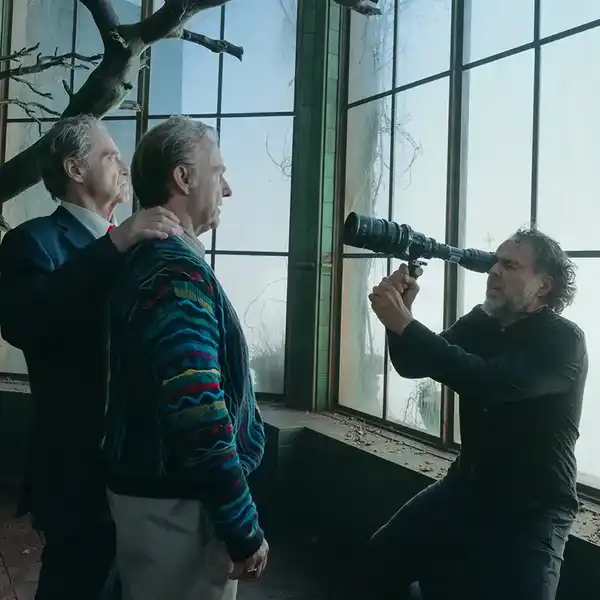
Michael Keaton in a still from Birdman (2014)
Have you ever felt like the movie you are watching suddenly winked at you? As in, a character in the movie implying, or straight away addressing the fact, that they are inside the movie, and you are observing them?
If you have, then this surreal moment, blurring the line between story and storytelling, is what we call the magic of metacinema.
What is a Meta Movie?
A meta movie displays self-awareness, acknowledging the artificial or cinematic nature of its constructed narrative/world, and makes it known to the audience. There are several ways in which a meta movie can establish this:
1. Breaking the fourth wall
- A character directly addressing the audience (Example: Deadpool)
- An off-screen narrator expressing inner thoughts (Example: American Psycho)
2. Movie-within-a-movie format
- Behind-the-scenes focus, where the narrative explores the process of filmmaking (Example: 8½)
- Genre deconstruction, where the movie parodies its own genre (Example: Tropic Thunder)
- The found-footage narrative, where the movie is presented as an artifact of its own story (Example: The Blair Witch Project)
The main objective of metacinema is to push the boundaries of traditional storytelling by building a deeper, more intimate/intellectual engagement with both the subject matter and the audience. Aside from this, a metacinema is a perfect tool for parody, satire, for using genre deconstruction tropes, analyzing identity, tackling creative block, and obscuring the difference between fact and fiction for dramatic effect.
11 Meta Movies That Crack the Cinematic Illusion
Here is a carefully chosen list of 11 movies that use the elements of metacinema to inform their entire philosophy rather than merely experimenting with it for style points.
1. Sunset Boulevard (1950)
Written by: Charles Brackett, Billy Wilder, D.M. Marshman Jr. | Directed by: Billy Wilder
In the film’s famous opening scene, we see the narrator Joe Gillis (William Holden) dead and floating in a private pool. As his narration unravels his complicated involvement with a forgotten silent-era movie star, Norma Desmond (Gloria Swanson), we start to see the movie’s meta-critique of Hollywood, which exposes its industry rot. The casting of Swanson, a real-life silent-era movie star, further accentuates this self-awareness.
2. 8½ (1963)
Written by: Federico Fellini, Ennio Flaiano, Tullio Pinelli, Brunello Rondi | Directed by: Federico Fellini
A reputed film director, Guido Anselmi’s (Marcello Mastroianni) next feature production is suffering a delay because of his severe creative block. To make matters worse, he is also experiencing growing stress because of his failing marriage. This movie, a Fellini masterpiece, which is basically a sequence of fantasies, dreams, and unfinished concepts, blurs the line between Guido’s movie and Fellini’s movie. 8½ is metacinema at its rawest and best, as it exposes the director’s (both Guido and Fellini) psyche and the entire movie-making process.
3. Persona (1966)
Written by: Ingmar Bergman | Directed by: Ingmar Bergman
Nurse Alma (Bibi Andersson) is assigned to care for Elisabet (Liv Ullmann), a famous stage actress who has suddenly gone mute, suggested to be psychosomatic in nature. As the two women bond in their solitary environment, their distinctive personalities start to merge. This is an absolute meta-experiment, which opens with the visual of a movie projector. In this movie, Bergman constantly reminds us that we are watching a constructed narrative, such as the opening sequence, where we see a boy’s over-the-shoulder POV shot from inside the screen.
4. The Purple Rose of Cairo (1985)
Written by: Woody Allen | Directed by: Woody Allen
Cecelia (Mia Farrow), a disillusioned waitress in the Depression era, goes to movies to escape from her dull life. Her life takes a surreal turn when her favorite actor, Tom Baxter (Jeff Daniels), literally steps off the screen and into her world. In this movie, Allen, by bringing together art and reality, explores cinematic escapism. The movie also forces Tom to question his existence, while Cecilia tries to come to terms with loving a perfect, but artificial man.
5. The Player (1992)
Written by: Michael Tolkin | Directed by: Robert Altman
A studio executive, Griffin Mill (Tim Robbins), is getting death threats. After wrongly assuming his blackmailer to be a disgruntled scriptwriter, he accidentally kills him. He spends the rest of the movie trying to cover his tracks and pursue the deceased scriptwriter’s girlfriend. The film is also famous for starring many real-life stars in cameo roles. Intensely self-referential, the film’s long-take opening scene shows characters discussing and pitching long-take scenes. The film is an allegory for how Hollywood presents its own decay as just another story pitch.
6. The Truman Show (1998)
Written by: Andrew Niccol | Directed by: Peter Weir
Truman Burbank (Jim Carrey) lives a perfect life in a picturesque seaside town without realizing his life is being televised to millions of viewers as a reality show and that everyone he knows is just an actor. Once aware, he starts planning his escape. The Truman Show foresaw a future in which entertainment and surveillance would coexist long before social media and reality TV became popular. As viewers, even we are forced to face our complicity in this cruel farce, because we have been watching the movie (within the movie) with the same excitement and intensity. It’s a meta comment on being a spectator.
7. Being John Malkovich (1999)
Written by: Charlie Kaufman | Directed by: Spike Jonze
A struggling puppeteer, Craig Schwartz (John Cusack), finds a mysterious portal that opens into actor John Malkovich’s (Malkovich playing himself) mind. Before long, everyone wants a chance to live inside the star’s head. A wildly groundbreaking concept wrapped in magical realism, this movie is a metacinema to the bone. Their casting of a real-life actor to play himself keeps the audience rooted in reality. The movie, which parodies our obsession with identity theft through performance, takes a literal spin on the concept of “getting into the character’s head,” and leads it to a bizarre conclusion.
8. Adaptation (2002)
Written by: Charlie Kaufman | Directed by: Spike Jonze
Screenwriter Charlie Kaufman (Nicholas Cage) is hired to adapt Susan Orlean’s The Orchid Thief, an explorative, contemplative, and thematic exploration of passion and obsession in the field of New Journalism. However, for Charlie, someone who’s used to thinking in three-act structures, this book is unadaptable. Suffering from a creative block and running out of ideas, Charlie instead decides to write a screenplay about his own struggles with writing the screenplay. Adaptation breaks every narrative barrier by mixing reality, fiction, screenplay, and the final film until you can’t tell one from the other. The story about writing a film about the struggles of writing a film boasts a beautifully convoluted meta-premise.
9. Synecdoche, New York (2008)
Written by: Charlie Kaufman | Directed by: Charlie Kaufman
Theater director Caden Cotard (Philip Seymour Hoffman) stages a play based on his own life and hires actors to play him and other people in his life. Within the stage play’s narrative, the characters hire actors to play themselves. And just like that, Kaufman turns Synecdoche, New York, into a house of mirrors of metacinema. In essence, it’s a philosophical pondering on art, mortality, and the implausibility of capturing the entirety of a single life.
10. The Cabin in the Woods (2012)
Written by: Drew Goddard, Joss Whedon | Directed by: Drew Goddard
The movie starts off like any other slasher cliché: 5 friends go to a remote cabin, only to be killed one after another by someone—in this case, an underground facility of technicians. However, once the murder chain sets in, the movie offers a dramatic twist. The reason why these technicians are preying on this group is that these five friends are being offered as sacrifices to the ancient gods. The movie’s plot satirizes the formulaic nature of horror, mocking the slasher movie tropes, and yet being a slasher movie in itself.
11. Birdman or (The Unexpected Virtue of Ignorance) (2014)
Written by: Alejandro G. Iñárritu, Nicolás Giacobone, Alexander Dinelaris, Armando Bo | Directed by: Alejandro G. Iñárritu
Riggan Thompson (Michael Keaton), a washed-up actor best remembered for portraying a superhero, Birdman, tries to resurrect his career by directing and starring in a Broadway production. As the play and his life struggle to rise, he battles his insecurities, haunted by the voice of his alter ego, Birdman. The movie is a critique of acting, ego, and celebrity, with Keaton’s own real-life stint as Batman at its thematic core. Iñárritu films and edits the movie to appear like it’s one single continuous shot.
Conclusion
Each of these movies is a free-standing experiment that challenges the established trends in storytelling. By going beyond “the critique of life” and instead reflecting on itself, metacinema takes “commentary” to another level; it invites its audience into the deeper depths of art, reality, and perception.
So, keep an eye out for these signs the next time you watch a movie. You never know, it might be breaking the fourth wall and invite you in, so you can decide for yourself what is real and what is not.