Shadows and Sin: 9 Essential Film Noir Quotes That Define the Genre
These haunting lines of dialogue capture the cynical realism and moral ambiguity that define the genre’s darkest corners.
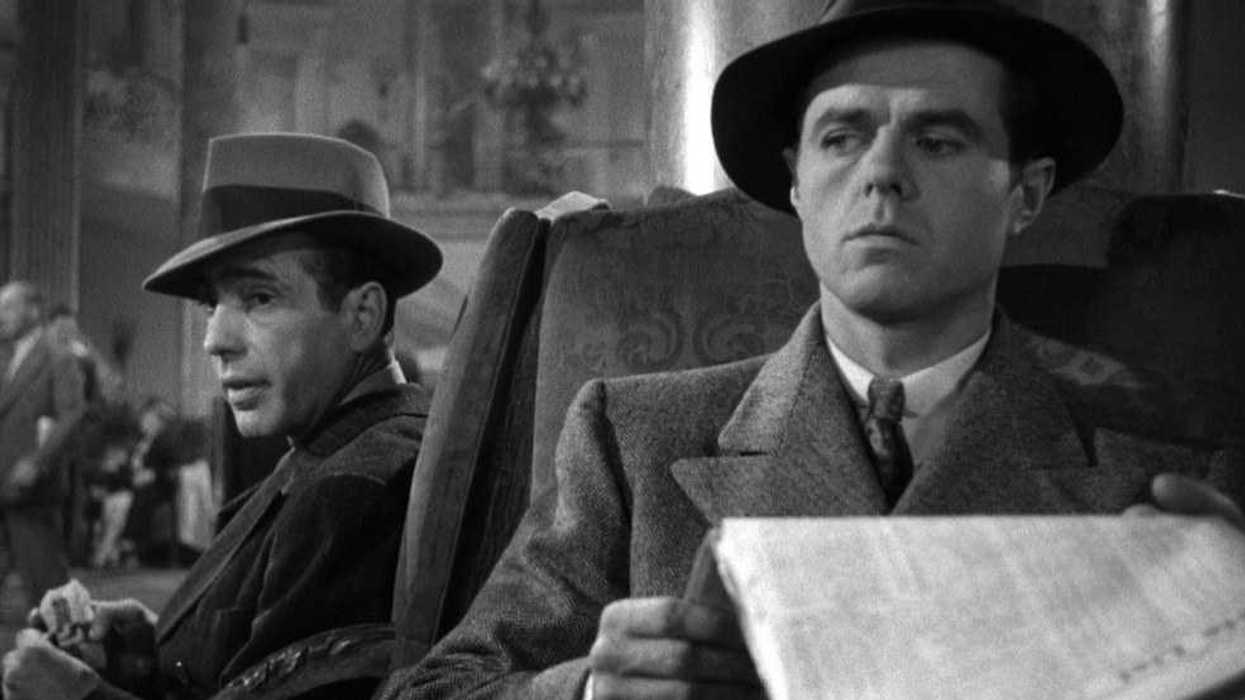
'The Maltese Falcon '(1941)
When it comes to expression, film noir took a rather unique route. They didn’t engage with “speech,” per se. Rather, they turned to sentences that stood firm on their feet while doing their job. A line muttered in a car. A confession spoken too late. A remark tossed off like it meant nothing, but in reality, it meant everything. Dialogue, in these quaint, black-and-white crime sagas, was more than decoration. It was evidence.
These lines haunt, and that’s because, in a very peculiar way, they capture cynical realism while highlighting moral ambiguity. In this world, innocence is nothing more than just a rumor. Heroes are exhausted, but smiles come too easily to the villains. The movie may give you a happy ending, but you might still feel like it was a clerical error. It’s not the violence that hurts; it’s the honesty with which characters admit their failures.
That’s the vibe of film noir. It may be a muted confession, a casual threat, or a throwaway remark; words land and stay put. Don’t look at these lines as memorable dialogue; look at them as the DNA of the cinematic underworld.
What is Film Noir
A French film critic and writer, Nino Frank, first coined the term. He fashioned it after a French publishing imprint called Série Noire. He used the term to describe the stylish crime dramas that were being made in Hollywood during the 40s. The term and the genre are rooted in German Expressionism and can be identified by now well-known characteristics: cynical worldview, sexual motivations, and dark aesthetics. In the context of cinema, this style relies heavily upon low-key lighting, deep shadows, and skewed camera angles. The goal is to create a sense of entrapment and moral ambiguity.
The common thread across (almost) all film noirs is that a flawed protagonist, quite often a hard-boiled detective, is lured into danger by a sexy femme fatale. People who significantly shaped the genre can be said to be directors like Fritz Lang, Billy Wilder, and John Huston, and actors, such as Humphrey Bogart, Robert Mitchum, Barbara Stanwyck, and Lauren Bacall. While film noir can be identified by its black-and-white cinematography, its legacy persists in modern Neo Noir films, such as Chinatown (1974), Taxi Driver (1976), and Fargo (1996).
9 Iconic Lines from Film Noir Cinema
1. “The stuff that dreams are made of.” (The Maltese Falcon, 1941)
Written by: John Huston | Directed by: John Huston
The eponymous jewel-encrusted falcon statue, which incites greed, deceit, and betrayal in everyone and around which the film’s main plot is woven, ultimately turns out to be a fake. As Sam Spade (Humphrey Bogart) turns in the statue as evidence, he dejectedly refers to it as “the stuff that dreams are made of.” The line points out the emptiness of greed. Interestingly, it was improvised (suggested) by Bogart. He referenced it from a line in Shakespeare’s The Tempest, which goes, “We’re such stuff / As dreams are made on, and our little life / Is rounded with a sleep.” It proves that the best noir moments perhaps come from a place of cynical improvisation.
2. “I killed him for money and for a woman. I didn’t get the money, and I didn’t get the woman.” (Double Indemnity, 1944)
Written by: Billy Wilder, Raymond Chandler | Directed by: Billy Wilder
The film starts with this quote, which is a confession recorded by its antihero, an insurance salesman, Walter Neff (Fred MacMurray). It sets the tone for the story that later unfolds and essentially is the ultimate summary of the whole “noir” experience. The quote was written in a repetitive sentence structure to bring out the character’s exhaustion and the pointlessness of his crime. You can also notice the Hays Code effect here. The censor board strictly forbade the depiction of crime in which the crime goes unpunished, and the criminal actually benefits from it. So, the line was written in a way that implied the punishing futility of his crime. Doing so, it served the narrative purpose and also kept the moral standards of the audience intact. Hurray!
3. “How could I have known that murder could sometimes smell like honeysuckle?” (Double Indemnity, 1944)
Written by: Billy Wilder, Raymond Chandler | Directed by: Billy Wilder
This line combines two things with wildly opposite vibes: the viciousness of murder and the pleasantness of honeysuckle. The protagonist, Walter Neff (Fred MacMurray), uses this contrast to describe how he was seduced. In the context of the story, it explains the role of the femme fetale in clouding his judgment.” (What other “vile” thing can cloud a man’s judgment, right?) Well, political correctness aside, this contrast worked in a narrative sense. It made the danger feel more intimate and less like a procedural. In short, it grounded the crime in a very human, misguided desire.
4. “You know how to whistle, don’t you, Steve? You just put your lips together and blow.” (To Have and Have Not, 1944)
Written by: Jules Furthman, William Faulkner | Directed by: Howard Hawks
When, as Marie “Slim” Browning, Lauren Bacall delivered this line, her effortless cool promptly opened the gates of stardom for her. The line is playful, yet unequivocally risqué—it clashed headfirst with the Hays Code. While the nuanced suggestiveness blurs the line between flirting and power dynamics, its simplicity is what truly makes it iconic. It’s also proof of how classic movies had the ability (and the guts) to turn everyday actions into moments of high-voltage chemistry and subtext.
5. “Hate is a very exciting emotion.” (Gilda, 1946)
Written by: Marion Parsonnet | Directed by: Charles Vidor
What you see here is Gilda (Rita Hayworth) masking her lingering feelings for her ex with a touch of cold cynicism. In many romantic relationships shown in noir films, there is always a thin line that separates obsession and loathing. This line perfectly captures it. This was the writer’s attempt to subvert the typical romantic trope. Today, you might relate to this if I said, “Conflict is more electrifying than peace.” It’s, of course, open for interpretation. Take it as you may, but the line remains a definitive example of the dark, psychological tension that this genre thrived on.
6. “I was born when she kissed me. I died when she left me. I lived a few weeks while she loved me.” (In a Lonely Place, 1950)
Written by: Edmund H. North, Andrew Solt | Directed by: Nicholas Ray
In the film, Dix Steele (Humphrey Bogart) is a screenwriter who is struggling with a script. A violent road outburst suddenly inspires him, and he writes this line and recites it to Laurel (Gloria Grahame). The line also mirrors his actual (and quite tragic) romance with Laurel. Poetic in its construction, the line is structured in such a way that it underscores the highs and lows of a volatile relationship. In a typical fashion of film noir, it also captures the protagonist’s fatalism, in this case, a man who knows he is his own worst enemy. The quote’s rhythmic pace also brings out the inevitability of loss, which is central to the film’s moody atmosphere.
7. “I am big. It’s the pictures that got small.” (Sunset Boulevard, 1950)
Written by: Billy Wilder, Charles Brackett, D.M. Marshman Jr. | Directed by: Billy Wilder
When Joe Gillis (William Holden) acknowledges Norma Desmond (Gloria Swanson) as a silent movie star who “used” to be big, Norma says that she is big, and it’s the pictures that got small. This is one of the lines that are central to the movie’s thematic core, underlining the tragic delusions of “has-beens.” It’s also a meta-critique of the film industry that leaves behind the very people on whose flair it evolves. The line may be ostentatiously arrogant, but it’s actually deeply sad. What we see as Norma’s ego is, in hindsight, a picture of fame within a dark, self-serving framework.
8. “All right, Mr. DeMille, I’m ready for my close-up.” (Sunset Boulevard, 1950)
Written by: Billy Wilder, Charles Brackett, D.M. Marshman Jr. | Directed by: Billy Wilder
This is one of the most iconic movie endings. Norma Desmond (Gloria Swanson), now completely descended into madness, imagines the police and the reporters as her film crew and signals the imaginary Cecil B. DeMille to take her close-up. In a quite heart-wrenching way, this moment marks the (narratively) perfect conclusion to her character arc: she finally found the elusive spotlight she was craving, except that it wasn’t for a movie but for a crime (murder) she committed. The quote is representative of the genre’s interest in the psychological breakdown of characters.
9. “We’re sisters under the mink.” (The Big Heat, 1953)
Written by: Sydney Boehm | Directed by: Fritz Lang
Debby Marsh (Gloria Grahame), an abused mistress of a gangster, says this line to Bertha Duncan (Jeanette Nolan), the widow of a corrupt cop. Bertha herself has relations with the city’s organized crime syndicate. This quote is Debby’s way of saying that, despite their different social standings, they are both tied to the same dirty money. The line is a veiled commentary on class and the burden women endure in crime circles. “Mink,” in this sentence, is a metaphor for the compromise they have to make to live this kind of life. You can also understand it to mean the rot beneath the luxury.
- What is the Neon Noir Genre? ›
- What is Neo Noir? Definition and Essential Examples ›
- Film Noir to Neo-Noir: A Dark Makeover of Crime-Thrillers ›
- What Does the Line “Forget it, Jake. It’s Chinatown." Actually Mean? ›
- What The Best Film Noir Movies Can Teach Every Filmmaker | No Film School ›
- The Stylistic Elements of Film Noir, Explained In One Handy Infographic | No Film School ›
- What Are The Best Film Noir Movies of All Time? | No Film School ›
- 11 Noir-Inspired Comedies You Forgot Exist | No Film School ›
- Uncovering the Mysterious World of Film Noir (A Comprehensive Guide) ›
- 9 Classic Noir Horror Films That Invented Psychological Terror | No Film School ›