Film Quote of the Day: Clint Eastwood's “Every Gun Makes Its Own Tune” Teaches About Writing Great Dialogue
The Good, the Bad and the Ugly dialogue explains why every person leaves a different mark on the world.
'The Good, the Bad and the Ugly'
There's a line in The Good, the Bad and the Ugly that lands so quietly, between bigger moments, you could almost miss it.
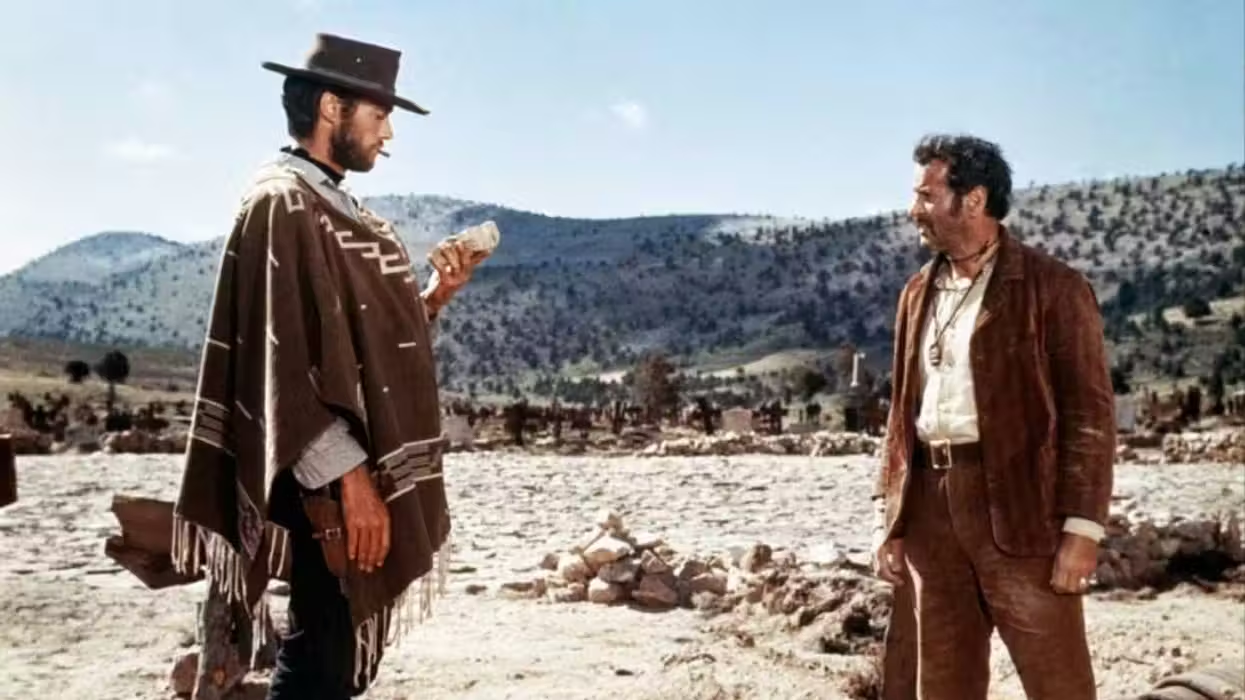
Blondie (Clint Eastwood's laconic bounty hunter) delivers it with the same flat affect he gives everything else. Tuco has just shot a one-armed gunslinger who had the drop on him and made the mistake of monologuing instead of pulling the trigger. Tuco says, "When you have to shoot, shoot! Don't talk."
Nearby in the ghost town, with Angel Eyes, Blondie hears the shot and offers his own commentary to no one in particular. "Every gun makes its own tune." He then goes to confront Tuco, who believed he was dead.
This all comes from the 1966 Sergio Leone film, the final chapter of the Dollars Trilogy, which pits three men, Blondie (Eastwood), Angel Eyes (Lee Van Cleef), and Tuco (Eli Wallach), against each other in a race to find $200,000 in Confederate gold buried somewhere in a Civil War-era cemetery.
The plot is almost incidental. What Leone actually built was a sustained philosophical argument about human nature, delivered mostly through silence, wide-angle shots, close-ups of sweaty, tense faces, and the very occasional line of dialogue that earns its place.
- YouTube www.youtube.com
Why Leone Said So Little
Leone is widely quoted as saying his films were "basically silent films" and that dialogue only existed to add weight (per the BBC).
There wasn't a lot of dialogue in these films because it was easier and cheaper to shoot just the action, without worrying about sound, and instead fill the soundtrack with music and effects. It was a practical issue that became an aesthetic philosophy.
Leone understood that compression is power. Every line that makes it into a Leone film has survived a process of elimination that most Hollywood scripts never even attempt.
If you're a low-budget filmmaker, can you turn your sound issues into a hallmark of your filmmaking like Leone did? We all probably know that if you're getting sound, it's incredibly important. And for that reason, it costs a lot, especially for features. Maybe instead of large casts, you reduce your character roster down to just a few people, eliminating the need for a ton of lavs. Or maybe you want the slightly hammy ADR later, like in a 50-year-old horror film. Or maybe you just have them talk less.
If your characters are talking a lot, ask yourself what they're saying that a look, a pause, or a single sentence could carry instead. Lean on subtext, and save on sound. A win-win.
"Every gun makes its own tune."
"Every gun makes its own tune" is doing several things simultaneously. Blondie isn't in the room. He hears the shot from elsewhere in the ghost town and registers what happened purely by sound. The line is almost diagnostic. He heard the gun, he knows whose it was, and he knows what it means.
Every person has their own method, their own timing, their own logic, and each is legible if you know how to listen. It also says something about identity. Who you are is readable in what you do, not what you say about yourself.
And it works as a statement about the world of the film, a brutal, amoral landscape where morality is a luxury nobody can quite afford.
As INGLORIOUS BAGUETTES' reading of the film puts it, with that line, Leone was saying every man makes his own tune, too, that no person is as simple as a singular title, and no situation is easily reduced to uncomplicated morality.
The Good, the Bad, and the Ugly of the title are categories that keep collapsing throughout the film, which is part of why the line resonates.
That's the second lesson. Great dialogue lands on multiple levels at once. The line serves as a character moment, a thematic statement, and a piece of world-building. One of the most consistent flaws in beginner screenwriters' dialogue is that all the characters sound alike, and a related failure is when dialogue only does one job at a time. If a line just conveys information or just reveals character, ask whether it can do both.
- YouTube www.youtube.com
Economy as a Structural Principle
The script of The Good, the Bad and the Ugly is basically allergic to exposition. Characters act, and they rarely explain. Leone trusted his audience to follow the characters' goals and silence rather than narration. The Civil War backdrop is present throughout the film, but is never discussed.
If you're writing a short film in particular, this is a great reminder. We've talked before about how short filmmaking demands compression at every level, and dialogue is no exception. Is dialogue working for you, revealing something imperative about character or plot? Every line that explains something the audience can already see should probably be cut. You don't want to be on-the-nose.
"Every gun makes its own tune" works because it trusts you to do half the work. It doesn't explain itself. It says a thing and stops. The willingness to put down a line and let it sit is what separates serviceable (forgettable) dialogue from the kind people quote 60 years later.
The Score Is Also Dialogue
Leone's collaborator Ennio Morricone understood this instinctively. The main two-note motif in the film's theme is used for each of the three main characters, but played on three different instruments. It's a flute for Blondie, an ocarina for Angel Eyes, and a choir of human voices for Tuco.
"Every gun makes its own tune," and Leone and Morricone built that idea directly into the score. The characters are distinguishable just by leitmotif, and it's great.
Morricone and Leone gave each character a sonic signature, a distinct instrument that tells you immediately who's in the room. Similarly, the goal with dialogue is that you should be able to cover the character names and still know who is speaking. Leone's characters pass that test.
Blondie's lines are clipped and almost aphoristic. Tuco talks in paragraphs, chaotic and self-justifying. Angel Eyes barely talks at all.
You can read more about writing characters who sound nothing like you.