12 Lines That Made Clint Eastwood a Legend
These razor-sharp quotes from Dirty Harry and beyond forged Clint Eastwood’s ice-cold screen persona.
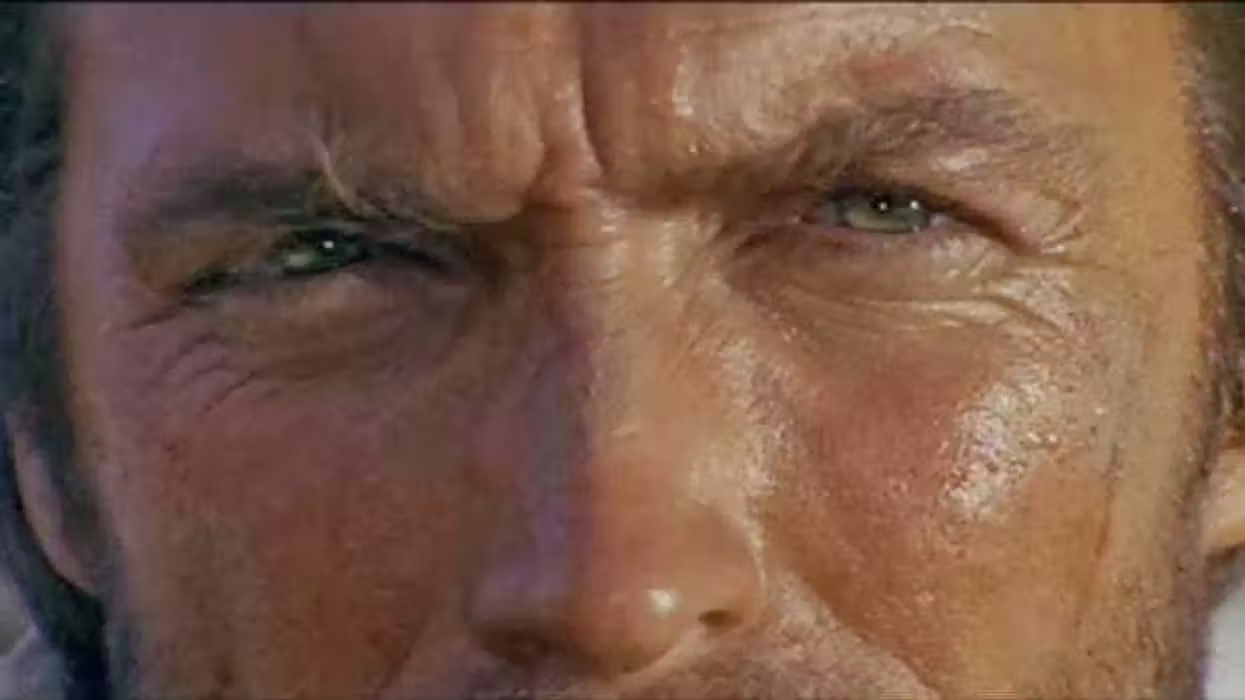
The Good, the Bad, and the Ugly (1966)
Clint Eastwood’s movie quotes are iconic, but giving sole credit to the stinging words and the shade they pack is somewhat unfair. The real building blocks of their legacy are the pauses, the finality of the message, and his legendary steely stare. All this comes together, and when he speaks, the moment feels complete. There is no negotiation, no cleanup.
At the heart of his dialogue delivery is one simple rule: say less, mean more. And that’s why his characters hardly ever need to explain themselves.
These 12 lines trace the evolution of his characters, from minimalist Spaghetti Westerns to his late-career reckoning. And yet, the man behind these quotes has remained the same: controlled, unshowy, and quietly intimidating. These quotes themselves are a masterclass in how to turn dialogue into authority.
Clint Eastwood’s 12 Iconic Lines
1. “Get three coffins ready.” (A Fistful of Dollars, 1964)
Written by: Víctor Andrés Catena | Directed by: Sergio Leone
“The Man with No Name” (Clint Eastwood) is one of the most iconic antiheroes in movie history, and this is where he makes his first appearance. He speaks very little and doesn’t engage in emotions, threats, or dramatic buildups. He is calculated to the bone. Violence is nothing but math for him. And that’s why he can tell how many men he is going to kill. Sergio Leone’s framing and Eastwood’s delivery of the line establish the character as a cultural mainstay.
2. “Thought I was having trouble with my adding. It's all right now.” (For a Few Dollars More, 1965)
Written by: Luciano Vincenzoni, Sergio Leone | Directed by: Sergio Leone
This is the second movie where “The Man with No Name” makes his appearance, and he continues his cold, calculated, and witty streak of “killing-machine” precision. Eastwood maintains his character’s emotionally distant approach to violence. The line also displays his signature dry wit immediately after the shootout.
3. “In this world, there are two kinds of people, my friend.” (The Good, the Bad and the Ugly, 1966)
Written by: Luciano Vincenzoni, Sergio Leone | Directed by: Sergio Leone
This is the third, and the last, film in which Eastwood stars as “The Man with No Name.” Here, he also throws light on the character’s psyche. It shows how his personality and worldview are shaped by each other. When he philosophizes that the world is built on division and consequences, he sounds like someone who has already done the sorting. It’s quite a skill to make dialogue sound conversational yet final.
4. “Do you feel lucky? Well, do you, punk?” (Dirty Harry, 1971)
Written by: Harry Julian Fink, Rita M. Fink | Directed by: Don Siegel
You know the cop characters who don’t care about the red tape? Harold “Dirty Harry” Callahan is that. This is one of the many moments where he transforms the police confrontation into psychological warfare. And “Do you feel lucky, punk?” is perhaps the most iconic of the police questions ever asked, in movies or otherwise. This quote is responsible for reinventing Eastwood’s screen image as a modern icon of justice that operates on the periphery of the traditional, slow-moving system.
5. “A man’s got to know his limitations.” (Magnum Force, 1973)
Written by: John Milius, Michael Cimino | Directed by: Ted Post
In Magnum Force, Harry is battling a surreptitious death squad within his own department. After multiple extrajudicial killings, he figures out his boss is the brain behind it. After the final showdown, when he manages to kill him, Harry delivers this line—already said once before, where he implies his boss is a coward—as the movie’s ending. Both times, the line takes a philosophical jab at those in authoritative positions. The quote also signifies the maturation of Harry’s own persona.
6. “You gonna pull those pistols or whistle Dixie?” (The Outlaw Josey Wales, 1976)
Written by: Philip Kaufman, Sonia Chernus | Directed by: Clint Eastwood
This is a classic example of Eastwood’s character (Josey Wales, in this case) using dry humour as a pressure tactic. In this Western, as Josey approaches, a bounty hunter recognizes him and declares his presence, shocking a group of other gunmen. Josey, unperturbed, waits for their reaction. When it doesn’t come, he lets out this line as a snide remark referencing the famous folk song, Dixie. This is a no-nonsense presence exemplified.
7. “Dying ain’t much of a living, boy.” (The Outlaw Josey Wales, 1976)
Written by: Philip Kaufman, Sonia Chernus | Directed by: Clint Eastwood
This is quite a rare moment for an Eastwood character; a moment of somber reflection. With this line, Josey acknowledges that a gunslinger’s life is a dead end. For a character, a literal gunslinger in a cowboy film, this line provides depth. Although simplistic, the line carries immense emotional weight. It reminds the audience that behind all the swagger and the cool exterior, there is a man who knows its cost.
8. “Go ahead, make my day.” (Sudden Impact, 1983)
Written by: Joseph Stinson | Directed by: Clint Eastwood
If there were an Eastwood-quotes competition, then “Do you feel lucky, punk?” and “Go ahead, make my day” would compete for the top spot. This is unadulterated Clint Eastwood, where he stands up to a goon, resolute like a rock, and challenges him to make a mistake. This is how a hero escalates a situation through confidence, not excitement. While most characters express their testasterony instincts through yapping and yelling, Eastwood does it with a casual, hushed delivery. Among the other over-the-top action heroes of the ‘80s, this individualistic style stands apart.
9. “You improvise, you overcome, you adapt.” (Heartbreak Ridge, 1986)
Written by: James Carabatsos | Directed by: Clint Eastwood
Some quotes grow out of their movies and into real life as a personal mantra or a motto. This line is one of those. Eastwood plays Gunnery Highway, a grizzled sergeant who has to whip his troops into shape. This quote is an example of how he uses mindful instruction in an environment that is usually rife with tedious red-blooded rhetoric. It also represents his shift from a gun-wielding macho man to a seasoned mentor.
10. “He should’ve armed himself, if he was gonna decorate his salon with my friend.” (Unforgiven, 1992)
Written by: David Webb Peoples | Directed by: Clint Eastwood
With Unforgiven, Eastwood returns to his time-tested “killer” instincts. He plays William Munny, a repentant outlaw, now living as a hog farmer, who is forced to avenge his friend. He says this line to the Sheriff “Little Bill” (Gene Hackman), while referencing a pimp who displayed his friend’s corpse outside of his salon. The line gives off a cold vibe that’s devoid of any mercy. Eastwood delivers it evenly, stripping off moral drama.
11. “Deserves’ got nothing to do with it.” (Unforgiven, 1992)
Written by: David Webb Peoples | Directed by: Clint Eastwood
Another Unforgiven quote, but with an added dash of philosophy. When Little Bill lies on the floor, with a bullet wound to his chest, death certain, he claims that he doesn’t deserve to die like this. Munny, in his cold and flat tone, says this line and quickly strips away Bill’s comforting assumption that life or death follows a certain moral code. And then he shoots him dead. This is the Western myth: cold, brutal, and bleak.
12. “You ever notice how sometimes you come across somebody you shouldn’t have fucked with?” (Gran Torino, 2008)
Written by: Nick Schenk | Directed by: Clint Eastwood
This is the newest entry. Eastwood, age 78, looks tired and old, and yet exudes the same grit and swagger that he did back in his prime. This scene—the words, optics—has got quite a bit of theatrics to it, but when does it ever hurt to have a little swank? Here, his Walt Kowalski is threatening a group of gang members. The line is practically Eastwood’s self-aware nod to his own image as a tough guy. What really makes it interesting is its casual, conversational delivery; it truly brings out the underlying threat. It’s a perfect capstone for a persona that spent over 50 years proving that he is “that” somebody.
- Which Stephen King Character Was Based on Clint Eastwood? ›
- Clint Eastwood is 90. Here Are The 10 Best Films He's Directed ›
- 8 Truth Bombs from Clint Eastwood's Cannes Masterclass ›
- Watch: Go BTS with Clint Eastwood in 'The Mule' | No Film School ›
- The Line That Made Clint Eastwood a Legend ›
- 'Unforgiven' 25 Years Later: 5 Ways Eastwood Masterfully ... ›
- Clint Eastwood's Top 10 Must-Watch Directorial Hits | No Film School ›
- “Dying Ain’t Much of a Living”: The Meaning Behind The Gritty Philosophy of The Outlaw Josey Wales ›
- "Two Kinds of People": The Line That Defines ‘The Good, the Bad, and the Ugly’ ›
- The Coldest Line Clint Eastwood Ever Delivered in ‘A Fistful of Dollars’ ›
- “I Reckon So”: Josey Wales’ Three Words of Steel in ‘The Outlaw Josey Wales’ ›
- “A Man’s Got to Know His Limitations”: The Power of Boundaries in Clint Eastwood’s Magnum Force ›
- Throwing Shade, Western Style: Why Josey Wales’ Iconic Taunt Still Hits in 2026 ›
- The 13 Best Westerns of the ‘90s: Ranked ›
- Why This One Line in ‘Unforgiven’ Shattered the Western Myth Forever ›
- A Nice Piece of Hickory: Why ‘Pale Rider’s’ Simplest Fight is Its Best ›
- The Lethal “Mule” Gag: How ‘A Fistful of Dollars’ Introduced a Legend ›
- More Than a Threat: The "No-Nonsense" Irony of the "3 Coffins" Gag in ‘A Fistful of Dollars’ ›
- The Doorway to Nowhere: Why the Final Shot of ‘The Searchers’ Still Haunts Us ›
- 6 Lessons from the 6 Films Clint Eastwood Loves Most ›
- Clint Eastwood Filmmaking Quote ›
- Clint Eastwood Classic Became John Wayne's Biggest Regret ›
- Film Quote of the Day: Clint Eastwood's “Every Gun Makes Its Own Tune” Teaches About Writing Great Dialogue ›
- This Interview Explains Why Clint Eastwood’s Career Lasted ›
- The Best Western of the 2010s Wasn't a Movie or TV Show—It Was 'Red Dead Redemption 2' ›
- Film Quote of the Day: The 'Good, the Bad and the Ugly' Line That Proved Fate Can Change in an Instant | No Film School ›
- Film Quote of the Day: The 'Dirty Dancing' Quote That Perfectly Captures Baby's Awkwardness | No Film School ›
- Film Quote of the Day: This Clint Eastwood Line in 'Gran Torino' Reveals More Than He Ever Says Out Loud | No Film School ›