Watch Spielberg Break Down the Perfect "Oner" in 'Close Encounters'
How the director is able to change perspectives in one singular shot.
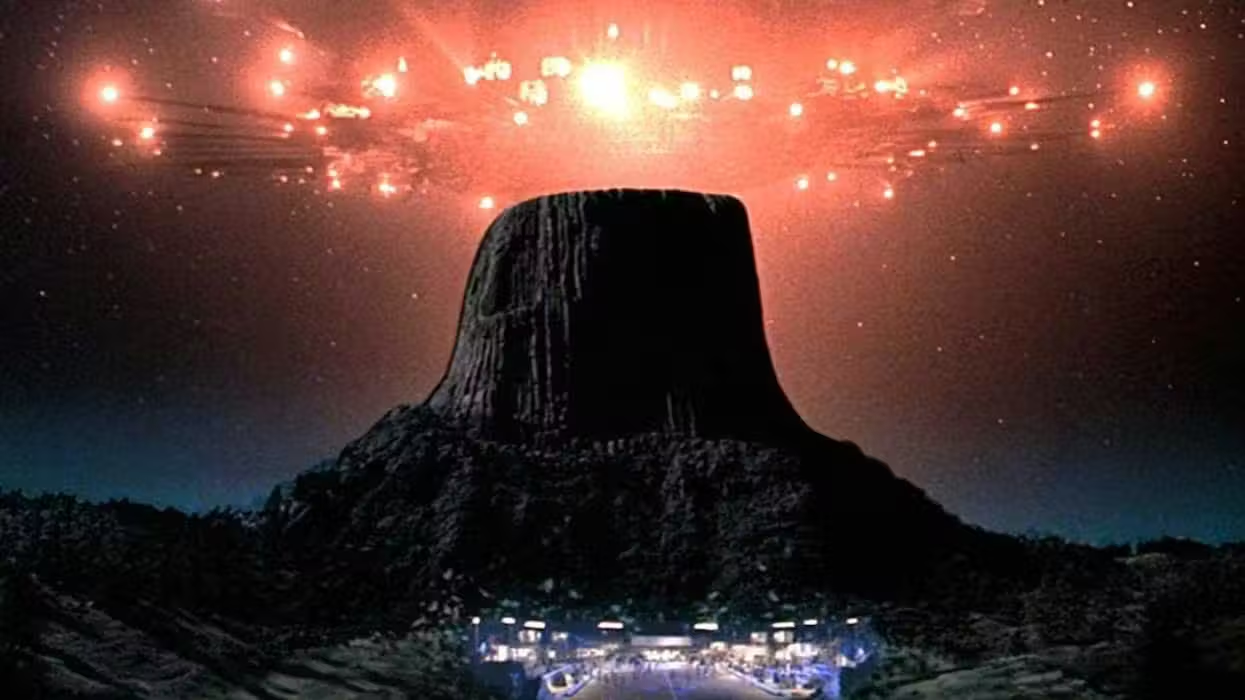
'Close Encounters of the Third Kind'
Blocking is one of those things that sends fear into the heart of filmmakers. You have to decide where to put the camera and the people. It's a lot of decisions to make when you get on set. And then you have to decide how to set up the angles you'll shoot after.
Well, leave it to Steven Spielberg to offer an easy alternative: just shoot a oner!
In an interview on CBS Sunday Morning, the auteur director sat down with Turner Classic Movies host Ben Mankiewicz to look back at his 1977 UFO masterpiece, Close Encounters of the Third Kind.
During their chat, Spielberg took a deep dive into one specific, unbroken take that perfectly illustrates how he uses scene blocking and composition to manipulate an audience's anxiety.
Let's dive in.
- YouTube www.youtube.com
The Anatomy of the Near-Invisible "Oner"
Steven Spielberg is famous for his oners. They're in all his movies, and they help us find the emotional core of the scene by allowing us to drift around
In the scene they watch here, Richard Dreyfuss's character, Roy Neary, looks outside at happy families, knowing he's lost his own. Then he turns from the window and goes back into the living room, where we get a reveal that he's built Devil's Tower from clay and dirt and train pieces and other things around the house.
Rather than cutting back and forth between a wide shot, a medium shot, and reaction close-ups, Spielberg captures the entire emotional collapse in a single, continuous camera movement.
It's sweeping and gets all those angles mentioned, but does it via blocking.
This technique is frequently celebrated by cinephiles as the "Spielberg Oner," a shot that bears his name because he does it so much!
These kinds of shots take precision and planning, but think of all the setups they save when you get them right?
Also, consider how the lack of an edit makes the audience feel trapped in the room with the character. Because there is no cut, there is no release of tension. The dread simply mounts in real-time.
We're getting into Dreyfuss's mental state without too much heavy lifting.
Mastering the Anamorphic Frame
During the interview, Spielberg pointed specifically to the film's widescreen aspect ratio as a crucial storytelling tool. Close Encounters was shot in a wide 2.39:1 anamorphic format.
That means they have a lot of room on the screen, so to fill it, they have action all over.
Spielberg and his cinematographer, Vilmos Zsigmond, used it to divide the emotional geography of the frame. You have neighbors outside playing; they let the curtain be a portal into a living room, where then we see the breadth of the model made of Devil's Tower.
Again, that model changes the scale of how we see Dreyfuss; it's so large and dark in there, we're seeing how it could absorb his mind.
It is a perfect reminder of how you choose to frame your film directly shapes the subtext of the script.
Spielberg relies on expert blocking with his "Second Team" stand-ins while his primary actors are still in hair and makeup to math out the technical physics of a tracking shot, the dolly speed, the lens height, and the precise moment an actor needs to cross the frame, so that when the main cast arrives, he can focus entirely on directing the performance.
You can see all that comes into effect here.
Takeaway for Filmmakers
The lesson in all this is clear: try a oner. I know it seems hard and complicated, but sometimes, the best way to build suspense is to just lock in your blocking and let the camera roll.
What is your favorite shot from Spielberg's filmography?
Let us know in the comments below!