In 1981, a weird little horror movie came out.
It was directed by Gary Sherman and starred Melody Anderson, Jack Albertson (who you might remember best as Grandpa Joe from Willy Wonka), and James Farentino.
In the film, a sheriff (Farentino) and his wife (Anderson) investigate a surprising series of murders in their small coastal town. But then, the victims begin to come back to life, so the sheriff enlists the help of the kooky local coroner (Albertson). They discover a dastardly plot.
The screenplay for Dead & Buried was written by Dan O'Bannon and Ronald Shusett (of Alien fame), and the film has special effects from the illustrious Stan Winston. And they still look great.
But it's a miracle this film got made and looks as good as it does. Dead & Buried survived creative battles, budget constraints, and corporate interference to become a cult classic. We can learn a lot from this near-disaster.
Spoilers for the film below.
- YouTube www.youtube.com
Drama with the Writers
As mentioned, O'Bannon and Shusett had just come off Alien's success (a fraught creative process on its own), and were ready for their next hit.
Sherman told The Flashback Files that Shusett just showed up one day with the script.
"I'm at home one day and there's a knock on the door. There's this little guy at my door who says: Hi! I'm Ron Shusett, and I'm going to be the biggest producer in Hollywood, and I wanna work with you. Apparently, he loved Death Line and had gotten my address through a mutual friend. He asked me what scripts I could sell him. He had a pile of scripts of his own that he asked me to read."
One of them was Dead & Buried.
"I liked about two-thirds of it," Sherman said.
The film's ending reveals that the town's coroner has developed a way to reanimate the dead, and the place is overrun with zombies under his control. In a final-act twist, it's revealed that the sheriff has been dead himself the whole time.
Sherman said he didn't care for how this exposition was delivered in the story, and he didn't necessarily care for the how or the why, either.
"The interesting thing is that he does it, not how he does it. The more you try to explain, the more people will say: Bullshit! Ron agreed with me, but Dan O'Bannon did not. So he separated himself from the film."
Later, O'Bannon disowned the movie, claiming it was Shusett who had written the script alone and needed O'Bannon's name for promotional purposes because of their success with Alien.
In a 1983 issue of Starburst Magazine, he said (via Hysteria Lives):
"All Ronald Shusett needed was my name to get it off the ground. I knew the script needed work, and he promised he would deal with it and not make it anything I would be embarrassed about. I trusted his taste and, with grave misgivings, accepted the $10,000 fee. When I saw it, I realized he hadn't changed one word of the original script I had read, and I hated it, but as he pointed out, I couldn't take my name off it. In print, I can, though, and I want my views on the subject on record. He wanted me to do the same scam with Phobia, but I refused. I swore after that I would never do anything like that again."
However, this tactic worked, Sherman said. Within three weeks of Alien's release, they got the green light on Dead & Buried.
The conflict between Sherman and O'Bannon is a tale as old as time. What happens when creators disagree on the fundamental issue of explaining everything or trusting your audience? Sherman chose mystery over mechanics.
Whether you agree with his choice or not, decide early what your story needs to explain and what it doesn't. Make sure you iron that out during the writing phase.
 Dead & Buried Credit: Embassy Pictures
Stan Winston Was Stressed Out
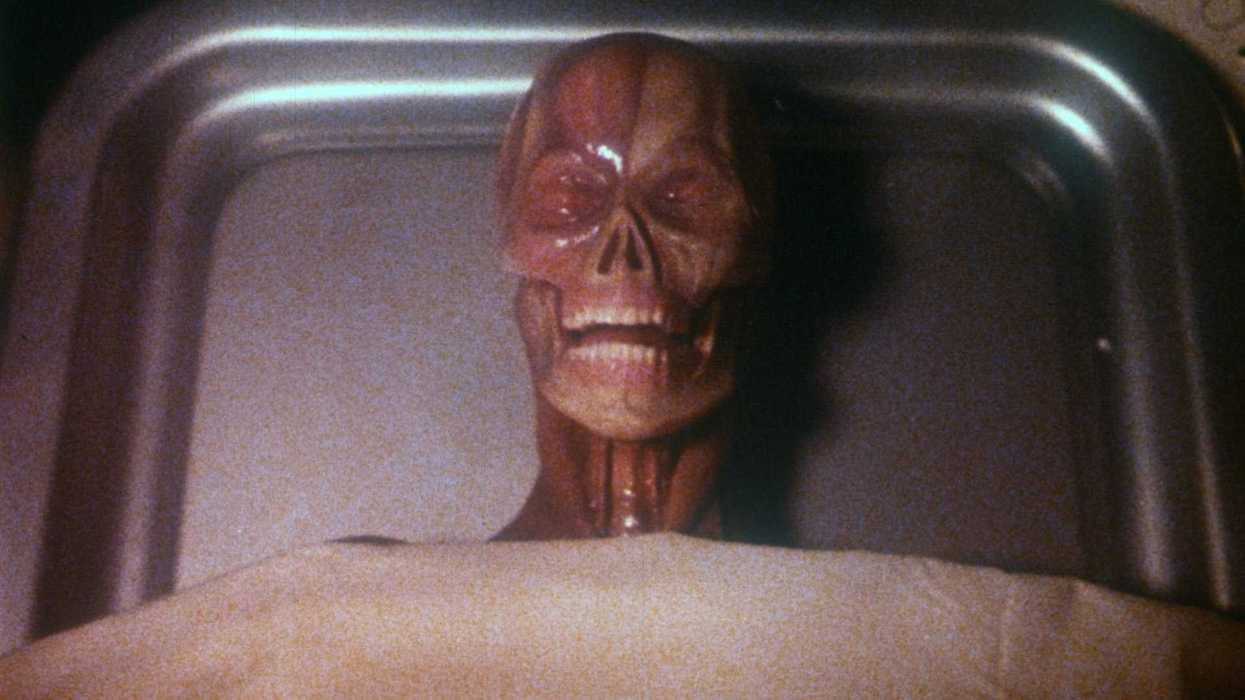
The film's effects are completely practical and hold up well 40 years later. In one sequence, a hospitalized burn victim is finished off by a nurse who uses a huge needle to stab him in the eye. They created an entire fake body and shot the sequence in reverse so that the needle would go into the eye perfectly with every take.
But even Winston did not have the best time on this shoot. He told Fangoria (via Stan Winston):
"I remember we did a test in my studio of the burning head. We did it upside down—which is the way it was scripted and the way it ended up in the movie—and right side up. I had spent an enormous amount of energy trying to create this very realistic burned victim puppet. And after the test, for my eye, it really didn't read as organic to me upside down as it did right side up. So I remember throwing a real hissy fit on the set. On that particular day probably, I was somebody that Gary would say, 'I don't want to work with this guy anymore, he is a brat.' Yet I must say revisiting the film it still works upside down and it really showed in this movie how extensively we could use puppets."
Tensions clearly ran high on set. But this is a good reminder to trust your prep work and know when perfectionism is just fear talking.
Post Production Offered More Conflict
A few years back, SciFiHistory.net looked at the movie's rerelease and director's commentary. Recorded during a gathering celebrating the film's 20th anniversary, Sherman's commentary reveals that the film started as a black comedy. But then the project's production company was sold to another company, only to be bought out a third time.
The third owner demanded a new cut with reshoots to up the gore. Sherman delivered, with all prints of the first cut destroyed by the studio.
Problems persisted into the film's advertising upon release.
According to Hysteria Lives, the ads opted to play up the film's connection to Alien's creators, which resulted in some confusion about its genre and content.
Posters purported that "The creators of Alien ... bring a new terror to Earth." So was this sci-fi horror? (No, it's a zombie film. Which you probably wouldn't get from its first ads.)
One early interview with Anderson in The NY Daily News even called it a sequel to Alien, according to Hysteria Lives.
Not to mention, the film's gore effects initially got it banned in the U.K. as a video nasty. So it had a lot working against it.
This rocky journey is unfortunately common, especially for genre films from newer directors. Protect yourself where you can. Get final cut in writing if possible. Document your original vision. Build relationships with producers who share your goals.
As you get started, know your story's core (Sherman knew the mystery mattered more than the explanation). Trust your craft (Winston's effects still hold up). And understand that external forces will try to reshape your work. Dead & Buried still found its audience despite the chaos.
Have you seen this one?