He’s the hero nobody asked for, the savior who was just trying to get through his day. He's the Everyman Action hero, and he and his tropes are back in the mainstream.
We went through a few decades of massive dudes on HGH playing otherworldly beings, and now it feels like Hollywood is going back to the everyman action hero, the guy next door who takes the role of the world into his own hands.
Today, I want to examine the character tropes and some examples.
Let's dive in.
The Everyman Action Hero
The everyman action hero is the relatable stand-in for the audience. He or she is an ordinary individual thrust into extraordinary circumstances, where they need to fight their way out.
Unlike their muscle-bound, hyper-competent counterparts, these heroes rely on wit, resilience, and a sheer luck to save the day.
Everyman Action Hero Examples

'Die Hard'
CREDIT: 20th Century FoxThe best way to understand the everyman is to look at some character examples from popular movies.
So let's take a peek.
- John McClane in Die Hard (1988): Rhe definitive everyman action hero, McClane is a New York City cop who is completely out of his element. He's barefoot, emotionally vulnerable due to his failing marriage, and physically beaten down. He isn't a super-soldier; he's just a stubborn guy with police training who refuses to give up. His wisecracks are less about bravado and more a coping mechanism for his terror.
- Dr. Richard Kimble in The Fugitive (1993): Harrison Ford portrays a respected vascular surgeon who is wrongfully convicted of his wife's murder. He's not a fighter or a strategist. Kimble is a doctor who uses his intellect, medical knowledge, and sheer desperation to survive, evade a nationwide manhunt, and find the real killer.
- Sarah Connor in The Terminator (1984): In the original film, Sarah Connor is the epitome of the everywoman thrown into chaos. She's a waitress whose life is upended when a cyborg from the future tries to kill her. She is not a warrior; she is terrified, overwhelmed, and completely reliant on a protector from the future, Kyle Reese. Her transformation into a hardened fighter in the sequel is a direct result of the trauma she endures as an ordinary person.
- Roger Thornhill in North by Northwest (1959): This Alfred Hitchcock classic features Cary Grant as a slick advertising executive who is mistaken for a government agent. He's a man who is more comfortable with a three-martini lunch than a gunfight, and his journey is a masterclass in an ordinary man using his wits to navigate a world of spies and assassins.
- Chief Martin Brody in Jaws (1975): The police chief of a small island town, Brody is a man with a fear of the water. He's not an expert monster hunter; he's a public servant who is forced to confront his greatest fear to protect his community from a giant shark.
- Hutch Mansell in Nobody (2021): This film plays with the everyman trope by presenting a seemingly mundane suburban husband and father, played by Bob Odenkirk. While it's later revealed he has a violent past via a bus fight, the setup perfectly captures the feeling of a man ground down by the monotony of everyday life who is reawakened.
Everyman Action Hero Tropes
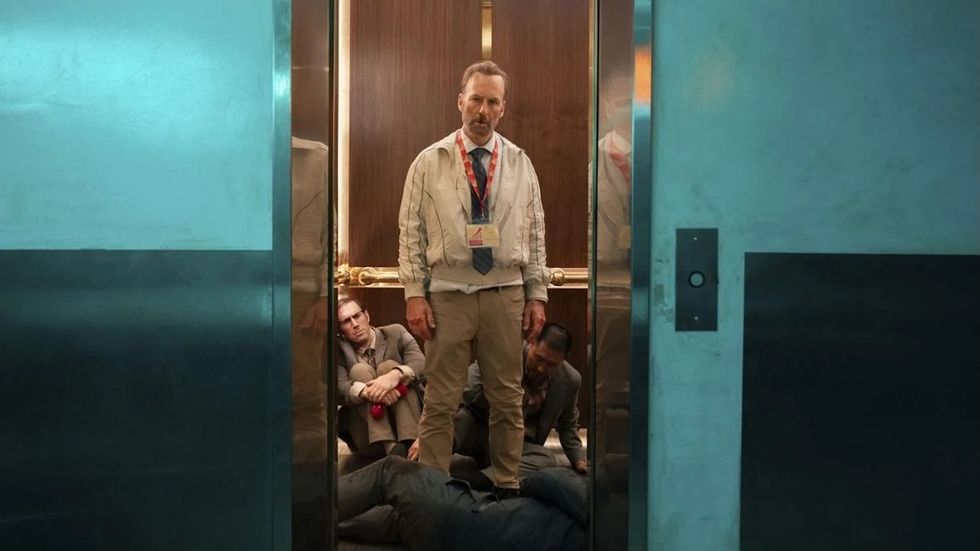
'Nobody 2'
Credit: Universal Pictures
When you're adding one of these characters to your screenplay, you want to dig into their tropes. These will allow you to build out the person and subvert audience expectations when you put your own twist on the subject as well.
- Ordinary Background: Has a normal, often mundane job (doctor, architect, office worker) and deals with everyday problems like bills or family issues, making them highly relatable.
- Initial Reluctance: Doesn't seek out danger. They are dragged into the conflict against their will, and their primary goal is simply to survive and return to their normal life.
- Resourceful, Not Skilled: Lacks formal combat training or advanced gadgets. They rely on intelligence, creativity, and on using everyday objects in their environment to overcome obstacles.
- Palpable Vulnerability: Gets physically hurt in a realistic way (bleeds, bruises, gets tired) and shows genuine emotional vulnerability, including fear, stress, and self-doubt.
- Innate Moral Compass: Driven by a simple, gut-level sense of right and wrong, which compels them to protect innocent people despite their own fear.
- Witty or Sarcastic Humor: Often uses sarcasm and wisecracks as a realistic coping mechanism to deal with the extreme stress and terror of their situation.
Summing It All Up
These characters are a lot of fun to write because you get to identify with them and use your own brains to get them out of certain situations. They have lives like ours, but they are in peculiar circumstances that are fit for a movie.
Audiences love these characters because they deliver movies that feel like they'll happen to them. And they make us think about what we would do if we were in these situations.
Let me know what you think in the comments.