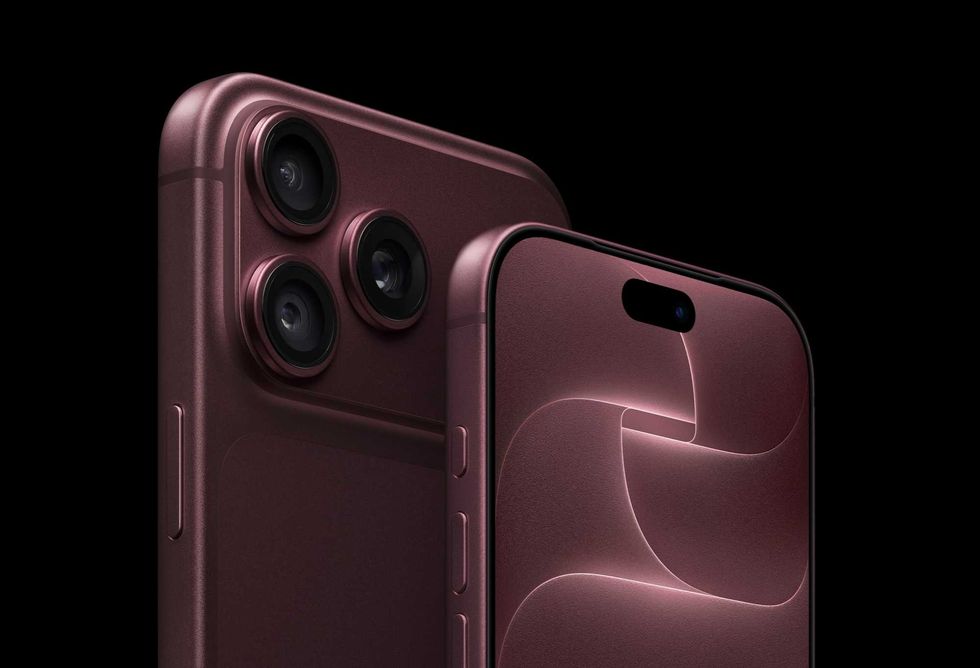
Among all the other news that has recently rolled out for the new iPhone, there is one bit of news that demands the most attention for filmmakers. The iPhone has added a bladed aperture to its lenses on the new iPhone 18 Pro and Pro Max. The camera in the 17 Pro opened to f/1.78, and now the camera can open to f/1.48, while also stopping down to f/4.
That means that, just like your cinema camera, and also like your Fuji X-H2S or Sony FX3, you can adjust the aperture of the lens. This is a tremendous technical feat: to squeeze even more functionality into the tiny little camera that goes in your pocket.
Why Are We So Attached to the iPhone
Credit: Apple
As the internet always does, some people pointed out that there are other competitors in the mix with a variable aperture. That’s true, but right now in the “cinematic filmmaking” space of people hoping to tell bigger stories with their phone, the iPhone really owns the space. Since Tangerine up through 28 Years Later, the iPhone is the defining “wow, you can do good work on this platform” camera.
Reasons to Be Excited
Credit: Apple
Well, first and foremost, it lets you adjust your exposure without either changing your ISO or adding external ND filters, and that is huge. Filmmakers care more than anyone else about consistent image quality, and changing exposure by ISO can mean that two shots in the same scene have different noise quality. To change exposure by exposure time can mean they have different motion sensations.
Mixing an f/2 and an f/4 shot in the same scene is so common it happens all the time. Filmmakers are going to love having this level of control without having to change other settings that create image issues they have to polish out later, if it’s even possible.
Why These Specific Apertures
Credit: Apple
So the widest aperture on almost every lens ever made is “as wide as the designers can make it.” It’s how lenses are marketed, it’s how we talk about them conversationally, it’s what we call the “speed” of the lens, so that wide end is not that big a deal.
It’s the other end of the range, the end of “stopped down” that might flag for some folks. Most higher-quality lenses can stop down to a 16, 22, or even occasionally a 32. This only goes to a 4.
The reality is that beyond a 4 is actually very rarely shot on set. First off, you start to get a lot of depth of field, and these tiny lenses and sensors already have a lot of depth of field, so there isn’t a benefit to stopping down. In addition, lens image quality tends to be best in the range of a few stops from wide open. Most filmmakers avoid shooting more stopped down since the image is most pleasing in that window. Stop down further from a 5.6 and on most lenses you start to worry about Lens Diffraction, which you also want to avoid.
It is likely that there was an engineering limit to why it only goes a 4; bigger blades need more space and take more time to move, so for what Apple wanted to do it didn’t make sense. But for filmmakers, the f/4 hits a real sweet spot where it’s unlikely there is going to be much need to stop down beyond that for us.
Of course, that is only a 3-stop range (roughly 1.4 to 2 to 2.8 to 4). But 3 stops is a big change in light! Try shooting a scene that should be at 1.4 with your camera set to 4, and you’ll see how dramatic the change is. Combined with small changes in ISO and shutter speed, you now have another major tool in the arsenal for creating the images you want in a consistent fashion.
But Why Not T-Stops?
Credit: Apple
Most filmmakers at this point are working in t-stops, not f-stops. But this is all listing f-stops; some might not feel like it's not "filmmaker" focused if it's not listing t-stops. The main reason is that f-stops are more broadly understood by the public, and that likely the f- and t-stops here are basically the same.
T stops measure the light passing through the lens (they are “tested” stops), since glass sometimes causes light loss. These lenses don’t have a lot of glass! So they aren’t going to lose a lot of light. There isn't really a benefit to Apple here of pushing T stops too hard, and with digital sensors the issue isn't as large.
Conclusion
Credit: Apple
Filmmakers should be very happy and feel very engaged to see this arrival on iPhones. The big focus on the new cooling tools is another good sign that Apple still focuses on filmmakers; very few other users use sustained processing power like filmmakers, so worrying about overheating is definitely a sign that we are in Apple's target as they engineer these devices.
Still photographers will care, and there will be some improvements in TikTok posts, but this is very much a feature that filmmakers will appreciate more than just about anybody else, and it’s always nice to feel a bit special.