The Chilling Montage That Turned ‘The Godfather’ Into a Masterpiece
Inside Coppola’s most haunting crosscut montage that seals Michael’s fate forever.
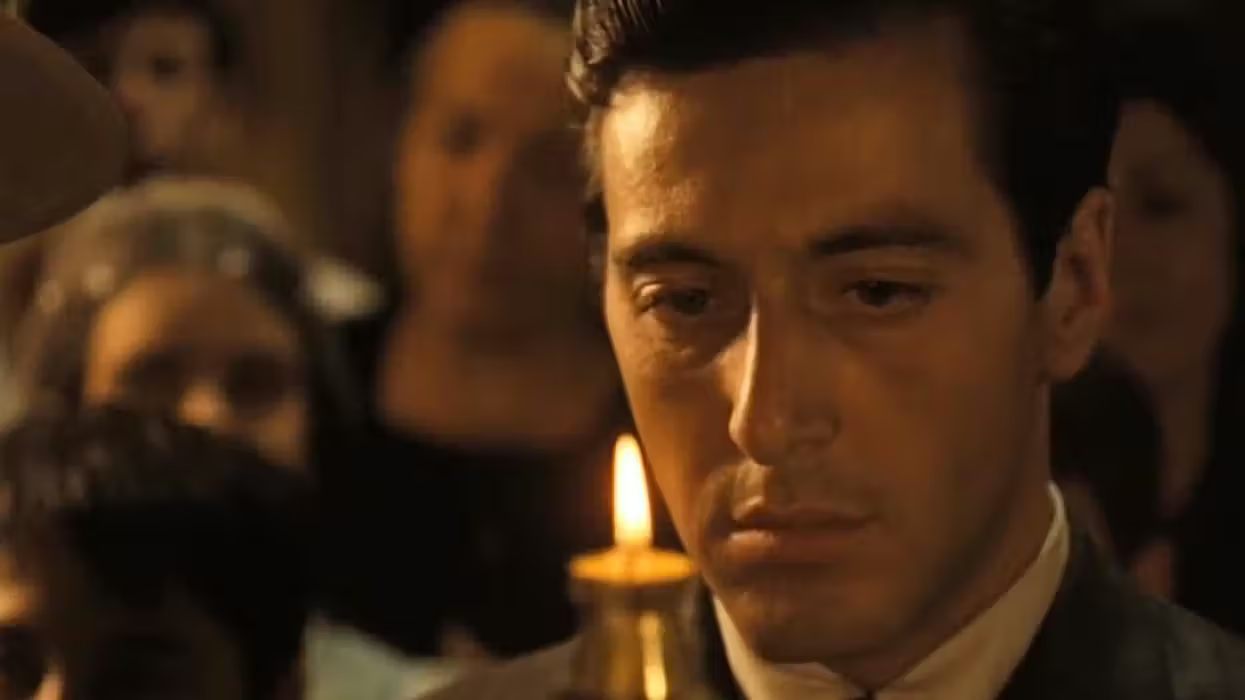
Al Pacino in a still from The Godfather (1972)
Watching the baptism montage in The Godfather (1972) is like watching a knight in shining armor looking into the mirror, only to see a monster returning his gaze. There couldn’t have been a better way to sum up Michael Corleone’s (Al Pacino) fall from grace than this sequence of contrasting images: the baptism and the carnage.
The baptism: solemn, peaceful atmosphere. Sacred organ tunes. Michael, or Uncle Mikey, holding his baby nephew as his spiritual godfather, guiding him onto his righteous path, vowing to protect him.
The carnage: Multiple mob bosses and heads of crime families being violently assassinated in broad daylight—on Michael’s directive.
As these images intercut with each other, we see Michael’s real-time metamorphosis from a golden boy and war hero into the monster he once claimed he would never become.
The genius of this montage lies in the fact that, aside from advancing the plot, it splits open the story’s protagonist, his soul, and shows us how he is going to exist in duality from now on: a loving, protective family man and a cold, calculating criminal.
Michael’s Journey
Michael’s character arc is one of the most studied ones in cinema. His journey from an outsider who rejected his family’s criminal legacy to someone who became its beating heart is a great example of character transformation.
The Gentleman
Michael once reassured his anxious girlfriend, Kay (Diane Keaton), saying, “That’s my family, Kay. That’s not me.” By saying this, he distanced himself from everything that his family stood for. Kay believed him. We believed him. How could we not?
He was the one who broke away from the circle of violent power that defined his family. He was the one who fought in a war for a noble cause. He was the one who epitomized the legitimate American future.
The Criminal
That respectable distance between him and his family, however, was shattered when there was an attempt on his father, Vito’s (Marlon Brando), life. His brothers were a dysfunctional duo—Sonny (James Caan) was too hot-headed to lead—or survive; Fredo (John Cazale) was too meek. The power vacuum that built up threatened to destroy the family. So, when Michael took charge, his transformation began, not as his hunger for power, but as a cold, calculated, and reluctant decision.
Understanding the Montage
The baptism scene is a prime example of how Coppola uses his directorial vision and cinematic language to show Michael’s internal and external conflicts. In fact, many critics consider this scene a technical marvel because of how he crafts and uses every element to heighten the scene’s grinding irony.
Crosscut Editing Between Two Parallel Tracks
The baptism scene gains its impact from its use of parallel editing, also known as crosscutting. Coppola intercuts between two realities that are happening simultaneously.
On one hand, the godly: the ornate church, the holy rites, the priest’s sacred words, and the anointing with holy water.
And, on the other hand, we see the ungodly: the massacre of the rival crime-family bosses, one getting shot through the eye while another being gunned down on the courthouse stairs or while stuck in a revolving door.
These intercuts transform the church’s serene setting into a holy backdrop against which the unholy purge unfolds.
Sound Design That Created Audio-Visual Paradox
Even though these two visuals taking place at the same time are wildly opposite, the sound that echoes in both is the same: the hypnotic, almost droning church organ tunes. This sound effect is what binds these two visuals together. It becomes the baptismal font at which Michael is anointed with blood.
Also, the organ tunes give the visuals of a massacre a kind of formal, almost ceremonial aura. It highlights the preordained nature of the violence, similar to the preordained nature of the religious ceremony.
The only sounds that disturb the steady flow of organ tunes are the priest’s words and the baby’s crying. They become the symbol of innocence being destroyed with each gunshot.
Christening of a New Don
The scene has minimal dialogue; only the ritualistic vows are exchanged between the priest and Michael. But that exchange is paradoxical. When the priest asks Michael if he renounces Satan, all his works, and all his promises, Michael, each time, while standing before God and with a straight face, affirms. “I do renounce him,” he says—while his men are doing Satan’s work, just as he had instructed them. The irony is that with every promise to renounce sin, Michael descends deeper into it.
The baptism scene underscores Michael’s professional victory and, in some way, the theme of the entire trilogy—he has taken down his rivals and has a monopoly over the sinister power that breathes in the lungs of his business. He has saved his family. And yet, on a personal, human level, he has sacrificed himself at the altar. He has damned himself for eternity.
When Michael says, “I renounce Satan,” he isn’t renouncing Satan. He is becoming one.
- Watch: How Minimalistic Cinematography Brought 'The Godfather ... ›
- Read and Download 'The Godfather' Script | No Film School ›
- What Does Steven Spielberg Think is the 'Greatest American Film ... ›
- 6 Secrets of 'The Godfather' Production from Coppola and the Cast ... ›
- Why Are These People Criticizing 'The Godfather' on Twitter Today ... ›
- Breaking Down Michael’s Kiss of Death in 'The Godfather Part II' ›
- Michael Corleone's Arc in 'The Godfather' Films Proves He's the Best ... ›
- How a George Lucas Box Office Bomb Saved 'The Godfather' ›
- The Calm Before the Storm: Analyzing Don Vito’s Lethal “No” That Ignites ‘The Godfather’ ›
- “They Didn't Want Me”: Al Pacino Thought He Would Be Fired From One of the Greatest Movies Ever Made ›