Margaret Atwood's 1985 novel The Handmaid's Tale imagined a dystopian future where women are stripped of autonomy and sorted into color-coded castes.
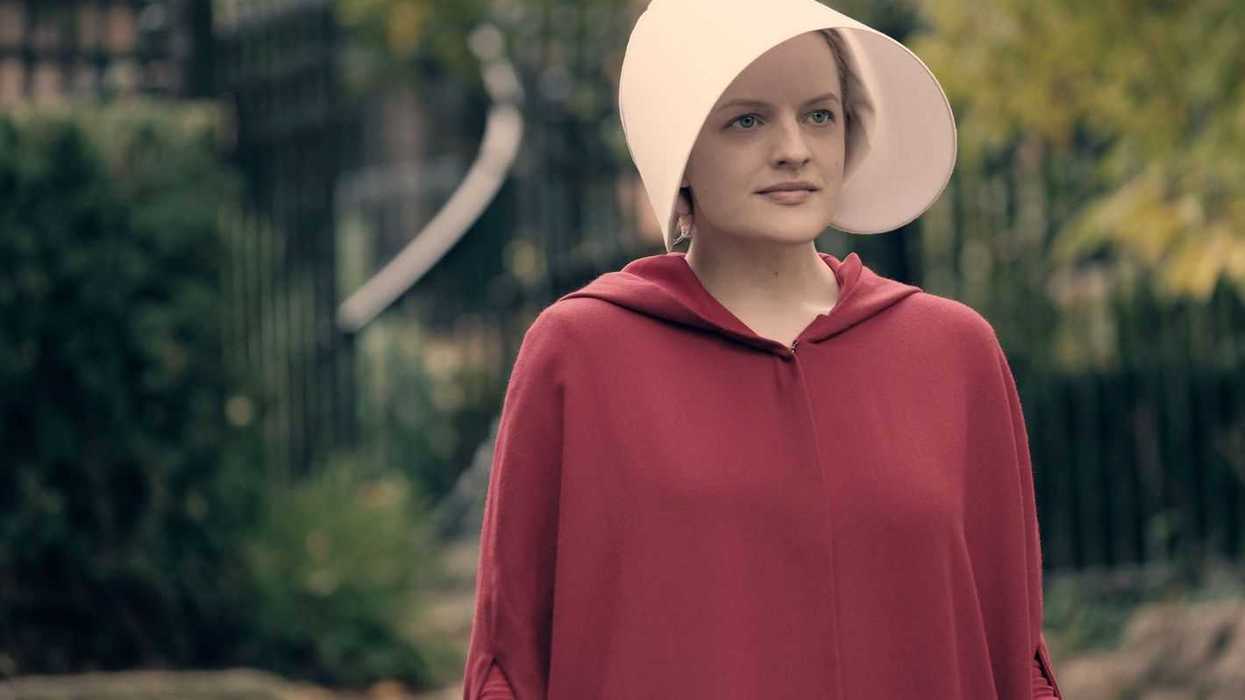
When Hulu adapted the story in 2017, costume designer Ane Crabtree had to bring to life uniforms that already existed in readers' minds.
In the novel, Offred talks about the clothing like this:
I get up out of the chair, advance my feet into the sunlight, in their red shoes, flat-heeled to save the spine and not for dancing. The red gloves are lying on the bed. I pick them up, pull them onto my hands, finger by finger. Everything except the wings around my face is red: the color of blood, which defines us.
Where did this come from, for Atwood?
It turns out that a childhood memory of a cleaning product terrified her as a child.
In a recent interview with 60 Minutes, Atwood revealed the origin of the handmaids' distinctive red cloaks and white bonnets. She brought up the Old Dutch Cleanser packaging, which featured a woman whose face was obscured by a bonnet, holding a stick and chasing something.
 Old Dutch Cleanser
The image disturbed young Atwood, and decades later, it became the template for one of fiction's most recognizable costumes.
Atwood also explained that the wives would wear blue, referencing the Virgin Mary, while the handmaids would wear red, invoking both Mary Magdalene and Hester Prynne's scarlet letter from Nathaniel Hawthorne's novel.
Building the Uniform
When Crabtree got the assignment, she approached the project as both a longtime fan and a visual artist determined to make something universal. She had read the novel when it was first published and seen the 1990 film adaptation, but she knew her version needed to feel immediate and contemporary.
According to multiple interviews with Crabtree, her design process began with an unusual perspective.
"The way that I started the kind of ideology of designing that, and that restrictive thing in the clothing for the different tribes, was to come at it from a male point of view—to pretend, while I was sketching, that I was one of the small percentages of white men in power, one of the commanders," she told Deadline. "I thought, let me just come at it from someone who's actually trying to be quite idealistic and iconic, in the way that people during wartime were."
The handmaids' costumes needed to function as what Crabtree called prison uniforms. She drew inspiration from how prisons remove shoelaces to prevent self-harm, applying similar logic. The heavy fabric restricted movement. The bonnets, which Crabtree calls wings, prevented peripheral vision and created isolation even in groups.
"We knew early on it could not be an abstract head-covering and dress. We wanted viewers to be filled with fear, psychologically looking in the mirror saying, 'Oh, my god, this is now,'" she told ARTSATL.
This approach of finding inspiration in everyday objects and images gives dystopian design its unsettling power. We recognize elements, twisted just enough to reveal their darker potential. That's how a cleaning product logo becomes a uniform of oppression.
The impact of Crabtree's designs extended beyond the screen faster than anyone anticipated. Shortly after the show's premiere, activists began wearing red robes and white bonnets at protests over reproductive rights. What started with a Texas protest organized by NARAL quickly spread to Senate hearings and other demonstrations.
- YouTube www.youtube.com
What Filmmakers Can Learn
Dystopian design doesn't require inventing everything. You can look to something familiar, like a famous image or label, a historical garment, or a memory, and give it your own twist.
As Crabtree noted in interviews, she wanted the uniforms to feel universal rather than tied to one specific religion or culture, but you're not limited to that unless your creative team gives you that directive.
Learn the psychology of color in film. It's an entirely different language you can draw from in your design.
Learn how to use costumes to show character transformations.