Character exits are painful for audience members.
So many times, I’ve cried like a baby after the death of my favorite character in a book. I’ve even been mad at an author for this and didn’t buy their book for quite some time as an act of rage.
What else could I have done? Could I have broken their ankles with a sledgehammer till they rewrote the character’s destiny?
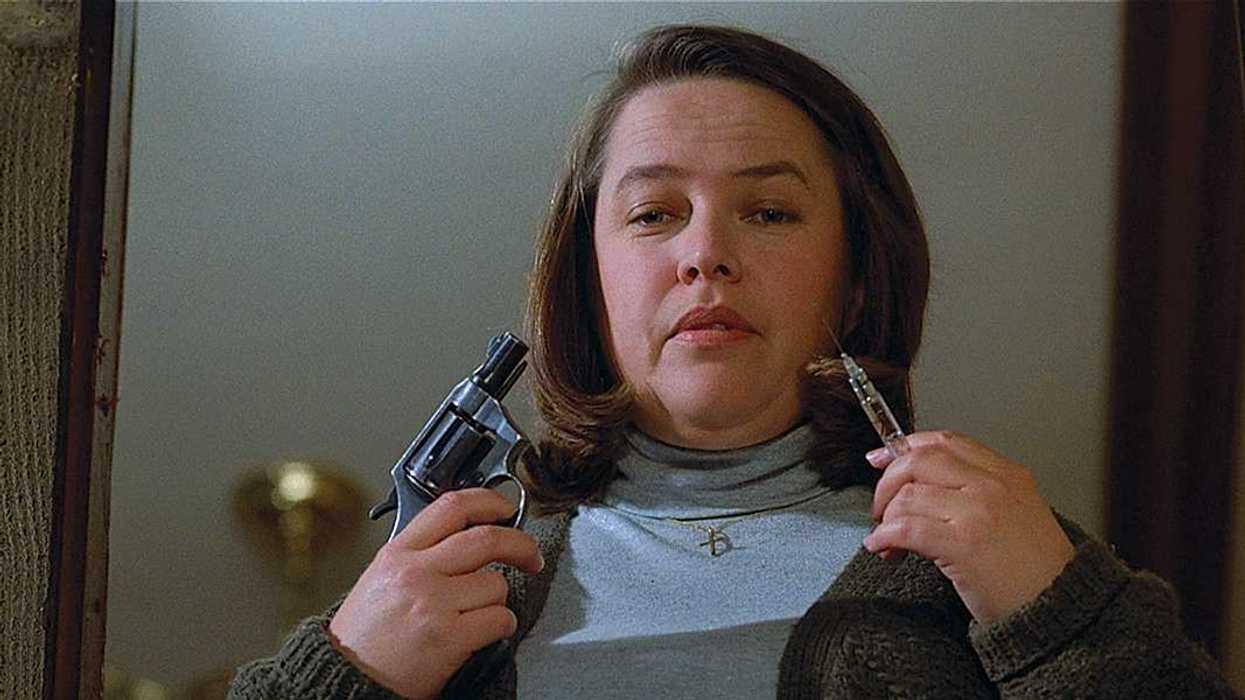
Relax, I’m just kidding. I’m no Annie Wilkes (Kathy Bates), yet she is someone who feels like she could be living next door, and I wouldn’t know this side of her even if we exchanged pleasantries every morning.
That’s what makes her so scary. Also, she’s a female character who subverts every societal expectation at will for something dear to her, yet is still very much molded by them.
In this article, let’s analyze Annie Wilkes as a female villain who reshaped how horror conceptualizes female villains.
To Give You a Little Context
Based on Stephen King’s namesake novel, Rob Reiner’s film Misery follows a famous author who’s held captive by his number-one fan after she learns he has killed off her favorite character in his upcoming book.
Enraged, the ardent fan tortures her favorite author into rewriting his novel, altering the character’s destiny.
The story opens with Paul Sheldon (James Caan), a renowned author, on his way home after completing his latest novel. Paul meets with a terrible accident while driving through a blizzard and would have died there, buried in snow, if not for Annie, who not only rescues him but also nurses him back to health.
She is Sheldon’s biggest fan and is honored to have this opportunity. Only, things suddenly get out of hand when she learns that Sheldon has killed off her favorite character in the upcoming sequel to her favorite novel series.
Bereaved, she takes Sheldon hostage, making him rewrite the entire book, after she burns his version of the manuscript. To ensure that he cannot escape her remote house in the mountains, she breaks his ankles with a sledgehammer.
Analyzing Annie as a Female Antagonist
Annie is like a breath of fresh air when it comes to antagonists. She has no supernatural motivations, but a passionate personal vendetta that gets triggered by grief—the kind that is alien to us but somehow ends up making connections.
The absurdity of the premise—that a fan believes they own the author and IP of their favorite book—reflects a toxic aspect of fan culture, showing how celebrities are burdened by their own fans.
When she meets Sheldon, it’s her life’s golden moment to meet the man who created a character that became family to her. But then something clicks the moment she learns that he is about to kill her in the next book.
 'MIsery'Credit: Metro-Goldwyn-Mayer, Columbia Pictures, New Line Home Entertainment
Annie embodies femininity and innocence until she unleashes her dark side. She bakes, speaks in folksy euphemisms, and is motherly—qualities typically not associated with violence.
Also, the most interesting part of Annie’s villainy is that she genuinely believes that she is helping Sheldon by forcing him to make corrections. In a way, she wants the best for him and the book, and Sheldon is not quite able to do it with his new manuscript.
Annie’s smile isn’t that of a manipulator. She is a caregiver whose love language is control.
 'Misery'Credit: Metro-Goldwyn-Mayer, Columbia Pictures, New Line Home Entertainment
She is annoyed from time to time when the one in her care disobeys her, but comes back to being the nurturer who’s fundamentally convinced of her own goodness. That smile is of someone who has rationalized their own pathology.
What is your favorite Annie moment from Misery?