"I Will Have My Vengeance, In This Life Or The Next" - Lessons From An Incredible ‘Gladiator’ Line
How a single sentence defined Maximus and sealed his fate.
Gladiator (2000)
Ridley Scott’s epic, Gladiator (2000), is brimming with iconic lines of dialogue from start to finish. “I will have my vengeance, in this life or the next” is perhaps the most defining one.
It isn’t merely a line that crystallizes Maximus’s willpower; it defines him as a human being, revealing his past, present, and the future he is fighting for.
The line reveals the grief that burns through Maximus, and the anger that makes vengeance his primary goal in life. In a few simple words, it drowns out everything else and puts absolute focus on Maximus’s ambitions.
Let’s take a deeper look at this dialogue and find out what writers can learn from it.
What Is Gladiator (2000) About?
Directed by Ridley Scott, Gladiator is an epic historical drama set in ancient Rome. It tells the story of General Maximus Decimus Meridius (Russell Crowe), a loyal commander admired by Emperor Marcus Aurelius (Richard Harris).
When Marcus Aurelius dies, his menacing son, Commodus (Joaquin Phoenix), seizes the throne and orders the execution of Maximus along with the killing of his wife and his son. Maximus manages to escape but is sold into slavery as a gladiator.
Over time, Maximus is trained by Proximo (Oliver Reed), and he rises through brutal arena battles and becomes a legendary fighter, “the Spaniard”, who is both admired and feared. Maximus is driven by his deep internal grief and the urge to take revenge for the death of his family. Eventually, his battle against Commodus becomes a battle to restore the Republic.
At the end of the film, Maximus gains his revenge, but at the ultimate price.
Breaking Down The Line
"Father to a murdered son, husband to a murdered wife. And I will have my vengeance, in this life or the next."
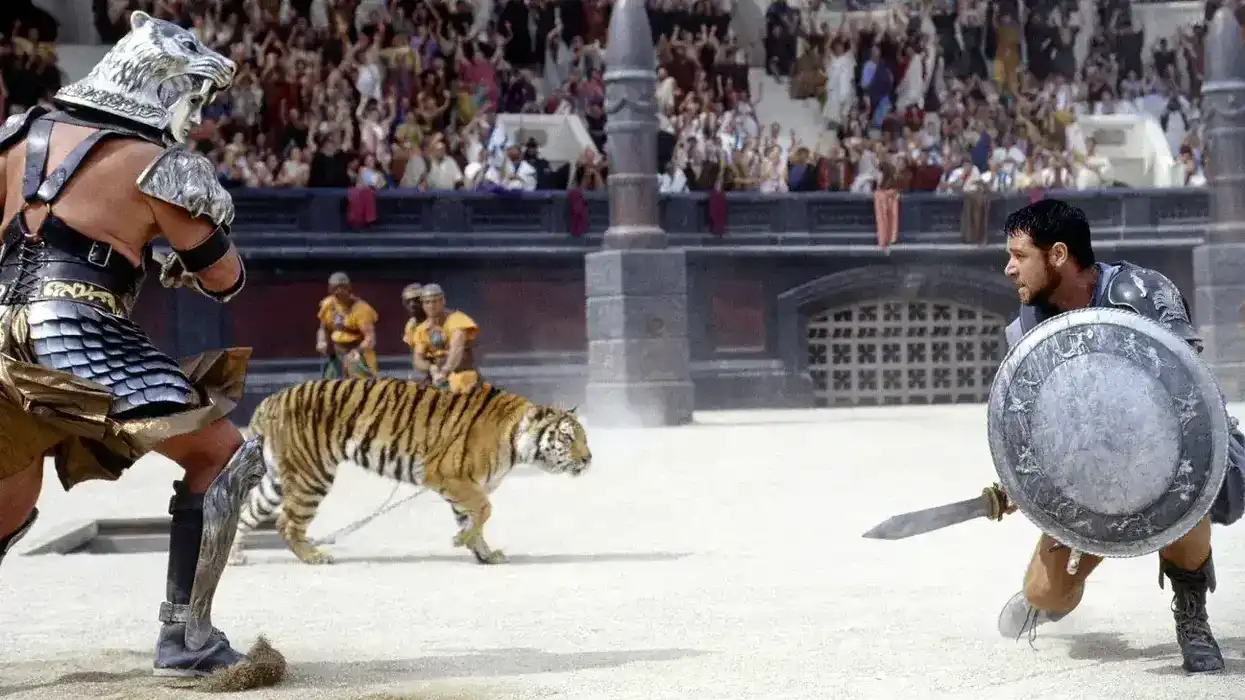
Maximus delivers this line, iconically, in the Colosseum, to Commodus, in front of other gladiators and an agitated crowd. It is a crucial moment in the film and in Maximus’s life. It is the moment Commodus becomes aware of Maximus’s identity and the name of his father.
The reveal is a powerful moment in the film. It sets the tone for a bloody vengeance saga fueled by Maximus’s unrelenting ambition. Without saying too much, the line condenses Maximus’s entire motivation in just a few words.
It leaves little room for Commodus to discover Maximus’s purpose in the later parts of the story. The manner in which Maximus says these words underlines his fearlessness and the fact that he feels he has nothing left to lose. Maximus turns his pain into his identity. The use of the word “murdered” twice commands attention to his suffering and dangerously blames a man who has complete control over him and Rome.
“I will have my vengeance” is stated as an assurance, not as a hope. Maximus’s emphasis on revenge is so spectacularly focused that anything that could deter him from it holds no consequence whatsoever. This line transforms a shattered man into a formidable force to be reckoned with. A man who is driven by a cause so deeply personal that his own life matters little.
This dialogue sums up Maximus, his purpose, his relationship with Commodus, and the film itself, which is driven by his fearlessness and ruthless determination.
What Writers Can Learn From This Line
Now that we have analyzed this line of dialogue, let’s take a look at what we can learn from it and how we can apply it to our writing.
The line “Father to a murdered son, husband to a murdered wife. And I will have my vengeance, in this life or the next” is a masterclass in heartfelt, devastating writing that is exceptionally true to the character who says it. As writers, we need to observe and understand how this line condenses Maximus’s entire character arc in a single, unforgettable moment.
We may not have a moment like this in everything we write, but we can learn from how keenly this dialogue understands and defines its lead character. What I mean by this is that this line, without going into a long, endless monologue, captures the essence of Maximus’s identity and uses his loss as fuel for his motivation.
It does not burden us with a backstory we are already aware of; it simply highlights it at a moment that is so threatening, it could cost Maximus his life then and there, with no real shot at revenge whatsoever. Now imagine this was a line uttered to a character in private, when the stakes were low. Would that establish Maximus’s character with the same amount of power and urgency? I don’t think so.
The idea of Maximus saying these words at a moment that would probably see others bend in fear brings attention to his confidence and makes his ambitions irreversible. “In this life or in the next” makes Maximus’s words a powerful vow there is no turning back from.
Most importantly, I think this line is a masterclass in quiet confidence. Maximus does not say these words by screaming them out, which wouldn’t make it unrecognisable in a period film of this nature. He says these words softly, confidently, turning his emotions into the purpose of his life.
As writers, we always try to put down words that can go far beyond the scene. Words that make people remember our characters. Often, the way to do this is by not trying too hard. I don’t think there is anything particularly complicated about these lines. They are simplistic and definitive of Maximus’s character, and they are performed with the same subtlety with which they are written. Being true to the moment, to the character, to their backstory, and to the scene can be the greatest trick in the book.
Final Thoughts
More than two decades later, Maximus’s words still echo in our ears because they perfectly capture his character, his purpose, and put him in a position from which there is no escape. There’s no spectacle or word play, only the truth that is delivered with utmost clarity.
What are your favorite quotes from Gladiator? Tell us in the comments below!
- The 11 Best Civil War Movies | No Film School ›
- How to Film in a War Zone | No Film School ›
- How To Write a Historical Drama Screenplay | No Film School ›
- How to Make Period Pieces on a Micro-Budget | No Film School ›
- Film Quote of the Day: The 'Gladiator' Line That Reveals Why Cicero Remained Loyal to Maximus | No Film School ›