Everyone Thought This Movie Would Be a Disaster, Then It Went on to Make Oscar History
How did It Happened One Night come into existence?
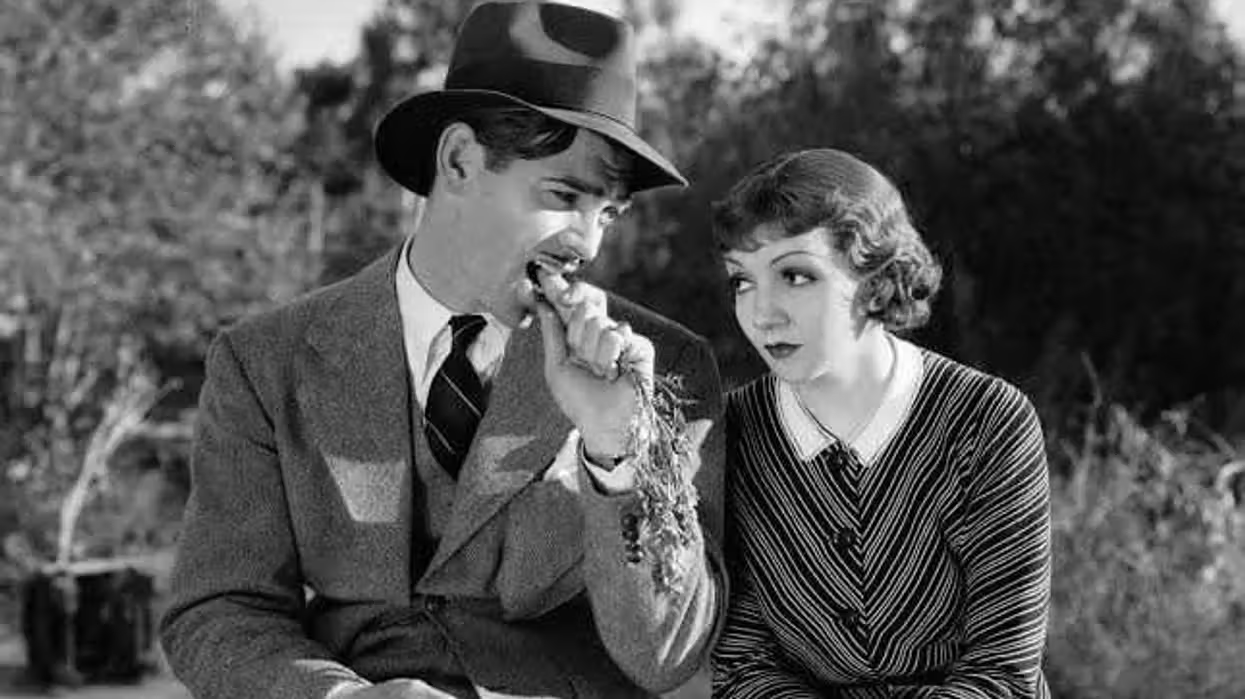
'It Happened One Night'
It can be hard to get young people into old movies. They tend ot think of them as stitled or slow, and for some reason, black and white can also be a barrier to entry.
But there's one classic movie I love to show to people trying to get into classical Hollywood, because I think it really captures what we still love about cinema and remains totally accessible.
That's Frank Capra’s 1934 masterpiece, It Happened One Night.
This movie basically invented the modern romantic comedy, pioneered the screwball subgenre, and became the very first movie to sweep the "Big Five" at the Academy Awards (Best Picture, Director, Actor, Actress, and Screenplay).
It's also a fun film to study, because the making of the movie was chaotic and hilarious. According to a deep dive into the archives by Turner Classic Movies, it was a study in how creative friction, happy accidents, and intense limitations can lead you to cinematic gold.
Today, I want to give you a brief history of the movie so that you have a way to pitch it to people you want to watch and know more about it yourself.
Let's dive in.
- YouTubewww.youtube.com
The "Poverty Row" Problem
In 1933, Columbia Pictures was not the powerhouse studio it is today, while partnered with Sony. It was considered to be one of the lower-tier places they thought of as just a tiny step up from "Poverty Row."
Poverty Row studios were looked down on as factories for trash pictures and B-movies that were more sleazier than star-driven.
If you read Frank Capra's awesome autobiography, The Name Above the Title, you know that before he was the most famous director in Hollywood, Capra was a guy searching for a job, usually along Poverty Row.
He and screenwriter Robert Riskin had a sharp script adaptation of a magazine story called "Night Bus," but no major star wanted to touch it. He sought out names like Myrna Loy, Miriam Hopkins, Margaret Sullavan, Carole Lombard, and Bette Davis.
Every single one of them passed.
When they tried to borrow Robert Montgomery from MGM for the male lead, he claimed that there were already "too many bus pictures."
So what did Capra do to get his little movie that could over the line?
He looked for a star that needed some help.
A Star Spanking
As all this was happening, Louis B. Mayer had a problem at MGM. He had a star, Clark Gable, rising through the ranks. But as Gable got more famous, he wanted more money and more opportunities. MGM had roles he didn't like, and he wanted more money to do the roles he did want to do.
Well, a studio head couldn't have his star pushing him around, so he decided to teach Gable a lesson. So he called up Columbia and said, "I got an actor here who's being a bad boy, and I'd like to spank him."
This version of spanking wasn't kinky; it was just Mayer sending Gable to Poverty Row to force him to do a low-rent movie made by Frank Capra about a bus.
Gable was admittedly pissed off about this kind of betrayal, and when he showed up to meet Capra the first time, he was hammered.
It was a terrible start, but once Gable actually sat down and read the screenplay, something shifted. He realized the fast-talking, cynical journalist Peter Warne was a great role, and that this story had something people would connect with on another level.
So Gable locked in and agreed to star in the movie he'd been looking for this whole time.
$50,000 and Extreme Skepticism
With Gable locked in, they still needed their leading lady. But now, they had a star to prove this wasn't just some poverty picture. So they went after Claudette Colbert, who was under contract at Paramount.
This was a warm read, Capra knew and had worked with Colbert on a box office bomb a few years prior...so maybe it wasn't that warm after all.
Still, Colbert knew how much a production like this one would need someone like her. So she agreed to take the role on two conditions: her salary had to be doubled to $50,000 for just four weeks of work, and shooting had to wrap before her scheduled vacation.
The nice thing about places like Columbia at the time is that they had no problem rolling the dice on paying these stars, so they were in.
That should have made Colbert happy, but she was deeply afraid she had just sold out her entire future for fifty grand.
Now, as the story goes, Colbert famously gave Capra a hard time about everything on set, from scheduling to wardrobe. In fact, the moment shooting wrapped, Colbert reportedly walked off the set and told her friends, "I've just finished the worst picture in the world!"
Production Constraints Become Plot Points
So the vibes making this movie may not have been high, but at least they all didn't have to spend too much time together. The four-week shoot went at a breakneck pace to make sure they captured everything.
All this friction led to some cinematic fire, supercharging the film's visual storytelling.
Because they were moving fast, they had to innovate on the fly, and we got the famous "Walls of Jericho" scene.
Basically, Gable was really clumsy at taking his shirt off. It was not graceful or sexy.
So Capra and Riskin used a blanket draped over a clothesline to separate the two characters in the room and did a rewrite on the fly, so they could undress off camera.
This forced piece of blocking actually made the scene build sexual tension out of literal thin air (and a bedsheet). It is easily one of the most famous scenes in cinema history and one that people talked about when they left the theaters back in the day.
The big reveal in that scene is that, as Gable removes his shirt, we see he has no undershirt. This supposedly caused a sharp drop in undershirt sales as men everywhere decided to wear their shirts like Gable, with nothing underneath.
Then there's the hitchhiking scene, which is probably one of the most famous scenes ever to be in a movie, maybe the most famous scene.
Colbert initially refused to pull up her skirt to hail a ride, prompting Capra to hire a chorus girl as a leg double.
That double pissed off Colbert, who swore she had better legs than hers.
So Colbert sent the double packing and delivered one of the most iconic comedic moments in cinema history.
- YouTubewww.youtube.com
Why this Echoes for Modern Filmmakers
Aside from being a classic movie, I love showing it to people who have never seen it. I think this movie holds a ton of lessons for modern filmmakers. It's one of those stories that tells you you have to not only be passionate and have a great script, but also be willing to go back to basics and improvise to get your movie made.
When It Happened One Night hit theaters in 1934, it exploded into the cultural consciousness.
The movie was a massive box office hit and dominated the Oscars, proving that the cast's initial misery had absolutely no bearing on the magic they caught on camera.
It rocketed Colbert and Gable into massive points of stardom they previously thought they might never reach, and it launched a few decades of wonderful Frank Capra movies that touched on the heart and soul of America.
Decades later, Capra reflected on the chaotic four weeks in a way that every filmmaker working on a stressful indie set should take to heart:
"We made the picture really quickly - four weeks. We stumbled through it, we laughed our way through it. And this goes to show you how much luck and timing and being in the right place at the right time means in show business: how sometimes no preparation at all is better than all the preparation in the world; and sometimes you need great preparation, but you can never outguess this thing called creativity. It happens in the strangest places and under the strangest of circumstances. I didn't much care for the picture, [yet] it turned out to be It Happened One Night."
Summing It All Up
This is a great movie that is fun to go back to and to hold to your heart as you trek forward on your own filmmaking journey.
No matter the ups and downs of your career, it's important to try to find creative solutions to your problems. Sometimes the answer is not to fight, but to rework ideas in ways that feel like they have the best payoffs or that dig into the theme in angles you never could have imagined.
Let me know what you think in the comments,