Film Quote of the Day: Line from John Wayne's 1940 Western Classic Reminds Us New Beginnings Come at a Cost
"It takes a good fire to burn down the weeds... to let the flowers grow." - John Wayne as Bob Seton.
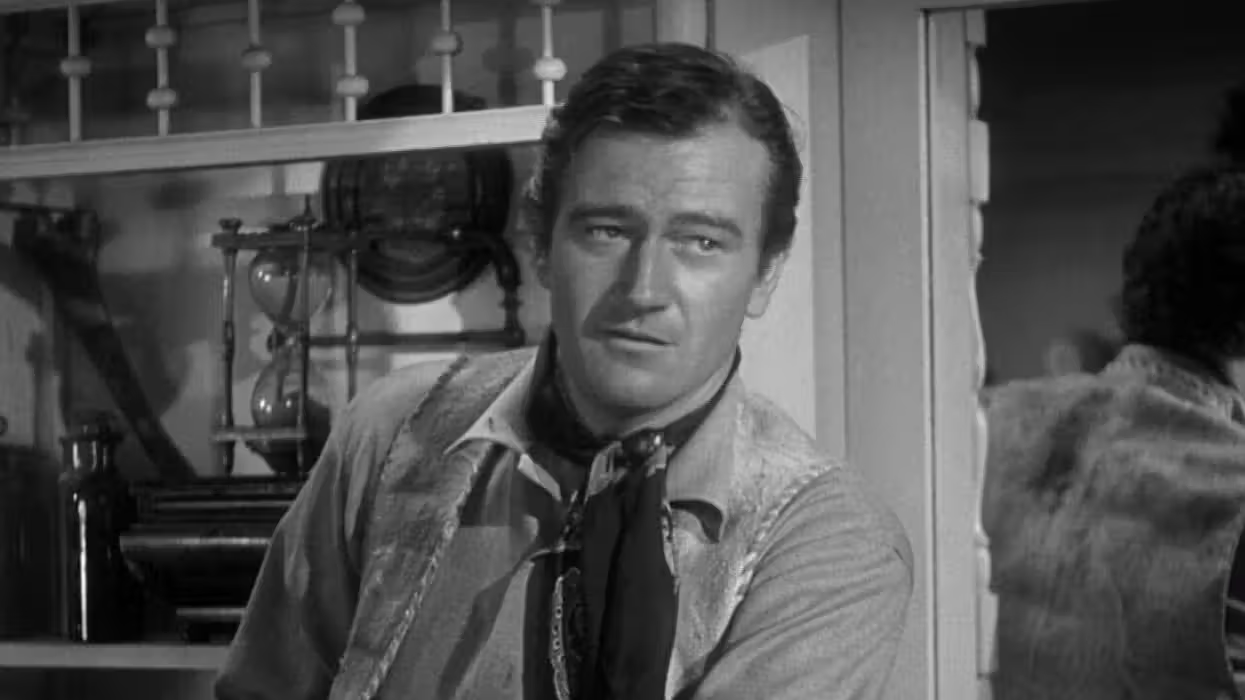
'Dark Command'
John Wayne is a pillar of the legend of the American West. It can feel like everyone knows movies like The Searchers or Rio Bravo, but there’s a specific era right after he broke out in Stagecoach, where he was still kind of figuring out what kind of cowboy he'd be on screen.
To me, that's when he delivered some of his most interesting work and played some of his most interesting characters, like his role as Bob Seton in Dark Command (1940).
This was a classic studio movie directed by Raoul Walsh, but I think it's criminally underrated. It plays out like an intense emotional prequel to the massive epics that's way more focused on the people in the movie than the stunning vistas, although it has plenty of those as well.
Today, I want to look at a Wayne line in the movie and talk about what it meant to him as a persona in the Wild West.
Let’s dive in.
- YouTubewww.youtube.com
The Scene In Question
This movie is available to rent on Mubi, which is how I had to watch it, because it feelsl ike it's been kind of lost in other places.
Dark Command tracks Bob Seton (Wayne), a straight-shooting Texan who rolls into Lawrence, Kansas, and decides to run for the position of Federal Marshall. He runs against a local schoolteacher named William Cantrell (played by Walter Pidgeon), who is menacing and sort of seethes danger.
When Seton wins the election, the two of them enter a bitter rivalry that pits them against one another directly.
Cantrell turns into a guerrilla raider who loots and burns down towns, all while pretending to still be a teacher during the daylight.
Everyone in the community looks to Seton to solve this problem, and eventually, to deal with Cantrell.
We get this dissection of ego from two points of view, one winner and one loser, and pick apart why each of them makes different decisions after the election and as they careen toward a standoff.
Amid all the chaos and the burning buildings, Wayne's character drops a line that anchors the entire thematic weight of the narrative.
He looks out over the destruction of a town and says...
Yeah. Well, we got a saying down in Texas: that it takes a good fire to burn down the weeds... to let the flowers grow.
The Cost of a Clean Slate
The Wild West was known for its lawless nature, and people were trying to tame not only the land but also its occupants and each other. It was a time of checking egos and solving problems with bullets.
Sometimes, the easiest way to set things right was to burn it all down and then erect something new on the ashes.
In this scene, you can hear Wayne's words and see them as a reassurance to a town that has literally watched its homes go up in smoke.
They can build back, and better.
But the other layer here is all about the frontier, and it’s a brilliant distillation of screenplay architecture and character arc.
It's Wayne saying this whole American West is seeing some of this chaos, and while things may look bleak now, it will all come back better once the fires die out.
And that fire may not just be in the towns, but in the hearts of people like Cantrell who can't control themselves or who have slipped into violence to try and gain some semblance of control.
Unfortunately, sometimes they need a cleansing force. to keep them in line...enter Wayne. And you get kind of the ethos for most Western genre movies that follow. You gave these fires that rage across the west in the version of people, can they be tamed and put out, or are they going to be sotris of what is built in their aftermath?
The Takeaway for Screenwriters
As filmmakers and writers tracking our own screenplay development, we often fall into the trap of protecting our characters from too much pain or devastation.
But there is no movie worth writing about the village of the Happy people. We need to see drama, and the idea of a fire within or externally gives us that.
It's maybe the prime example of conflict in storytelling.
Furthermore, if you are trying to master the art of the three-act structure, your second act always needs to be the fire.
It needs to be the crucible that burns away the character's flaws, their old coping mechanisms, and their comfort zones so that they have to evolve in the third act and change; otherwise, we don't get much of a story.
Ensure that whatever they lose in the second act directly forces them to abandon their core flaw before entering the climax.
Summing It All Up
Dark Command might be over eighty years old, but its look at how we survive our darkest moments still hits home, and I think it is a big win for Wayne, who leads this performance with vulnerability and not just his trademark stoicism.
Let me know your favorite lines from classic Westerns in the comments below!