James Cameron Calls Gen AI 'Horrifying' and Says Human Art is 'Sacred'
The dreaded soulless computer is coming for us all.
'Avatar: Fire and Ash'
I am not a technological expert, but when there are huge advancements in anything tech in Hollywood, I turn to James Cameron. The guy is both an engineer and a filmmaker, and he has a knack for breaking down all these advancements and what they mean for filmmakers.
And it doesn't make me feel good that he's so worried about AI.
In a recent interview with CBS Sunday Morning, Avatar director James Cameron has drawn a line in the sand regarding generative AI. He calls the prospect of AI replacing actors "horrifying."
Let's dive in.
- YouTube www.youtube.com
Cameron's Quotes on AI
James Cameron is a technological wizard. So he's been keeping track of AI and its advancements for quite some time.
“For years, there was this sense that, ‘Oh, they’re doing something strange with computers and they’re replacing actors,’ when in fact, once you really drill down and you see what we’re doing, it’s a celebration of the actor-director moment, and the actor-to-actor moment. It’s a celebration of, I call it, the sanctity of the actor’s performance moment,” Cameron explained.
“Now, go to the other end of the spectrum, and you’ve got generative AI,” he continued, “where they can make up a character, they can make up an actor. They can make up a performance from scratch with a text prompt. It’s like, no. That’s horrifying to me. That’s the opposite. That’s exactly what we’re not doing.”
This kind of pushback on AI from Cameron makes a lot of sense. He's spent decades trying to get people to understand the tech in his Avatar movies and what makes them special. And now he has to deal with people assuming it's AI.
And it takes away from what he's able to achieve as a director.
Cameron said, “I don’t want a computer doing what I pride myself on being able to do with actors. I don’t want to replace actors, I love working with actors.”
It’s easy for the uninitiated to conflate Cameron’s heavy use of CGI and performance capture with AI generation. However, Cameron emphasizes that they are fundamentally different disciplines.
It must be so frustrating for Cameron to do all this work and have people assume he was able to achieve it with a few prompts.
He describes his work on Avatar as a "celebration of the actor-director moment."
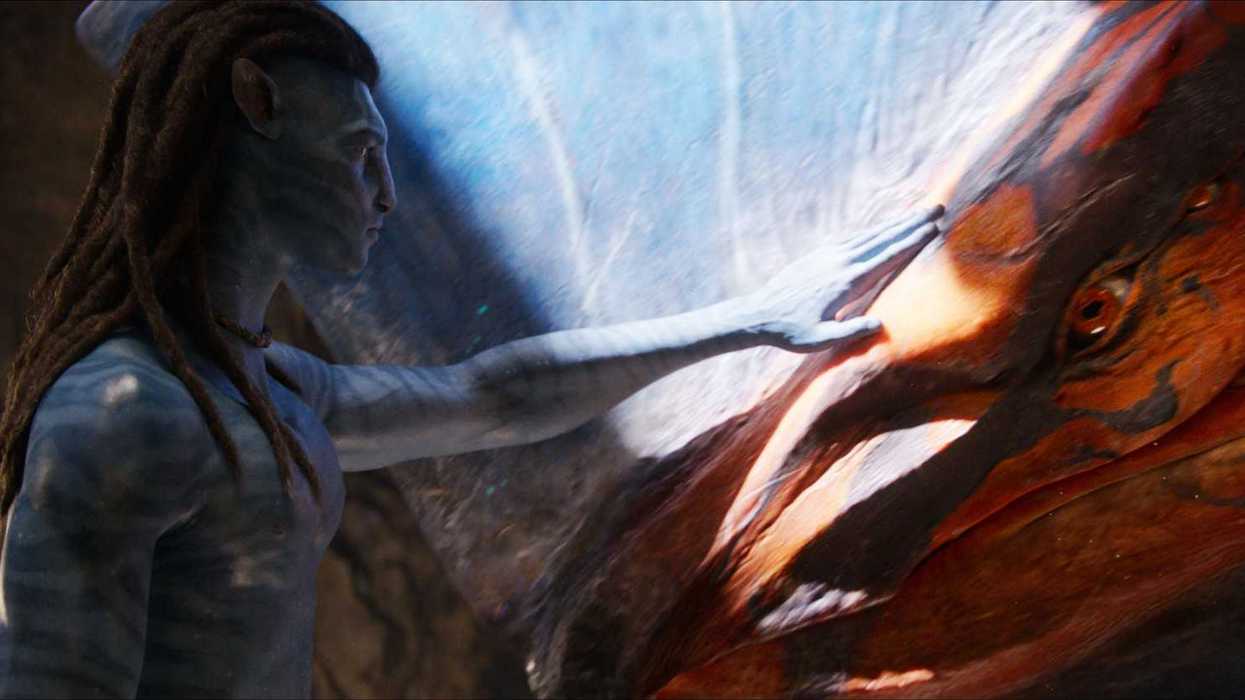
When Zoe Saldaña or Sam Worthington perform on a volume, every facial tic, breath, and emotional beat is captured and translated. And those performances are found by collaboration with Cameron.
It's what is at the center of actually directing.
Why Human Art is "Sacred"
Perhaps the most poignant takeaway for indie filmmakers is Cameron’s philosophical stance on the nature of art itself. He describes generative AI as a "magic trick" that acts as a blender for all human experience, outputting an average of what it has been fed.
For Cameron, the idea that a prompt could replace the vulnerability and spontaneity of a human actor is enemy of the filmmaking process. And I think he's right.
I want to see art made by humans. I want to be entertained by things with a soul. When you take away the collaborative aspects of the process you get something empty.
And he makes his point with some important facts.
AI is just ripping off what has already been made...there's nothing innovative or new about it. When asked if he was worried about AI ripping him off, Cameron offered this answer:
"It might, but it also causes us to have to set our bar to a very disciplined level, and to continue to be out-of-the-box imaginative … what generative AI can’t do is create something new that’s never been seen. If you think about it, the models — it’s a magic trick, what they can do is quite astonishing. But the models are trained on everything that’s ever been done before that; it can’t be trained on that which has never been done. So you will innately see, essentially, all of human art and human experience put into a blender, and you’ll get something that is kind of an average of that. So what you can’t have is that individual screenwriter’s unique lived experience and their quirks. You won’t find the idiosyncrasies of a particular actor.”
Cameron believes that the idiosyncrasies, the "unique lived experience," and the flaws of a human artist are what give stories their power.
That's what connects us and where we turn when we want to communicate with actors to access something that connects, so it can then be translated to the audience.
AI's aim is to take a lot of that away, and to me, it is proof that AI will never truly be successful.
Summing It All Up
As you develop your next project, ask yourself: Are you using technology to amplify a human performance, or to bypass it? If James Cameron, the king of high-tech cinema, thinks the human element is "sacred," maybe we should, too.
Are you really a director if you're not working with actors, but with AI?
Let me know what you think in the comments.