Tobe Hooper’s Texas Chain Saw Massacre has given cinema one of its greatest horror icons, alongside Michael Myers, Freddy Krueger, and Jason Voorhees.
Unlike its contemporary horror antagonists, who are corrupted by the supernatural or a personal vendetta, Leatherface is a victim of the people and the circumstances in which he is raised. Symbolically, he and the cannibalistic Sawyer family embody the growing cultural anxieties of 1970s America.
It is for the same reason that Leatherface’s final tantrum at the end of the movie is not only downright scary but also heavily symbolic.
In this article, let’s analyze The Texas Chain Saw Massacre’s denouement.
To Give You a Little Context…
Hooper’s 1974 movie, The Texas Chain Saw Massacre, presented the world with a template for horror slashers, cementing the final girl trope as one of the core horror tropes that refuses to fade.
The narrative follows a group of five friends (a pair of siblings and their three friends) en route to the siblings’ family homestead, but on the way, they are brutally hunted down by a psychopathic killer and his deranged family.
The Scene
By this moment in the movie, four out of five friends have lost their lives at the hands of Leatherface.
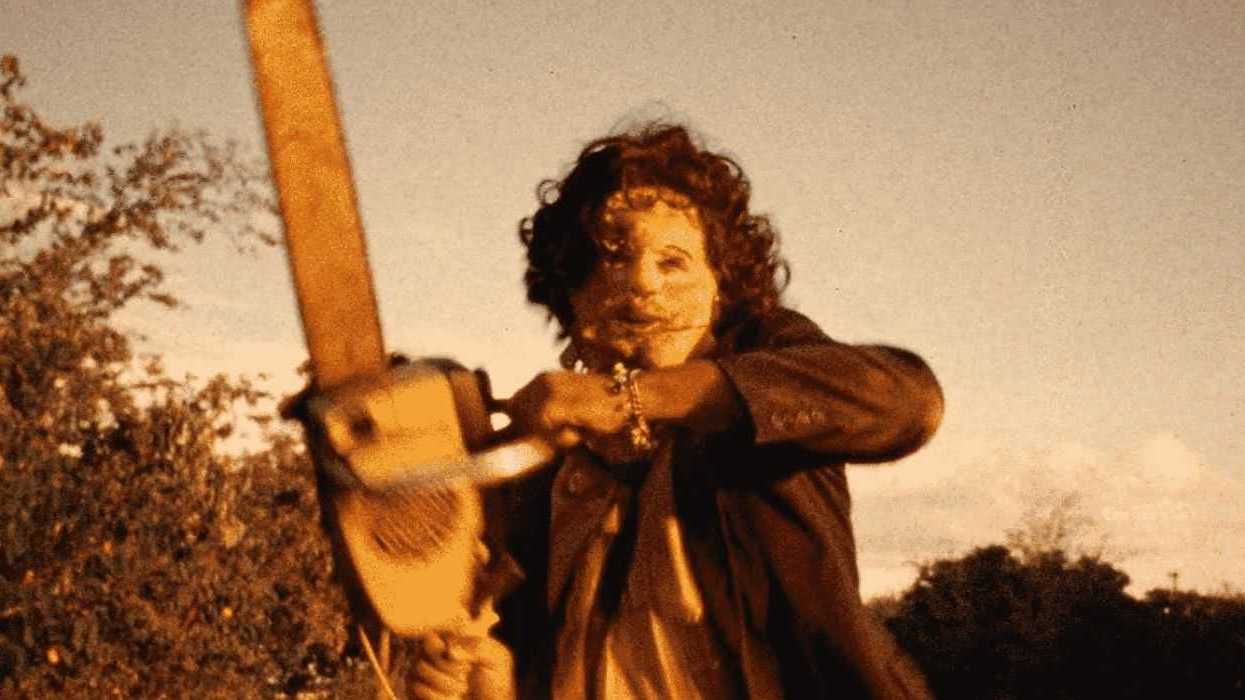
Right before she is about to be killed, Sally (Marilyn Burns) manages to leap out of the horror house and begins running for her life. The hitchhiker and Leatherface follow her with a running chainsaw in his hand.
Sally is completely covered in blood, struggling to escape as she can hear the chainsaw and heaving footsteps almost catching up with her. Her cries fill the air as she runs through the field toward the highway, in the hopes of stumbling upon help.
Things begin to look up when the hitchhiker is killed by a passing semi truck on the highway. Sally manages to escape Leatherface after she flees in the back of a pickup truck, leaving him huffing and puffing in frustration, having missed his victim.
Why Leatherface’s Final Tantrum Is the Ultimate Sting of Horror
I mentioned that Leatherface is a special kind of evil—one bred by society.
His deranged family symbolizes the decaying society that turns on itself. The five friends stumbling into them symbolizes how we often inadvertently walk into the darkness. In those times, it’s almost impossible to escape, unless you have a spirit that refuses to give up, like Sally.
Sally’s survival isn’t marked by leverage but by sheer determination. She isn’t superior in strength or tactical intelligence. She doesn’t have any kind of upper hand on Leatherface, but she survives, which celebrates the power of perseverance and psychological endurance (and a little bit of luck).
 'The Texas Chain Saw Massacre'Credit: New Line Cinema, Byranston Distributing Company
Sally’s laughter in the face of a failed Leatherface is symbolic of how there is hope after all.
Leatherface’s reaction to losing his victim is nothing like I’ve ever seen before. But despite that, his tantrum hints at the presence of an evil that refuses to quit. It’s not only extremely passionate about spreading dread and misery but also works hard (doesn’t even bother to take a break, even after his own weapon injured his leg) to continue the cycle.
Leatherface and his family are a metaphor of social decay. Therefore, his reaction mirrors the tendencies of social evils—how they refuse to die or quit until they have claimed as many victims as they could have.
The rising sun in the background of a frustrated Leatherface symbolizes a new day and the beginning of a new cycle of violence. Much like the sun, Leatherface will rise again, claiming the innocent lives who stumble into their hellhole.
Leatherface’s tantrum induces a surrealistic fear within the viewers when we watch him being forced to spare a life.
What do you think of The Texas Chain Saw Massacre’s ending?
- How Can You Make a Slasher Fresh? Learn from This Director ›
- How to Create a Slasher Villain ›
- The Evolution Of Slasher Movies ›
- How to Write a Slasher Movie ›
- Why 'Texas Chain Saw Massacre' Has One of the Best Openings in Horror ›
- Iconic Film Character Intro: Leatherface Became a Horror Icon in Less Than 20 Seconds ›