5 Lessons In Filmmaking From The Late Bela Tarr
There's so much to learn from the esteemed director.
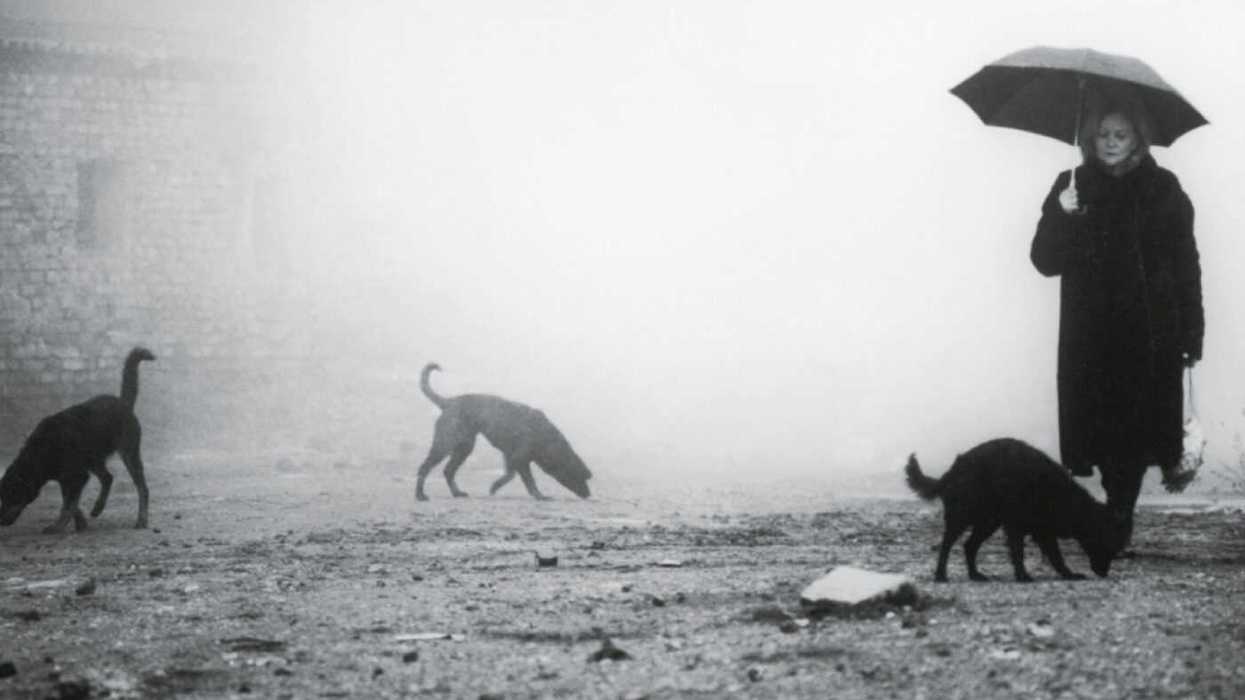
'Damnation'
We woke up to the news that Béla Tarr, the legendary Hungarian filmmaker who reshaped the landscape of world cinema with his haunting, slow-motion meditations on the human condition, had passed away. He was 70.
He's one of those directors who was a titan of a particular part of moviemaking called slow cinema. It was this experimental wave that prioritized showing scenes of everyday life and the human experience.
Even if that's not your jam, Tarr was someone you could learn from. So I want to harken back to this appearance he made at part of the 24th edition of the Transilvania International Film Festival, where he was honored as a Hungarian master with a Lifetime Achievement Award.
There, he imparted a ton of filmmaking lessons in a masterclass for the audience, and I wanted to take some of those lessons and disperse them here today.
Let's dive in.
- YouTubewww.youtube.com
1. Forget the "Original" Story
Tarr is famously dismissive of the traditional screenplay. "I don’t have a script," he told the audience. "I just carry a piece of paper in my back pocket with words written on it." For the opening of Werckmeister Harmonies, that word was simply: "Eclipse."
This may not be your cup of tea, but I think he has a point. It's all about finding ways to break what you think the limits to your imagination might be. And finding originality.
His logic? We’ve been telling the same stories since the Old Testament. Trying to be "original" with a laptop is a trap.
"You know what’s interesting? How we tell the same old story. That’s why I find people more interesting—their faces, their eyes, how they touch each other, how they move. That’s my goal, not to tell you another boring old story."
2. Casting is "Hunting" for Personality
One of the things about Tarr's films is that they are perfectly cast. The people feel real, and the stories are so deep that they need special actors to carry them.
If you are looking for a performance, you aren't looking for Béla Tarr. He explained that if an actor is clearly "acting," he tells them it’s beautiful, but "not for this film."
He looks for presence and a specific spark of inspiration. He recounted how Werckmeister Harmonies sat in limbo for years because he couldn't find the lead, until he spotted Lars Rudolph, a street musician, at a casting session for a different director.
"When the camera is rolling, your actors are naked. You sense what kind of people they are, how they respond to the situation when they’re truly in it. You’re hunting for a real moment."
3. The Location is a Character
We talk about this a lot on No Film School, but your location has to function as a character.
For Tarr, scouting isn't a logistical chore; it’s an artistic necessity. He does it himself because "the location has a face." If the environment doesn't have a meaning that is "all the time present," the film loses its soul.
4. "Action! Cut!" is Boring
When you're making movies, you develop your own signature style in how you roll through different scenes.
For Tarr, those are pretty long takes that never break. And these signature long takes aren't just a stylistic flourish; they are a protest against the "boring" logic of the modern industry.
- The Tension of the Long Take: He knows a scene is working when he can hear the cast and crew breathing in the same rhythm.
- Respecting Time: "Our lives unfold in space and time—but most films ignore time," he noted. He’s uninterested in plot-driven action; he wants to capture life itself.
- The "Dolly Guy": Interestingly, while Tarr has cycled through different cinematographers, he has worked with the same dolly grip since his first film. Stability in movement, it seems, is the secret to his meditative flow.
5. Social Responsibility and "Liberation"
Tarr’s time at his film school in Sarajevo was defined by one slogan: "No education, just liberation!" He believes that freedom makes a filmmaker more open to others.
But that freedom comes with a heavy price: responsibility. You have to tell stories that matter and that help people understand humanity.
Tarr worked in a shipyard before he became a filmmaker, and he considers that his "university."
"The world is the way it is because we made it. If it’s shit or if it’s nice—that’s on us. I don’t like to talk about 'humanity' as some abstract idea... I know real, concrete people. And that’s why I believe: we are responsible for how the world looks."
Summing It All Up
Béla Tarr’s cinema is a reminder that the camera is the way we can make the world a better place through storytelling.
So challenge yourself and your work to live up to those expectations.
Let me know what you think in the comments.