Less Is More: 7 Best Minimalist Films to Stream Now
Films that win hearts by cutting out the bling and grandeur, exploring complex themes through life’s most mundane moments and experiences.
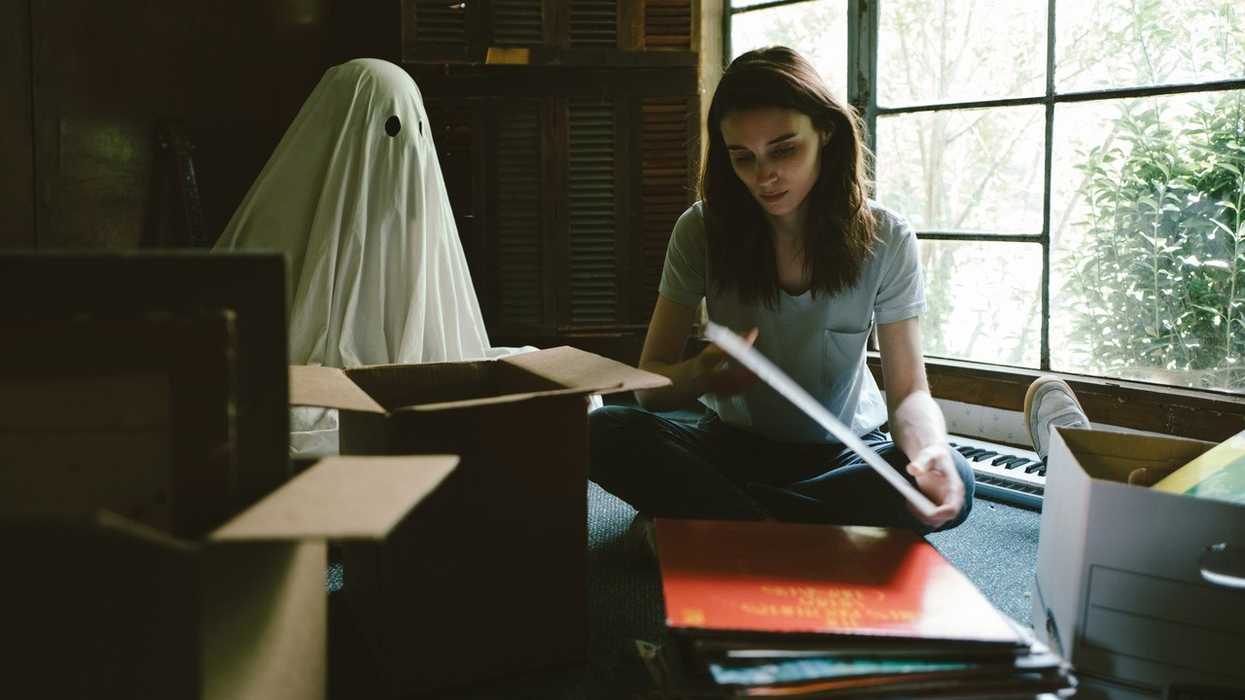
A Ghost Story (2017)
Often associated with filmmakers like Robert Bresson, Yasujirō Ozu, and Chantal Akerman, who are known to shape its foundation, minimalist films explore storytelling, rooted in the belief that “less is more.”
Unlike blockbuster films that focus on crowd-pleasing moments and spectacle, minimalist films are flagbearers of simplicity and restraint. A style of filmmaking that emerged post-World War II, minimalist films rely on silences, subtle gestures, stripped-down visuals, and atmosphere to express.
If you love watching films that inspire you to think, self-reflect, and feel your vulnerabilities, here’s a list of the best minimalist films for you to watch on your next movie night.
Spoilers ahead!
7 Best Minimalist Films that you might want to watch
If you’ve never explored films that feature minimalist filmmaking, these films are a great place to start:
1. Tokyo Story (1953)
Yasujirō Ozu’s Tokyo Story is a tale of alienation and loneliness that comes with growing old, the generation gap, and the breakdown of family tradition. An elderly couple, Shūkichi (Chishû Ryû) and Tomi (Cheilo Higashiyama), travel from their rural hometown, Hiroshima, to the city of Tokyo to visit their adult children, only to realize that they are now nothing but an inconvenience to their own children, now that they have their own lives.
Soon after the heartbroken couple returns to their village, Tomi falls ill and dies. Her funeral brings the family together, prompting them to reflect on their relationship and the lost time that they could have spent together as a family.
Ozu relies on his signature low-angle static camera style, the “tatami shot”, in which the camera always stays three feet above the ground, mimicking the viewpoint and stationed at the eyeline of someone sitting on a traditional Japanese tatami mat.
Ozu jumps the line of action with intention, and uses non-narrative transitional shots, such as cityscapes or still-lifes of objects, almost like visual commas, semicolons, or periods, to punctuate his narrative. Tokyo Story is a masterpiece in character-driven storytelling that ditches melodrama for visual poetry, offering profound insight into family and the flowing nature of time.
2. Duel (1971)
Steven Spielberg made his directorial debut in feature films with Duel in 1971. A mild-mannered salesman, David Mann (Dennis Weaver), is pursued and terrorized by an , rowdy tanker truck driver (Carey Loftin), after he upsets him by overtaking him on the highway.
Spielberg deliberately steers clear of showing the truck driver’s face, using anonymity to his advantage to induce fear and paranoia. With the real antagonist unseen, the truck becomes a near-superhuman antagonist: its hulking presence embodies the faceless peril that is the truck driver.
Duel demonstrates the power and creative possibilities of a limited cast, simple premise, single location, and ambiguity across narratives.
3. Suspiria (1977)
Featuring a minimalist narrative and maximalist visual language, Dario Argento’s Suspiria follows an American ballet student, Suzy Bannion (Jessica Harper), who moves to Freilberg, Germany, to join the prestigious Tanz Akademie. Little does she know that the dance academy is a front for a coven of witches, with Helena Markos as their leader, who is supposedly dead.
Argento uses saturated colors, dramatic lighting, and elaborate set design, prioritizing mood over the complexities of the narrative. Keeping the narrative lucid and avoiding in-depth character development, Argento blends genre conventions with an expressionistic visual language and sensory storytelling.
4. A Ghost Story (2017)
Directed by David Lowery, A Ghost Story is a profound meditation on life through the lens of the afterlife. Imagine being tethered to your home as a spectral presence, or as we commonly say, a ghost, after your death, to just observe till eternity. You can’t leave, you can’t communicate with your grieving loved ones, you can’t move on—just watch in despair like C (Casey Affleck): you’re stuck in time, as time flows past you.
The narrative is non-linear and almost poetic, yet lucid and resonant, emphasizing universal emotions over detailed backstory and complex characters, keeping the dialogues to a minimum. Lowery sticks to archetypal characters, inviting viewers to engage with themes of grief and existence on a personal level.
5. The Turin Horse (2011)
Directed by Béla Tarr and Ágnes Hranitzky, the story of philosopher Friedrich Nietzsche’s mental breakdown in Turin, Italy in 1889 inspired The Turin Horse. The story goes that Nietzsche witnessed a cab driver brutally whipping his horse and subsequently collapsed, allegedly triggering his descent into madness.
Reimagining this event, Tarr co-wrote the story with László Krasznahorkai, which follows an elderly farmer, Ohlsdorfer (János Derzsi), and his adult daughter(Erika Bók), over six days, living in a wind-battered farmhouse, with their ailing horse. Their life gradually goes from bad to worse, as their only water source, the well, eventually dries up.
The Turin Horse uses imagery, allegory, and repetition in its structure to present a slice of life to the viewers. Tar and Hranitzky present the story in black-and-white, against a bleak setting, and a near-total absence of dialogue, focused on meditative storytelling over spectacle.
6. Alice (1988)
Lewis Carroll’s classic Alice in Wonderland has been adapted multiple times into a movie. Jan Švankmajer’s 1988 Alice is a surrealistic interpretation of the story. The narrative follows the basic structure of its source material, but steps away from the original’s whimsy.
Wonderland is presented as a decaying and often hostile world, populated by grotesque puppets, taxidermy animals, and animated objects. Unlike the source text, Švankmajer’s Wonderland lacks any wonder whatsoever.
Švankmajer uses Wonderland as a mirror to reflect Alice’s (Kristýna Kohoutová) real-life anxieties and conflicts, such as the fear of growing up. Švankmajer showcases an innovative way of using sound (creaking joints, ticking clocks, sliding food, etc.) to heighten the tactile atmosphere, ensuring a more immersive experience for the audience, almost placing them into the labyrinth, alongside Alice.
7. A Single Man (2009)
This film deeply resonates with everybody—after all, we’ve all grieved the loss of a loved one at some point in our lives. Based on Christopher Isherwood’s 1964 namesake novel, Tom Ford’s directorial debut, A Single Man, follows George Falconer(Colin Firth), a grieving British college professor, shattered by the sudden death of his longtime partner of 16 years, Jim (Matthew Goode).
The film opens on a certain day–it’s been eight months since Jim’s untimely demise in a car accident. This day has been decided by George to be his last day of life. He would use the morning to settle his affairs, and in the evening, he would end his miserable life, that has no meaning without his partner. The day manages to convince George to put off his deadly decision. However, almost ironically, by the end of the day, George dies of a heart attack, in grief for his lost partner.
A Single Man showcases bold use of colors. Ford shifts color saturation, mirroring George’s emotional state in the scene, such as washing out tones for numbness while employing rich hues for Jim’s flashbacks. A Single Man demonstrates the power of color in any narrative—an aspect in filmmaking that is hardly ever used to its full potential.
Which of these have you watched already? Do let us know your favorite.