How the Call From 'Taken' Made Liam Neeson an Action Star
How the iconic bad-ass phone call in Taken (2008) reshaped Neeson’s career and legacy.
'Taken' (2008)
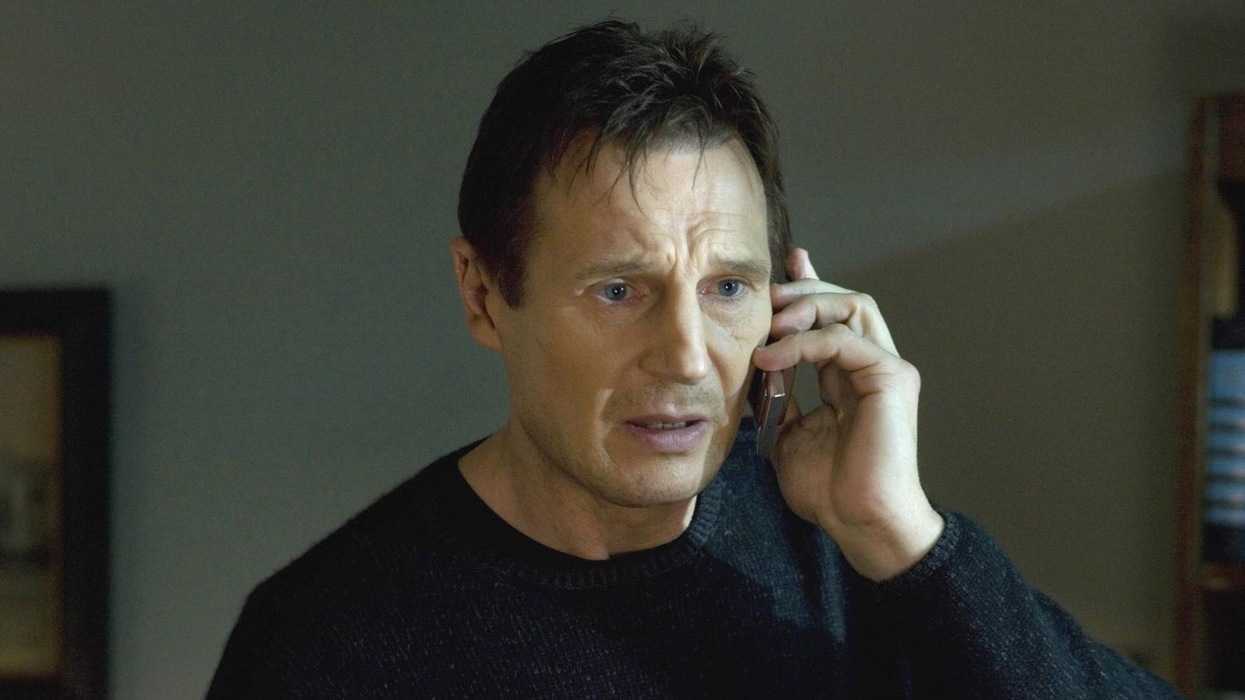
In a sterile apartment, Bryan Mills (Liam Neeson) is sitting with a phone in his white-knuckled grip. The men on the other end are the ones who have just kidnapped his daughter, Kim (Maggie Grace). Instead of shouting or thrashing, Mills steadies himself, takes a breath, and speaks in a voice that cuts through silence like steel.
“I don’t know who you are. I don’t know what you want. If you are looking for ransom, I can tell you I don’t have money. But what I do have are a very particular set of skills.” After this, a formal and almost polite introduction, he ends the speech saying, “...but if you don’t (let my daughter go), I will look for you, I WILL find you, and I will kill you.”
The line isn’t particularly grand. It isn’t exactly a neon-lit cinematic bluster. It’s a straightforward promise of what’s to come—and it’s very cold.
In 2008, threats worked in a traditional way for the audience. This was new. So simple and straight that it stood out. Suddenly, a mid-budget thriller turned into a goosebumps-inducing movie. Every theater erupted in applause as Neeson’s voice demanded attention. In ninety seconds, a well-known actor from serious dramas had changed his brand.
In this article, we are going to explore how this single monologue not only elevated a low-key European action movie but also changed the course of Neeson’s career.
Liam Neeson’s Pre-Taken Career
Neeson was praised for his character’s depth and conscience before viewers imagined him brandishing a gun. His devastating performance as Oskar Schindler in Schindler’s List (1993) earned him a nomination for an Academy Award. He went on to play strong parts in Rob Roy (1995) and Michael Collins (1996). He was respected as an actor of seriousness rather than spectacle, and his work carried moral weight. But by the mid-2000s, Neeson’s career had reached a peculiar turning point. Although he didn’t exactly command leading roles that ensured box-office traction, he was still respected. His gravitas was demonstrated in supporting roles in Batman Begins (2005) and Kingdom of Heaven (2005), but Hollywood wasn’t rushing to make franchises centered around him. By 2008, he appeared destined for a steady, respectable, but hardly seismic career of voice acting, character roles, and sporadic prestige dramas.
That’s precisely why the Taken moment came down so hard. This wasn’t an actor who was already well-known for his exaggerated machismo entering a recognizable role. On the contrary, a dramatic artist suddenly revealed a new identity in front of millions of people.
Deconstructing “The Speech”
At its core, the writing makes the phone call a success. Screenwriter Robert Mark Kamen and Luc Besson wrote dialogue that was devoid of superfluous words. There is only ruthless clarity—no nonsense and no wasted words. Specificity is the key to genius: “a particular set of skills” is strangely formal, bordering on bureaucratic, but ominously intimidating. It’s the ideal illustration of how blunt language can be more effective than ostentatious threats when it is sharpened.
It was sealed by Neeson’s performance. He did not spit out lines in rage through grinding teeth. As he addressed the kidnappers directly, he lowered his voice almost to a whisper. His tone of exhaustion conveyed the weight of a man who has witnessed too much but is ready to let it all out. He made something more terrifying by not yelling: the inevitability.
This was recognized by director Pierre Morel, who shot it carefully. Nearly uncomfortably, the camera stays close to Neeson’s face. There is a silence that allows each syllable to be heard clearly, without any fancy cuts or distracting music. His words are amplified by the subdued sound design, which keeps listeners waiting for each pause as if their own heartbeat were accelerating.
The Immediate Impact
The monologue serves as a mission statement for the movie. Bryan Mills is warning us, not just the kidnappers, about what is coming. With the promise that the remainder of the story will fulfill this chilling vow, the narrative’s fuse is being lit. Taken would have still been a good action movie without that speech, but with that speech, it evolved into something more akin to a contemporary myth.
You could sense the change in theaters. What started out as a simple thriller about kidnapping abruptly turned into a reality show. When Mills hung up, the audience erupted, leaned in, and whispered back the lines. It was a group adrenaline rush, not just a scene from a movie.
That enthusiasm paid off handsomely at the box office. Taken made over $226 million worldwide on a production budget of $25 million. Studio executives rushed to understand what had just transpired. The answer was obvious: people were paying to listen to Liam Neeson on the phone, not to watch gunfights or car chases.
The Ripple Effect
The monologue became inevitable both inside and outside of Hollywood. Family Guy made fun of it, SNL made fun of it, it was spoken of in talk shows, sports promos remixed it, and memes cited it incessantly. The phrase “I will find you, and I will kill you” suddenly became ubiquitous: it was half threat and half joke.
The Career Resurrection
The change was instantaneous for Neeson. He went from being a “respected actor” to being “action bankable” almost overnight. Screenplays of tough men with tumultuous histories and unresolved issues lined up at the studios. In thrillers such as Unknown (2011), The Grey (2011), Non-Stop (2014), and, of course, the Taken sequels, he established himself as a mainstay.
Even though critics pointed out the repetition, the second act was a huge financial success. The audience didn’t mind—they wanted more of Neeson’s gravelly voice promising harsh justice anyway. He turned into one of the few actors whose name alone could elicit attention, especially in foreign markets.
Conclusion
It’s more than just quotability that makes that Taken phone call memorable. It’s the accuracy of its components: timing that came just when audiences were looking for something fresh, writing that didn’t waste any words, and a performance anchored in gravity. Every element came together to create a cinematic storm.
The Taken call is ultimately more than a line or a speech. It is an enduring element of contemporary pop culture and the pivot that opened the second half of Liam Neeson’s career. To remind the world that sometimes the most frightening hearts are whispered, all it took was 90 seconds on the phone.