Film Quote of the Day: The 'Miller's Crossing' Line That Might Be One of the Coens' Most Underrated
"Nobody knows anybody. Not that well."
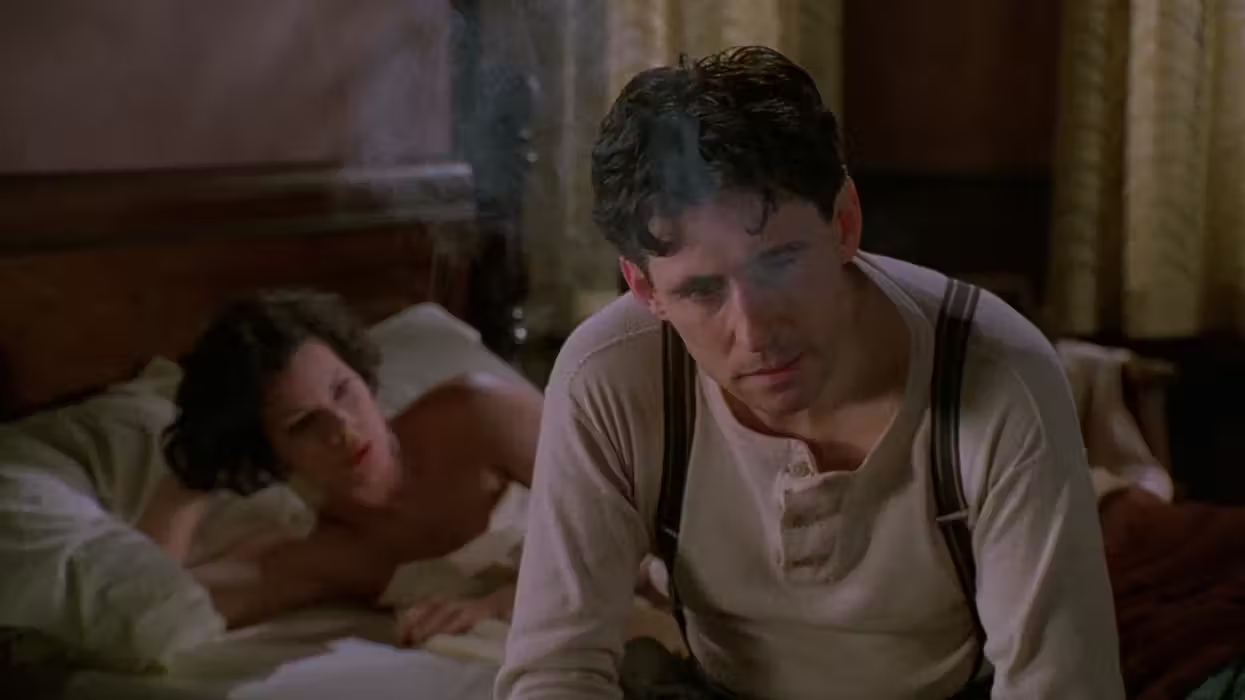
'Miller's Crossing'
I can't think of a better way to spend any amount of time than watching a Coen Brothers film. Those two guys just have this special ear for storytelling that challenges the audience and characters to reconcile a complicated world.
They always have characters whose actions get them into trouble, and I love the webs that are woven that seem impossible to untangle.
These are filmmakers whose stylized dialogue has given us some of the most memorable conversations in The Big Lebowski, dream recounting in No Country for Old Men, or the rhythmic Midwest patter of Fargo.
But today, I want to talk about a line from their 1990 Prohibition-era gangster masterpiece Miller’s Crossing that anchors every beat of the film.
Let's dive in.
- YouTube www.youtube.com
The Scene in Question
This is a movie about gangsters and three different kinds of love: romantic, familial, and paternal. It's one of their more austere, even difficult, movies to unpack.
In fact, I don't think I truly understood the characters and their backstories on screen until I had seen this movie about three times. There's so much going on that's unspoken, and even when spoken, so many lines can mean a few different things.
So pay close attention to all the ways this quote fits into the story.
Early on, things are getting messy between mob boss Leo O'Bannon (Albert Finney) and his right-hand man, Tom Reagan (Gabriel Byrne).
When a power struggle erupts between Leo and the ruthless Italian gangster Johnny Caspar (Jon Polito) over a crooked bookie named Bernie Bernbaum (John Turturro), Tom tries to keep the peace by playing both sides.
But Tom's loyalties are as compromised as everyone else's.
Leo is hopelessly in love with Verna (Marcia Gay Harden), a femme fatale who is also Bernie Bernbaum's sister. And she's also sleeping with Tom, too.
In order to prove his loyalty to Caspar and his brutal enforcer, Eddie Dane (J.E. Freeman), Tom is forced to murder Bernie in the woods at Miller's Crossing.
Verna wants Tom to spare her brother's life, and he loves her, so he promises to help. So Tom sends Bernie on his way, duping the others into believing he's been killed.
Then, through relentless manipulation and tactical maneuvering, Tom turns the rival factions against one another until they wind up killing each other, all while maintaining his ruse.
In one of his final affairs wth Verna, Tom offers her a quiet dose of cold, hard truth that pretty much sums up the entire movie, which has way more twists and turns after that.
"Nobody knows anybody. Not that well."
What The Quote Means
I love this movie so much. It's so deep, and you can see so many personal relationships stripped bare in each scene of the movie. It lays itself out slowly, taking its time to make you question what could happen next.
The quote is indicative of that unpredictability.
On the surface, it reads like classic noir cynic-speak, but in true Coen fashion, it operates on a much deeper level.
- The Illusion of Control: Tom survives the entire movie not because he accepts that human motives are fundamentally unknowable, and therefore he rigs a system that only he can win, no matter what people choose. He always has a gun pointed at someone and always knows his escape in case they change their mind.
- Character Motivation as a Mystery: Everyone in Miller's Crossing acts on assumptions, which turn out to be false. Every single time a character thinks they "know" what drives someone else, it bites them.
- The Coen Philosophy: This line is a direct lens into the brothers' overarching worldview. We see in movies from Fargo to A Serious Man that characters constantly try to impose order on a chaotic world by pretending to understand the people around them. Tom’s thesis statement strips away that ego and shows a man who operates knowing he can never know, and that's how he gets the upper hand.
Summing It All Up
Screenwriters can learn a ton from how Miller's Crossing uses dialogue to double as a theme. We know what the line means in one context, but after the movie is over, we could go back to it and consider another interpretation.
I love what this does to our brains on rewatches and how it rewards us for sticking with the movie, too.
Let me know what you think in the comments.