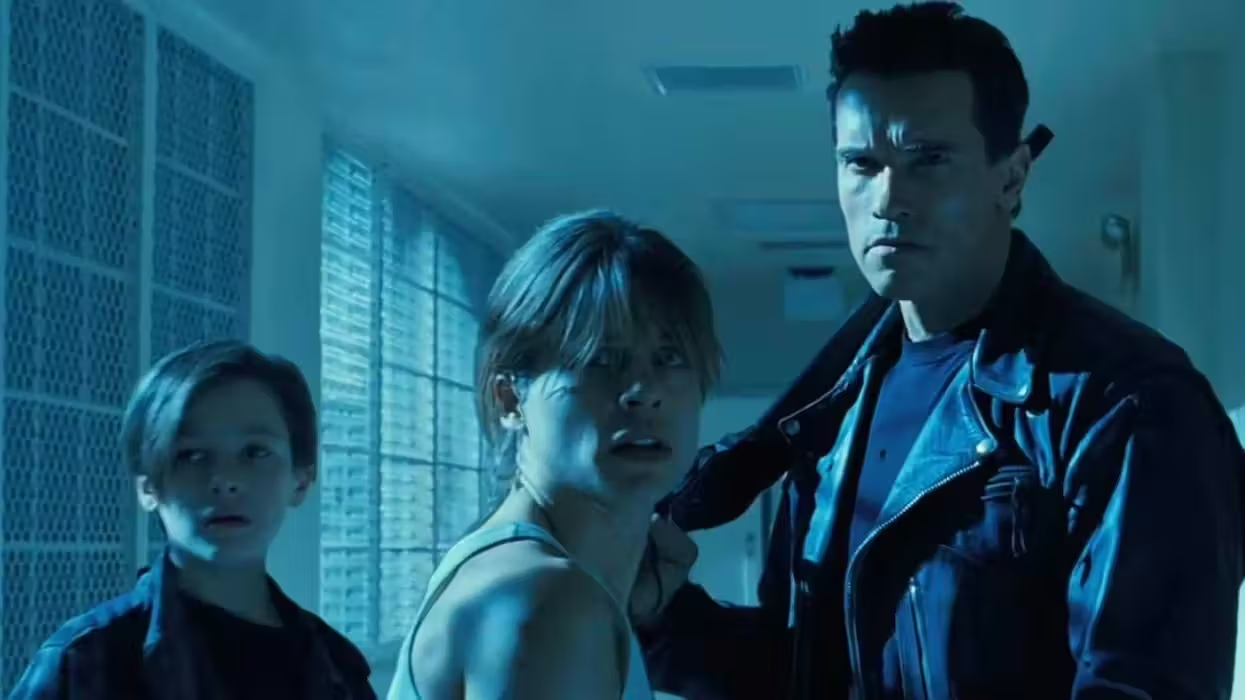
In 1991, director James Cameron built one of cinema's most ambitious practical-effects sequences: a nuclear holocaust that annihilates Los Angeles in Terminator 2: Judgment Day.
The sequence was primarily constructed by hand using miniatures, air cannons, matte paintings, and prosthetic body doubles, with digital compositing used to complete specific shots. The result was a sequence that scientists have since cited as one of the most realistic depictions of a nuclear blast ever put on screen.
But how did he create one of the most realistic depictions of a nuclear blast? And in 1991?
Let’s stop scratching our heads about it and dig in.
James Cameron's Vision of a Nuclear Blast
The scene takes place in Sarah Connor’s (Linda Hamilton) nightmare premonition, before the main plot starts unfolding.
This sequence sets the stakes at the beginning. To heighten the terror, Cameron wanted the scene to feel as real as possible. He wanted to see bodies literally incinerated on screen, along with real destruction and shock waves from the nuclear blast.
Gathering the Team and Hatching a Plan
 'Terminator 2: Judgment Day' (1991)Credit: Tri-Star Pictures
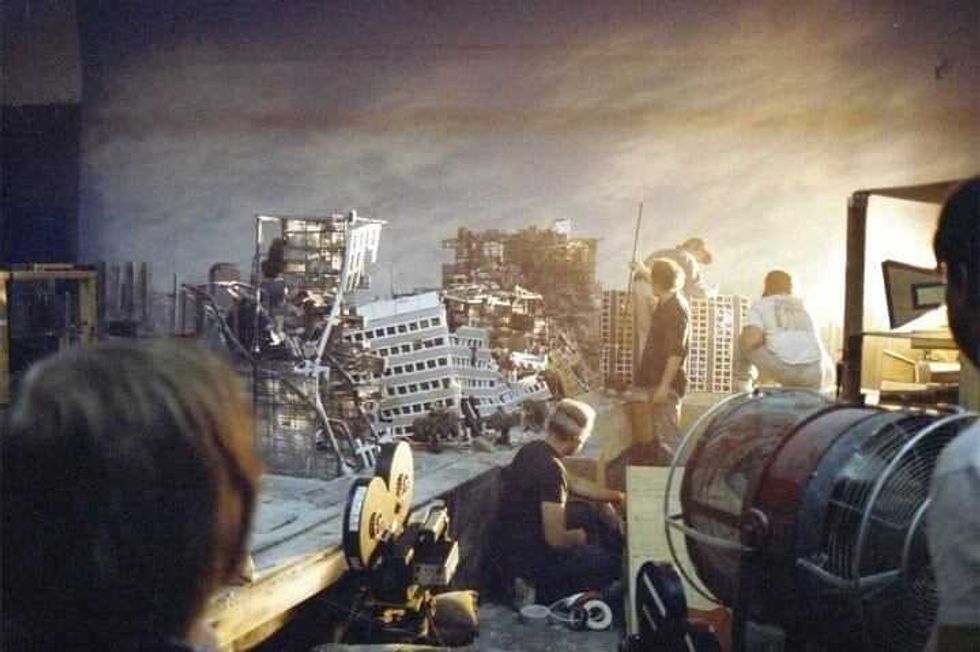
Cameron divided the work across four companies. ILM handled the CGI effects. Stan Winston Studio was responsible for prosthetics and animatronics. Fantasy II Film Effects developed miniatures and optical effects. 4-Ward Productions took on the nuclear explosion sequence specifically.
Together, the effects teams studied archival documentary footage of actual nuclear tests to understand the mechanics of the blast wave before building their plan around large-scale miniatures and high-powered air cannons.
The Challenge in Building the Miniatures
 'Terminator 2: Judgment Day' (1991)Credit: Tri-Star Pictures
One thing that the team noticed in the nuclear blast footage of actual tests was that after the blast, the concrete and the masonry blew up into millions of pieces. So, they had to build the miniature models in a way so that they could be easily disintegrated.
To achieve the effect, they experimented with various concrete materials and plaster to create buildings that could withstand their own weight yet be fragile enough to be blown into millions of pieces by air cannons.
The team experimented with all kinds of things—cardboard boxes were augmented with matzah crackers, which were not only cheap but also technically economical. They could easily glue them together and break them apart. They also used balsa wood chunks, metal chunks, plaster pieces, and various types of cereal. (Yes, cereals. This is for all the indie makers out there.)
Executing the Devastation
Capturing the Destruction of Los Angeles
 'Terminator 2: Judgment Day' (1991)Credit: Tri-Star Pictures
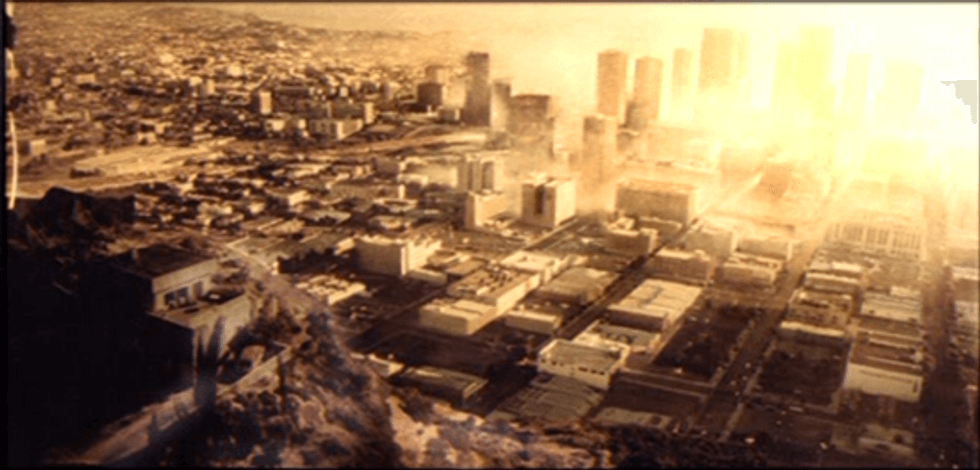
To make the scene work, actors in the playground were set in the foreground of the shot, which was then combined with the miniature model of LA in the background.
The team at 4-Ward Productions created a miniature mushroom cloud that could be manually adjusted to achieve full control over its shape.
To capture the monumental destruction in wide shots of Los Angeles, they took a reference photo of the city, which the artists used to create a painting of the ruins after the explosion. Then, they used a digital wipe to transition from the actual photo to the painting, showing fire emerging from the blast radius and engulfing the whole city.
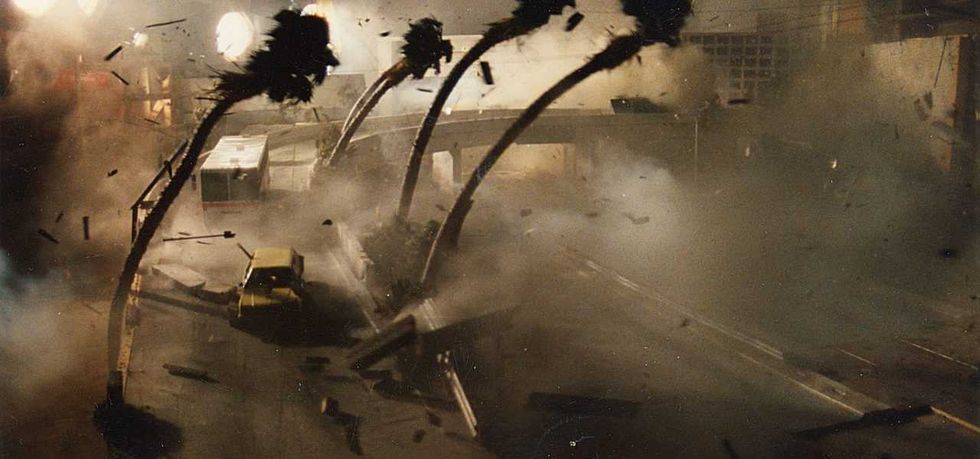
Production accounts describe the team using approximately eight to ten air cannons spread across the miniature set, loaded with debris and metal shrapnel to break apart the building facades.
Each air cannon delivered 200 pounds of pressure. They had to figure out a way to push a continuous, even wall of air against the models.
Bodies Turning to Ash
 'Terminator 2: Judgment Day' (1991)Credit: Tri-Star Pictures
Since human bodies had to be vaporized on screen, Stan Winston Studio designed and built several charred, ash-covered puppets based on Linda Hamilton's likeness. Because Hamilton couldn't hold the required expression long enough for a traditional lifecast, the crew scanned her face using Cyberware digital scanning technology. It used that data to build the puppets.
The flaming Sarah puppet included articulated arms attached to cables and a movable jaw, operated by a puppeteer in a fireproof suit covered in fire gel. These models were then destroyed by fire and debris on camera.
There’s also haunting sound design by Gary Rydstrom, which, when coupled with the visuals, gave us the final sequence of utter destruction.
Summing It Up
Sarah Connor’s nightmare is the narrative engine that drives the film from the start. It had to be hard-hitting. The sequence holds up as a benchmark for hybrid effects work.
- An Inside Look at VFX: the Making of 'The Terminator' & 'Terminator 2: Judgement Day' ›
- Seven Things You Didn't Know About the Making of 'Terminator 2' ›
- The First Major CGI Villain: How ‘Terminator 2’ Changed Visual Effects Forever ›
- How 'Terminator 2' Pulled Off the Iconic T-1000 Blade Shot (Without CGI) ›