There’s nothing more thrilling than watching a big ol’ explosion in an action flick. (Just ask Michael Bay!) The buildup of all those car chases, gun fights, and narrow escapes has to culminate in something spectacular enough to give the audience a satisfying release — and yeah — a white hot fireball that sends debris all over the place is a pretty good way to do it.
Now, you can go the CGI route — which is fine. There are plenty of talented artists out there who can pull it off. However, practical explosions just hit differently, you know? There’s something a little more organic and immersive about watching a real-life explosion on-screen.
If you feel the same way, here’s a list of practically done explosion scenes in movies to make you feel good.
Most Real and Practically Done Explosions in the History of Movies
1. Spectre
Blofeld’s Base blow up
The monstrous explosion at the end of James Bond’s (Daniel Craig) escape sequence from Blofeld’s (Christoph Waltz) base set the Guinness World Record for the largest stunt explosion ever filmed.
Following Bond’s subtle instruction, Madeleine (Lea Seydoux) initiates the sequence by throwing a high-tech watch that explodes near Blofeld. The sequence ends with a bombastic explosion lasting about seven seconds.
The explosion was shot in Morocco. Over 9,000 liters of kerosene with powdered explosives were used for the bang at the end. The James Bond saga features several practical stunts, and Director Sam Mendes kept the tradition alive in Spectre.
2. Apocalypse Now
Napalm Strike
The Napalm strike ordered by Bill Kilgore (Robert Duvall) has to be one of the largest practically executed explosions in movies.
Stunt coordinators Joe Lombardi and A.D. Flowers made it happen by storing gasoline in a 200-foot PVC pipe across the lush jungle of the Philippines. It created a seemingly long stretch of fireballs. Moreover, they carefully coordinated with real F5 jets used to fly over just before explosions to signify the dumping of napalm canisters.
And, who can forget Kilgore’s disturbing line, “I love the smell of the napalm in the morning.” Horrors of a war, man!
3. Oppenheimer
Trinity test
Christopher Nolan was in no mood to film the nuclear test with CGI and green screens. He used gasoline, magnesium, and other explosive powders with practical pyrotechnics to create that massive nuclear fireball experience, just for us. Nolan himself said that it was the most intense thing he’d ever filmed.
Multiple tests had to be done at night to achieve that perfect blinding flash. Plus, the mushroom cloud that looked so real was created by miniature effects.
4. Police Story 2
Warehouse Fireworks factory
 Police Story 2 (1988)Orange Sky Golden Harvest, Universal Pictures, Media Asia Entertainment Group
The final showdown between Inspector Chan Kwok Wing (Jackie Chan) and the serial bombers group takes place in a fireworks factory.
Jackie wanted large-scale pyrotechnics in the factory instead of shooting the explosion with miniatures, which was popular at the time. The result was scary — the explosions set off more firecrackers than the safety limit. The smoke rose higher than expected, but Jackie rolled with it with little scratches and burns here and there. The shot made it to the cut.
5. The Dark Knight
The Joker blows up the hospital
The hospital that Joker (Heath Ledger) detonated was a former four-story candy factory in Chicago, and was already on its way to demolition. The practical effects team carefully placed the explosives in the structure to create the bomb effect rather than a demolition.
Remember that little pause in the explosion when Joker looks back to check? Yeah, that was intentional, carefully planted by Nolan and his team. It was choreographed to keep a safe distance between the blast radius and Heath Ledger.
Christopher Nolan keeps it real — legendary shot in a legendary film.
6. Mad Max: Fury Road
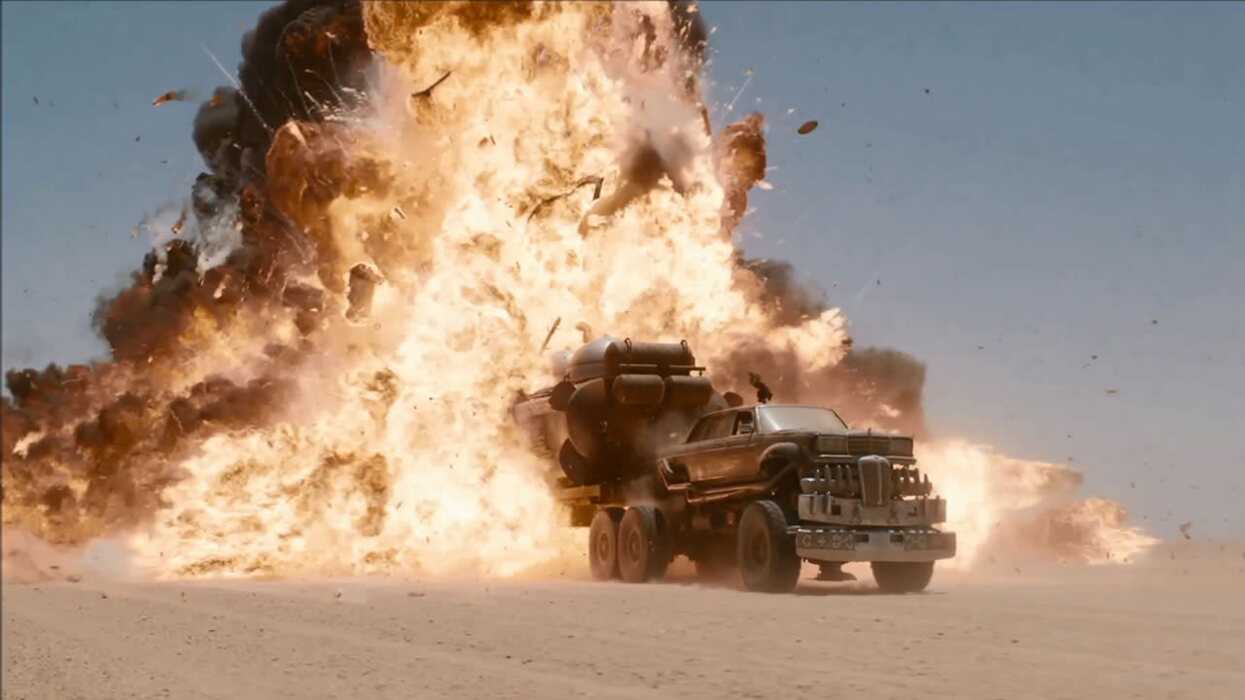
Tanker explosion during the chase
 Mad Max: Fury Road (2015)Warner Bros.
It’s awe-inspiring how George Miller and his effects team, led by Dan Oliver, shot the anxiety-inducing chase sequence in Namibia’s desert.
The tanker was driven by a remote control fitted with detonators. Plus, the whole sequence was shot with custom-made cars and a specially built war rig. Multiple cameras in cars were installed along with helicopters overhead. Later, VFX was used to composite cars in post and to enhance the already-shot practical explosions.
7. Terminator 2: Judgment Day
Cyberdyne building explosion
James Cameron, with Pyrotechnics supervisor Tom Fisher, looked at an office building in Fremont, California, and said to each other, “Let’s bring it down.”
They had only one chance to shoot the huge collapse and gasoline fireball. So, they used an army of cameras rigged at every angle and distance possible to cover it. A few cameras and rigs were damaged as they were mounted dangerously close to the blast, which grew bigger than expected. Moreover, the explosion sound kept the entire neighborhood awake for most of the night.
8. Independence Day (1996)
The White House goes down
Everybody knows this movie, and the time UFO beams destroyed the White House, the Empire State Building, and the entire city.
Roland Emmerich used practical explosions as the special effects team built miniature sets of buildings and a large web of streets, to blow them up with explosive charges. Vertical slow-motion cameras depict the colossal damage caused by high-power, color-filtered light beams.
The fact that this movie was released at the cusp of CGI, the practically done destruction has earned its iconic status.
9. The Bridge on the River Kwai (1957)
The collapse of the bridge in the Kwai River
You know it's madness when a filmmaker like David Lean rigs a 425-foot bridge with explosives that he constructed, and blows it with a REAL train crossing over it. And in 1957, no less.
The backdrop is Thailand, World War II, with British prisoners of war captured by the Japanese. Colonel Nicholson (Alec Guinness), a fellow prisoner, is ordered to build a bridge on the River Kwai for Japanese troops to carry out their important functions.
Following a moment of confusion in the high-stakes climax, Nicholson falls over the detonator, causing the bridge to collapse with a train carrying high-ranking Japanese military officials.
10. Star Wars: Episode IV – A New Hope
The death of the Death Star
Shortly after Luke Skywalker (Mark Hamill) fires missiles into the exhaust port, the Death Star blasts off, followed by shimmering sparks.
To give that effect, George Lucas used a combination of miniature models, pyrotechnics, and other practical effects at Industrial Light and Magic. Moreover, the explosion was shot in slo-mo to give an illusion of enormous destruction. The shockwave ring was added later by using Optical Compositing.
Wrapping Up
All these films set the example for those filmmakers who still believe in shooting their explosion scenes practically. It’s hard work, but worth it when the audience feels the rawness in those frames.
So, did you like the list?
Did we miss any of your favorite bangs?
Let us know in the comments.
- The Best Fight Scenes In Movies ›
- 5 Action Films with Almost No Dialogue—And Why They Work ›
- Top 11 Jason Statham Action Movies Ranked ›
- 15 Best Action Comedies Ever Made ›
- Bullet-Fu Lovers Unite: What Are The Best Hong Kong Action Movies? ›
- 8 Walk-Away Explosions That Live Rent-Free in Our Heads ›
- 6 Movies With the Most Insane Practical Stunts ›