Next week, unless there's some sort of crazy final-minute block, Paramount and Warner will finally merge, and another studio consolidation in Hollywood will be complete.
A federal judge signed off on a settlement resolving an antitrust lawsuit filed by a California-led coalition of 12 state attorneys general, and the Paramount Skydance deal to close its mind-boggling $110.8 billion acquisition of Warner Bros. Discovery will officially pass on October 6th.
This has been a long road, with injunctions, petitions, press conferences, and general unrest out in the world. For a second, I want to thank all the people who worked at both studios there who will undoubtedly lose their jobs. We're already seeing a lot of high-level exits. More will follow.
Thank you for the movies, the TV, for the marketing, for helping build a Hollywood where a lot of people were employed for a long time.
I hope you land on your feet, and I hope there are only a few of you.
Now, let's get into this deal and talk about how this megamerger will affect filmmakers everywhere.
1. Court Clearance: What Was the Hold-Up?
This merger was supposed to go through in the summer, but was put on ice due to pushback from state regulators who argued that a combined Paramount-WB would reduce competition, inflate consumer prices, and shrink opportunities for filmmakers.
But Judge Martínez-Olguín approved a five-year consent decree that resolves these antitrust concerns.
That moved the closing date to Tuesday.
Under the terms of the settlement, the newly created megastudio must follow specific safeguards regarding theatrical release schedules, production spending commitments, and newsroom oversight to remain in good standing.
In addition, the Writers Guild of America (WGA) settled its own dispute. They found common ground with Paramount, which agreed to contribute $17.5 million to the Writers Guild-Industry Health Fund and to cover up to $6 million in union legal fees.
For more details on the legal ruling, you can read the full report on Reuters.
2. Executive Exit: Mike De Luca & Pam Abdy Out
After Warner had one of the greatest years of all time, with One Battle After Another, Weapons, and seven weeks in a row as the number one movie at the box office, they followed it up with a merger and a regime change.
Film co-heads Michael De Luca and Pamela Abdy are departing the studio.
Noe, these are massively successful producers who will get gigs elsewhere. But this marks a real pivot for where WB can go, and will go under new leaders.
Some hypotheticals:
- Fewer Risky Original Auteurs: Mike and Pam were known to favor auteurs and big ideas. They loved new voices. Will the new studio? A shift away from high-budget artistic gambles that lack franchise potential seems likely.
- IP and Franchise Focus: The merger means money. So what are the safest bets? This feels like an immediate return to safe, reliable intellectual property, sequels, and world-building (think Top Gun strategy over auteur passion projects)
3. The New Name: Everything Is 'Skydance'
So after months of people speculating what we're going to call this huge place, the answer is rather simple. David Ellison announced that the entire parent company formed by merging Paramount, Skydance, and Warner Bros. Discovery will simply be called Skydance.
That's the name of Ellison's original company, and it will be how we and everyone else refer to the movies this giant place makes from now on.
But there's a catch...
Paramount Pictures and Warner Bros. Pictures will continue to exist as standalone labels under the Skydance corporate umbrella.
So we're still going to see those banners before movies and TV.
Ellison has promised to maintain a combined goal of delivering around 30 theatrical releases a year across both labels.
That's good news for writers and directors and producers and crew all looking for work.
As we said at the top, we still anticipated layoffs in the thousands in order to save money and to eliminate redundancies. Time will tell.
What Skydance Owns
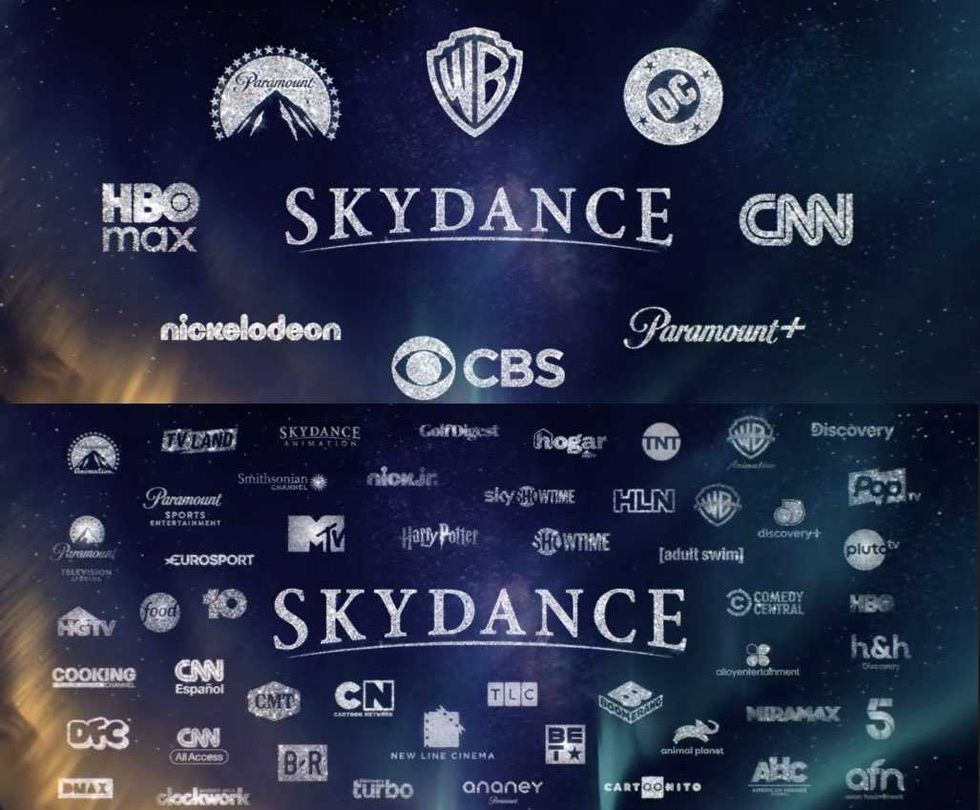
David Ellison shared a graphic for what the new Skydance studio actually owns. Let me give you a taste here.
Major Networks & Streaming Platforms
- Premium & Streaming: HBO, Max, Paramount+, Showtime
- Cable & Cable News: CNN, TNT, Comedy Central, MTV, Adult Swim, Cartoon Network, Nickelodeon, TCM
Key Studios & Film Franchises
- Major Studios: DC Studios
- DC Universe & Fantasy: DC Comics, Harry Potter, The Lord of the Rings, Game of Thrones
- Sci-Fi & Action: Star Trek, Dune 3 (distribution), Transformers, Mission Impossible, A Quiet Place, MonsterVerse (distribution)
- Horror, Comedy & Classics: Beetlejuice, Gremlins, The Conjuring, Citizen Kane, Mortal Kombat
- Animation, Kids & Gaming: SpongeBob SquarePants, Avatar: The Last Airbender, Teenage Mutant Ninja Turtles, Dora The Explorer, Looney Tunes, Tom & Jerry, Minecraft (distribution)
 Skydance Crdit: Skydance
David Ellison's Statement
New CEO of the megastudio, David Ellison, took to Twitter and other forms of Social Media to talk about his vision. This is his statement:
What once was the peak, is now just the beginning. Paramount and Warner Bros. shaped over a century of culture. By combining them, we aren't rewriting history — we're equipping these iconic studios with a more powerful engine. Together, we are Skydance: a creative-first home for bold, quality storytelling. We chose this name for a few important reasons. First and foremost, as we bring Paramount and Warner Bros. together, we wanted to preserve what has made each of these studios iconic. Both have distinct identities, extraordinary legacies and brands that have resonated with audiences for generations. We never wanted a new corporate identity to diminish, alter or overshadow either one. Instead, we wanted a name that would give the combined company an identity of its own while allowing Paramount and Warner Bros. — and all our extraordinary brands — to remain in the spotlight. We have big goals for Skydance, and we intend to pursue them with passion, imagination and a willingness to take smart risks. At the same time, we will honor what makes Paramount and Warner Bros. special — giving both studios the opportunity to grow, tell more great stories and bring those stories to even broader audiences around the world, powered by the scale and capabilities of Skydance. I couldn’t be more excited about what we’re going to build together.
What This Means for Filmmakers
Not to beat a dead horse, but this means Fewer Buyers in Town. With two major legacy studios now sitting under one corporate roof alongside Disney, Universal, and Sony, the pitching ecosystem is tighter than ever.
I also think it's going to be harder to break in, as this new giant studio will be focused on wooing existing talent and not taking too many risks.
The bright side is that 30+ movies a year is a lot of jobs available.
That will also help theater owners.
If we could get a federal tax credit, we could see this studio humming and employing a ton of people moving forward.
Summing It All Up
The merger might wind up being one of the biggest moments of the 2020s in Hollywood. We're in a consolidation era. This is bigger than Disney-Fox, and we saw how that's turned out. I am hopeful this can lead to great places as long as movies and TV shows keep being made and artists keep being employed.
Everyone, just hold on. I'm rooting for you.