Billy Wilder's Some Like It Hot came out in March 1959 and still shows up on just about every "best comedy ever" list.
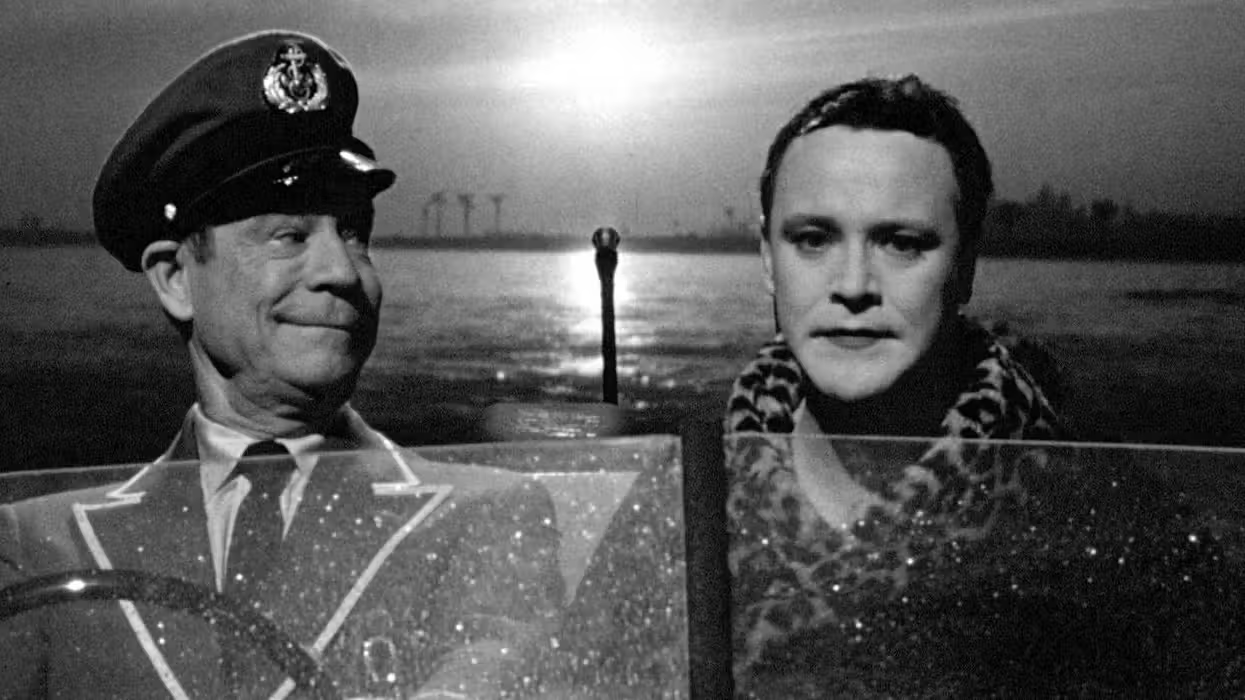
The film finds two musicians on the run from the mob after witnessing a Chicago gang shootout. They decide to pose as women to join an all-ladies jazz band. Marilyn Monroe plays singer Sugar Kane. Tony Curtis and Jack Lemmon play Joe and Jerry, the band's two newest musicians. Joe E. Brown plays Osgood Fielding III, an aging millionaire who falls hard for Jerry's alter ego, Daphne.
The closing line of the movie is one of the most famous curtain lines in American cinema. Billy Wilder even had it engraved on his gravestone. And in 1959, it was a joke almost nobody else would have gotten away with.
Watch the scene, then let's look at why it's so iconic.
- YouTube www.youtube.com
The Scene
The characters have been hiding in Florida, playing in the band at a hotel. But then the Chicago mobsters, led by "Spats" Colombo (George Raft), arrive for the "Friends of Italian Opera" meeting. During the climactic banquet scene, a rival mob boss ("Little Bonaparte") has Spats and his goons assassinated by a hitman popping out of a giant birthday cake. Joe and Jerry witness this murder too, forcing them to make a frantic final escape.
They dress as their female personas and make plans to steal away, but not before Joe (dressed as a woman) kisses Sugar Kane in front of everybody. Sugar, realizing who Joe really is, follows the men as they rush to the doc and Osgood's boat.
Joe reveals the truth to Sugar. Meanwhile, Jerry tries to do the same with Osgood.
"Well, in the first place, I'm not a natural blonde."
Osgood says, "Doesn't matter."
"I smoke. I smoke all the time."
"I don't care."
"Well, I have a terrible past. For three years now, I've been living with a saxophone player."
"I forgive you."
Jerry tries emotion. "I can never have children."
Osgood is unfazed. "We can adopt some."
Jerry finally decides to be fully honest, removing his wig. "But you don't understand! I'm a man."
Osgood smiles. "Well, nobody's perfect."
Credits follow.
What's wild is that Wilder and co-writer I.A.L. Diamond didn't believe in the line when they wrote it. In a 1996 Paris Review interview, Wilder said it was almost an accident.
"Diamond and I were in our room working together, waiting for the next line—Joe B. Brown’s response, the final line, the curtain line of the film—to come to us. Then I heard Diamond say, 'Nobody’s perfect.' I thought about it, and I said, Well, let’s put in 'nobody’s perfect' for now. But only for the time being. We have a whole week to think about it. We thought about it all week. Neither of us could come up with anything better, so we shot that line, still not entirely satisfied. When we screened the movie, that line got one of the biggest laughs I’ve ever heard in the theater."
Why the Line Is So Funny
Comedy runs on surprise, and the surprise here is in Osgood's reaction—or lack of reaction, really.
The scene has primed the audience to expect a specific reaction. Jerry rips off the wig. He drops his voice. He tells the truth. Traditionally, especially for the time period, this would be the moment where Osgood is shocked and horrified. The audience would have been ready to laugh at Osgood's horror.
Osgood just shrugs. He's still smiling. And the laugh goes off like a trap in the opposite direction, aimed at the audience's own expectation of what the laugh was going to be.
That's the thing Wilder learned from Ernst Lubitsch, who Wilder credited with the "Superjoke" or the trick of stacking a second joke on top of the first one.
The reveal is already a punchline. "I'm a man!" is itself the big line for a laugh. Then Wilder and Diamond put a bigger laugh on top of it by having Osgood refuse to react the way the whole script has promised he will.
 Credit: MGM
In 1959, This Was a Joke Almost Nobody Else Would Make
It probably is obvious that this was fairly edgy for the time period. And, yeah, the Hays Code was still in effect in 1959.
The Production Code Administration had rules about what Hollywood movies could show and say, and a mainstream studio comedy playing with gender presentation and a man happily agreeing to marry another man after being told he was a man was, let's say, not on the list of approved content.
The PCA rejected Some Like It Hot and refused to issue it the Code seal. Wilder released it anyway, and it was a smash hit, one of the key films that signaled the Code was finished. NFS' roundup of Classic Hollywood quotes that broke the Hays Code places "Nobody's perfect" at #6 for exactly this reason. The line is open-minded in a year when open-mindedness was pretty much against the rules.
The joke feels modern and doesn't punch down at anyone. It isn't a joke at Osgood's expense. Joe E. Brown doesn't play him as a fool who missed what Jerry said. He plays him as a man who heard it clearly and just really does not care. He loves Daphne. If Daphne is Jerry, then he loves Jerry. It's subversive and warm and funny all at the same time.
It's not, "Oh, haha, Osgood is going to marry a man." The joke is more like, "The only person in this scene with their head on straight is the one everybody else assumed was the fool."
What to Use in Your Script
Endings are difficult. It's hard to tie everything up in a tidy bow. This line isn't really closure on anything because these characters have literal bodies in their wake. We actually don't know what happens next with the mob (it's suggested the police will take care of things) or whether Joe and Jerry are actually safe.
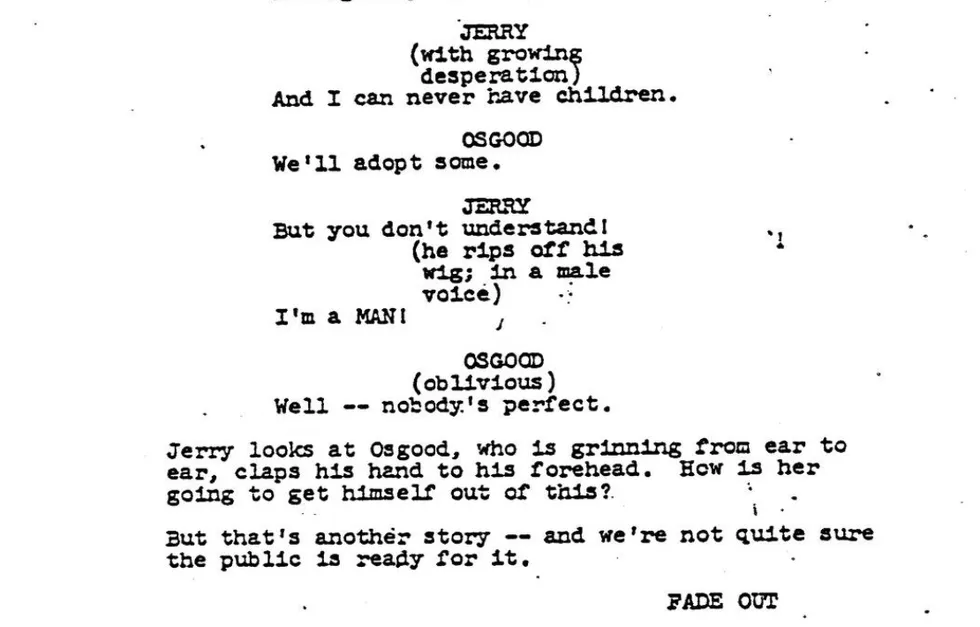
The script itself says that Jerry doesn't know what he's going to do to get out of his situation with Osgood. "But that's another story—and we're not quite sure the public is ready for it."
Sometimes a last line just needs to be the button on a scene, not the whole film.
If you're working in comedy, play with reversals. You might write a joke and find a line that works, but what if you could find something better? Paul W. Downs, Hacks showrunner, talks about how when he wrote with his partner, if they had a joke that matched, it might be too "first-thought." As in, maybe it's the easy reach, too expected. Try something else.