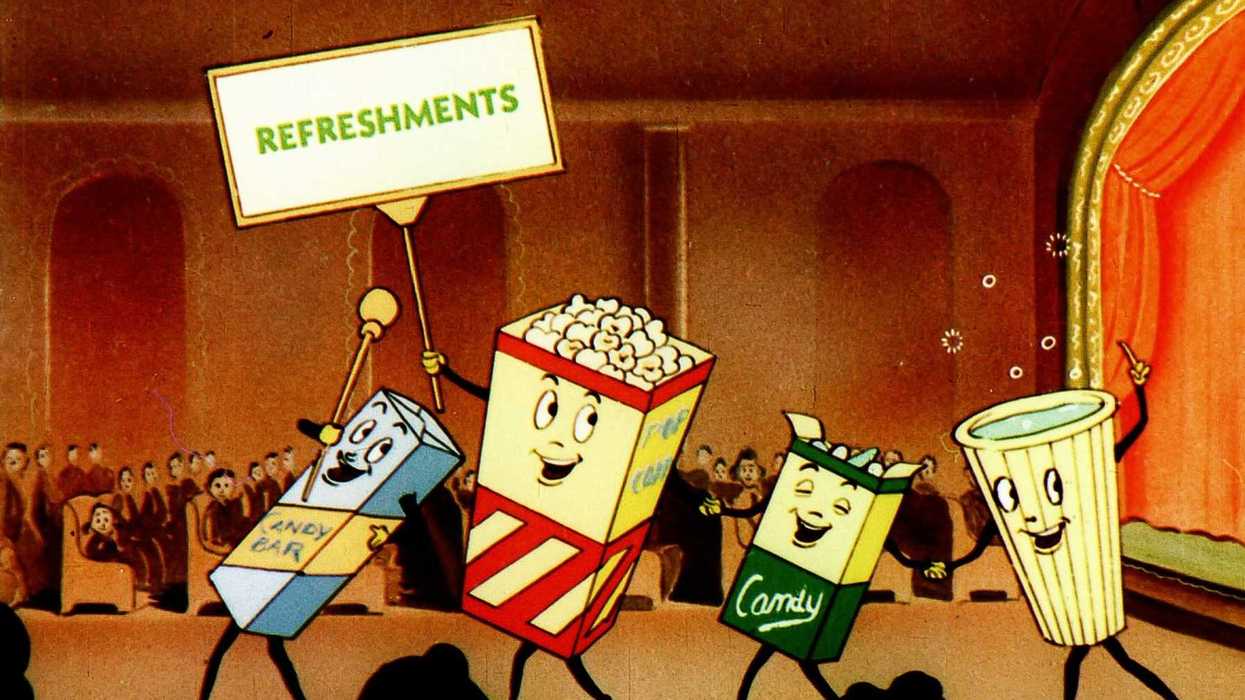
I don't know about you, but I'm the kind of person who always veers straight to concessions after arriving at my local AMC. I'd readily tell you that movie theater popcorn is one of my favorite foods. I have an almost Pavlovian response to hearing the Universal or Columbia Pictures fanfares—I can taste that movie theater butter just thinking about it.
But why and how did popcorn become synonymous with the movie-going experience? Today, National Popcorn Day, seems like the right time to explore why.
It turns out, the pairing wasn't as ubiquitous as we always thought.
- YouTube www.youtube.com
Theaters Wanted Nothing to Do with Popcorn
Originally, popcorn was popular on its own. Of course, it was delicious, but it was also easy to make and mobile, because by the late 1800s, C. Cretors & Company had built a mobile popcorn-popping cart based on a previous design of a peanut roaster.
Theaters of the period didn't want people smacking on a crunchy food in their fancy picture houses. They wanted to be distinguished environments, almost like the opera. Plus, during the silent film era, the sounds would have been distracting.
"Movie theaters wanted nothing to do with popcorn," Andrew Smith, author of Popped Culture: A Social History of Popcorn, told Smithsonian Magazine. "Because they were trying to duplicate what was done in real theaters. They had beautiful carpets and rugs and didn't want popcorn being ground into it."
 Credit: Corina Rainer/Unsplash
The Rise of Movie Popcorn
Many point to the Great Depression as the turning point for popcorn at the movies. A bag of popcorn ran you 5 to 10 cents, money people were willing to spend. So the snack was cheap, and more and more people were going to the movies as an escape, so theater owners finally embraced it. As a bonus, the kernels were shelf-stable for years.
Initially, owners found themselves competing with those street vendors. Some theaters even asked that patrons check their popcorn at the door with their coats, according to Popped Republic. (If you know anything about movie theater rules, people found ways to break them.)
Street vendors were initially allowed into lobbies to sell to patrons. Theaters started leasing lobby space to popcorn vendors for a daily fee. One early entrepreneur, Julia Braden of Kansas City, got rich setting up stands in theater lobbies, reportedly pulling in over $14,000 a year by 1931 (via The New York Times).
Soon enough, theaters started running their own concession stands. According to Smith, theaters that embraced popcorn sales typically survived the Depression, while those that resisted often went under.
World War II ensured the continued rise of popcorn. Rationing meant candy was scarce, but popcorn stayed cheap and plentiful. By 1945, over half the popcorn consumed in America was eaten at movie theaters.
Movie Popcorn Today
If you're not swinging by a theater today, check out how to make movie theater popcorn at home.